
May 9, 2024
Webinar: Effective Skills for Supporting your Child after a Stressful Event
Written by Rachel Eddins
Posted in Parenting & Family, Webinars and with tags: parenthood, parenting, teens, webinar
Do you fear that your happy, carefree child might never reappear? After that difficult experience, are they withdrawn, anxious, or maybe even acting out? You’re not alone. Many children struggle to cope with traumatic events.
This free webinar, Effective Skills for Supporting Your Child After a Stressful Event, hosted by trauma-focused therapist Courtney Chiles-Cloud, will equip you to parent a traumatized child. Here’s what you’ll learn:
- How to help your child identify and understand their big emotions: Children often have trouble expressing their feelings, especially after something tough. This webinar will provide strategies to help your child recognize their emotions and communicate them in a healthy way.
- Techniques to manage and cope with stress effectively: Stress can manifest in various ways, from physical symptoms to behavioral changes. Learn tools to help your child manage stress in a healthy way, reducing negative impacts.
- Effective parenting skills to build resilience: This webinar goes beyond just coping. Discover strategies to help your child develop resilience so they can bounce back from challenges and thrive.
Our webinar host, therapist Courtney Chiles-Cloud, has extensive experience helping children overcome a variety of challenges, and in this webinar, she’ll share her knowledge and practical tools in a warm and engaging way.
Watch a replay of the presentation here.
This webinar is facilitated by Courtney Cloud, a licensed professional counselor with Eddins Counseling Group, and on the topic of “Effective Skills for Supporting your Child after a Stressful Event”.
This webinar is going to include information on how you can help you to better identify and understand your children’s emotions. It will also touch on helpful ways of coping and then effective communication skills.
Stress
Stress is a normal reaction to everyday pressures, but can become unhealthy when it upsets your day-to-day functioning. It involves changes affecting nearly every system of the body, influencing how people feel and behave. – American Psychological Association.
Moderate exposure to stress is common and can also be helpful as it encourages resilience. Chronic exposure to stress, however, can be extremely harmful to the body. It can disrupt day-to-day living and actually disrupt the way that our bodies naturally function. You might start to notice some physical aches or changes in mood and even in behavior.
What Are Some Different Stressful Experiences?
We, as well as our children, have some type of stressors in our lives. Whether you are a parent, guardian, teacher, administrator at a school, or coach, (whatever capacity it is that you work with kids), there are some challenges and stressors that your kids are facing.
Sources of Stress in Kids
- Academic Pressure
- Social Relationships
- Family Issues
- Parental Expectations
- Transition and Change
- Health Concern
- Media and Technology
- Traumatic Events
For example, we have pressures of academics, we have the weights of social relationships, issues within the family, and then expectations from parents or even from society. There are, of course, life changes and transitions, health concerns, the media, and then traumatic events.
Here is a list of things that fall into these categories:
Stressful experiences for kids and teens:
- Pee pressure/Fitting in
- Moving/Changing schools
- Re-marriage
- New siblings
- Excessive arguing
- Shcool work/Test
- Unhealthy relationships
- Instability at home
Traumas:
(A traumatic event is a frightening, dangerous, or violent event that poses a threat to a child’s life or bodily integrity)
- Divorce/Separation
- Natural disasters
- Abuse/Neglect
- Domestic violence
- Bullying
- Death/Illness
- Serious accidents
The Stress Response
How Can These Stressors Impact Your Child Physically and Mentally?
Many people are pretty familiar with fight, flight, and freeze. There are ways in which we can respond to something that creates stress. The stress response can present in different behaviors and emotions for kids. The fight response can show up as defiance or as yelling or demanding control. For the flight response, it can appear as being unfocused, hard to pay attention to, or maybe there’s some procrastination going on. Then last for the freeze response, it could look like maybe they’re really zoning out often, or maybe they are just verbally not really responding much or even feeling numb.

Common Reaction to Stress:
- Irritability
- Anger
- Hopelessness
- Sad/Tearful
- Withdrawn
- Anxiety
- Aggression
- Hyperactive
- Depression
- Changes in Appetite
- Difficulty Concentrating
- Acting Out
- Defiance
- Academic Difficulty
- Difficulty Sleeping
- Restlessness
- Aches/Pains in the Body
- Gut Issues
- Fatigue
- Weight Changes
On the other side, you’re going to see common reactions to stress. That could look like aches and pains in the body. Is your child complaining of stomach aches or headaches or some form of discomfort? Are you noticing that they’re more fatigued, so they’re more tired, maybe they have less energy or are sluggish? Then academic difficulties are a big one. Are you noticing a drop in grades? Maybe there is low motivation or they’re uninterested in things that maybe they once had more interest in.
By knowing your child’s warning signs in these responses, you can show up for your child in the way that they need.
Establish Structure
Attain to your child’s needs
After a stressful event, children need:
- Feel safe
- Stick to a routine
- Feel heard or understood
Maslow’s Hierarchy Of Needs

https://www.simplypsychology.org/maslow.html
Maslow’s hierarchy of needs is a five-tier model of human needs. Starting at the bottom, a person has physiological needs that have to be met first. That’s going to be our basics. That’s our food, that’s shelter, that’s clothing. Then we have safety and security, so feeling safe within their home and their environment. Then we move up to love and belonging. This is where they have a sense of connection with other people within those relationships. Their self-esteem, and then the top is going to be self-actualization. This is where they are experiencing purpose and meaning in their life.
Let’s go back to safety. Kids need to feel safe, not only physically, but also emotionally and psychologically. You can provide that by creating a secure and structured home life for them. You pretty much want to make sure that they still have that set routine, that there is still order in their daily lives with trying to juggle between school and different activities, time with family, and then social engagements.
Emotions and Self Awareness
Help your child identify and label their experience

Many times, kids find it difficult to verbalize what it is that they’re feeling. You may get hit with the “I don’t know”, or there may be the shoulder shrugs because sometimes kids, they’re just unsure confused, or even overwhelmed by what is happening inside of their body. This makes it challenging for them to put those feelings into words. They do need that support to be able to figure it out.
Tune into Cues
Here is how you help. First, tune into your child’s cues. Their body language, their gestures, and their behaviors are signals that they’re experiencing something. When you are aware of these signals, you can better prepare for how to approach and support your child. Is my child behaving impulsively? Is their voice becoming a bit more elevated? Am I noticing maybe that their body is a little bit more shaky or maybe they’re fidgeting more? Maybe they’re not able to follow directions.
By picking up on these cues, you can also then help them become more aware of their cues. Then you both can work together and put a plan in place as to what to do in these moments when you start to notice these things happening.
Body Scan
Another way that you can help your child become more aware is by encouraging them to do what’s called a body scan so that they can become more in tune with themselves. A body scan pretty much describes what you’re experiencing in your body, starting from your feet and moving upward. That can look like my feet feel really sweaty, or maybe my stomach feels like it’s in a knot, or I’m really feeling some tightness, or some heat in my chest, or maybe it feels like someone is squeezing my head to where I’m just feeling all of this pressure.
Having them describe what they’re experiencing is also going to keep them grounded in the present moment. If your child tends to get stuck in their head with a lot of thoughts going on, getting them to tune back into their body can be very grounding for them.
Name It
The more awareness that your child has, the better that they will be able to connect a feeling word to what they’re experiencing. Encouraging them to be able to use an “I feel statement”, so being able to name it, so That can look like if they were to say: “There’s a knot that I’m feeling in my stomach. Okay, maybe that’s because I feel nervous, or that tightness or that heat that I’m feeling here in my chest. Oh, it’s because I’m feeling angry.”
I encourage you to actually have either a feelings chart or a feelings wheel or a feelings list to help your child expand their feelings vocabulary. Most kids, of course, know the basics: I feel angry or I’m mad or I’m sad or I’m nervous. But having these lists of seeing these different feeling words allows them to go a level deeper. So, they may be able to say I’m mad or I’m angry, but maybe they’ll also be able to identify that maybe it’s because I’m feeling assaulted or maybe it’s because I feel offended in some way.
You can find those feelings wheels or feelings lists online for different ages. Some may just have the emoji pictures for younger kids, and some may have a full list of actual words listed.
Ways to Identifying Feelings
Only when we tune in to our children at their feeling level, not our own, are we able to meet their spirit as it manifests moment by moment. – Dr. Shefali Tsabary
The more that you talk about and normalize feelings, the better your child will be able to notice and label them. For younger kids, asking them to describe what they’re feeling is like a climate weather, or natural disaster. If they were to say to you, “It really feels like a thunderstorm is going on in my body”. Maybe that’s because they’re feeling frustrated. Or if they were to say, It’s feeling gloomy or cloudy out. Okay, maybe it is that you’re feeling a bit sad about something. For kids that like music, that are really into music, you can actually ask them to maybe name a song that describes what it is that they’re feeling.
Feelings Thermometer
Another one that is helpful for younger kids is having them create a feelings thermometer. You can literally Google a thermometer, you can print it out, and you can have them color in different sections with an associated feeling.
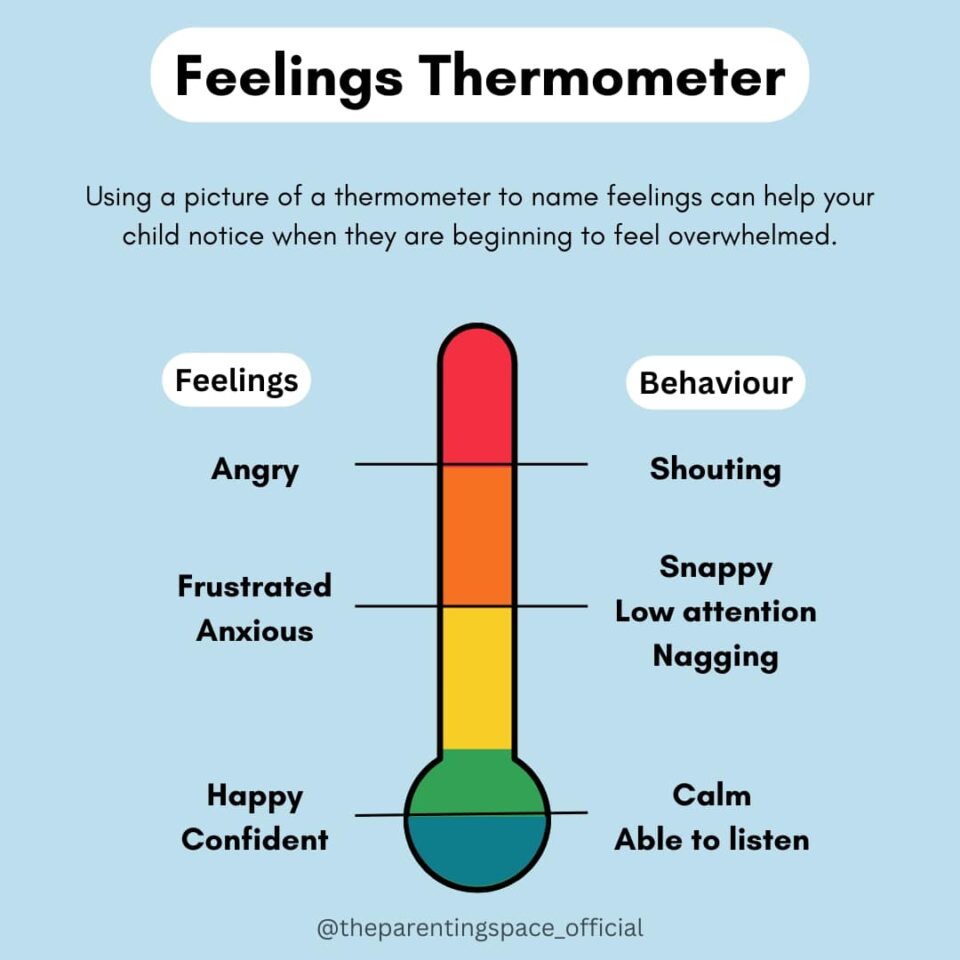
https://www.cpcs.org.uk/parenting-space/feelings-thermometer/
Another thing you can do on those feelings thermometer is for each feeling to have a need section. When they’re feeling angry, a need could be some physical activity to help them redirect that energy. Maybe that looks like going outside and jogging, or maybe that looks like doing some acrobatics, or maybe that’s stretching. It could be anything to get their body moving.
Mood Journal App
There are so many apps out there. One of the apps you can download on your phone is called the Mood Journal app. This actually allows the child to select different emojis based on what it is that they’re feeling. Then they have an area in which they can type out a journal, they can attach a picture to that feeling, or even do a voice recording if they prefer that over typing.
These different resources help children get creative and flexible. They help them to notice better, be aware, and label what it is that they are feeling.
Coping with Stress
Redirect/Refocus/Reset
Kids naturally gravitate to certain forms of self-soothing. There are kids that will suck on their thumb or their fingers or put objects in their mouth. Or maybe you have kids that pull on their ears or rub their ears. Maybe you’ve seen some that will rock or sway. Maybe your kid likes to wrap themselves up really tight in a blanket or there are certain sounds and music that they like to listen to.
Whatever currently works for your kid, you just want to build on that.
You can offer some additional types of techniques. It’s really trial and error and see what works for your kid and what doesn’t. Let’s look at what are some things that will help you to calm your body and redirect all of this overwhelming or intense energy.
Calm the Body
- Breathing techniques (4-4-6)
- Progressive muscle relaxation
- Sensations (ice, sour, massage, slime/play-doh, rubberband)
- Get up and move
- Rhythmic movement (rocking/swaying)
- Hugs
Breathing Techniques
First, of course, we always recommend breathing techniques. Breathing techniques are going to go beyond just doing an inhale, and exhale. We can try the 4-4-6, which is going to be you’re inhaling for four, you’re then going to hold that breath for four, and then you’re going to exhale through your mouth for six. You can try that about 2-3 times until you can see that they’re getting back to a baseline.
Progressive Muscle Relaxation
Progressive muscle relaxation is where you tense up your muscles, hold them for a few seconds, and then you release them. Typically, you’re going to start at your feet. Flex your toes to where they’re being pulled and you’re going to hold it just for a few seconds and then release. Then you’re just going to move up your body. You’re going to move to your calf. Tense up your calf for a few seconds, relax it, move up to your thighs, move up to your stomach, chest, arms, shoulders, face, all of that until they start to feel a little bit that they’re coming down.
Sensation
Sensation is going to look like doing things that are going to stimulate the different parts of our body. If you notice that they’re angry and they’re getting hot, maybe putting something cold like ice in their hand, maybe popping something sour that’s in their mouth, massages and pressure points, whether that’s on their shoulders if that’s where they’re feeling a lot of tension or their feet or even in their hands. Having something that they can physically have in their hands. So slime or Play-Doh can be really helpful. It gives that different sensation to them. For older kids, having a rubber band on their wrist and gently popping it. Even that can sometimes give that little bit of shock to help just with redirecting.
Get Up and Move
Getting up and moving is another way to calm the body. Any type of movement can be helpful for them.
Rhythmic Movement
Rhythmic movement, so getting back into that rocking and swaying. If they’re able to maybe go swing for a little bit, or if you have hammocks at your home that they can swing in as a way of soothing, that can also be helpful.
Hugs
Hugs have some positive effects. According to an article that was published in Psychology Today, hugging can actually reduce inflammation. It can actually reduce blood pressure, like bringing that down. It helps to promote the production of oxytocin, which as our love hormone. We recommend asking your child if they want a hug instead of just giving them one because sometimes kids don’t want the physical touch at that time. But this is just at least something that you can offer them if they want that.
Calm the Mind
- 5 Sense mindfulness (5-see, 4-touch, 3-hear, 2-smell, 1-taste)
- Room scan (shapes, colors, patterns)
- Guided meditation
- Recite lyrics/poems
- Visualization/Imagery
5 Sense Mindfulness
If your child tends to get stuck in their head, they are looping on negative thoughts, these are going to be some helpful strategies as far as calming the mind. Mindfulness is going to be a daily practice. One thing you can have them do is use all of their senses. This includes five things you see, four things that you can touch, three things you can hear, two things you can smell, and one thing that you can taste, and have them describe it in as much detail as they can.
Room Scan
Doing a room scan would look like this: “I want you to tell me everything you see that is the shape of a square.”, or “Tell me everything that you can see in this room that is the color yellow”. Or “Tell me what you see that is patterned”. Anything to get them to distract from what is going on currently up here.
Guided Meditations
If this is something that your child would be interested in trying, here are two websites that you can try. Mindful.Org is great for all ages. It has a lot of resources on there for kids and adults. Mindfulnessforteens.Com is specifically for teenagers. Then one app that you can use is called Insight Timer. This one is going to be for ages 12 and up, so just note that. But It does offer a lot of guided meditations at different times. There’s some that are only a minute, some that are five minutes, and then longer if that would be helpful.
Recite Lyrics or Poems
Have your child recite lyrics or poems. They can either do this verbally or non-verbally, but we just want to get them to do something that is going to redirect the overload that they’re having with thoughts going on.
Visualization and Imagery
Visualization and imagery are where you can ask them to visualize themselves in a place that is slow-paced and calm and give them room to really put that imagery in their head. Or to visualize themselves in a place that is fun and enjoyable and give them some time to reflect on that.
Any of these different skills, again, is going to be trial and error. Some will work for your kids and some won’t, and that’s okay. But just being able to provide them with some additional resources.
Let’s go back to Mazel’s hierarchy of needs. Remember that physiological needs have to be met first. That was the one that was at the bottom. Keep in mind that it is extremely difficult to regulate emotions and cope when you are exhausted, when you are hungry, when you are inactive, meaning not really any movement going on, and when you’re lonely.
If you start to notice your child is getting dysregulated or really agitated, check in and see what it is that they need and make sure they have their basic needs met. And if not, what is it that you need to offer them?
Coping Box
Create a Coping Box or Hope Kit
- Fidgets
- Coloring/Drawing books/Painting
- Yoyo
- Play-doh
- Legos/Blocks
- Essential oils
- Photos/Inspiration quotes/Cards
- Affirmations
- Poems
Stress Reset by Jennifer Taitz
In addition to coping skills, have them make a coping box that they can have at home and then a coping bag that they can have on the go, whether they have it in the car or whether it’s something that they’re able to keep in their backpack with them, can be really helpful.
These are going to include items that help them to calm down and reset. Fidgets, of course, are very popular. There are so many types of fidgets for various ages and interests. If your child is into coloring, drawing, or painting, have something like that in there. Yoyo actually is really a helpful tool for kids to use.
Again, Play-Doh, having something that they can have in their hands or even those really squishy balls can be helpful. Legos or some blocks if your child is into those things. And essential oils if your child is into scents or even any lotion.
We recommend for coping boxes or bags to try and have at least one item for each sense. So even having peppermints or gum or something like a sour candy or something in there to heighten their taste, something for sound, smell, touch, and then, of course, what they’re able to see.
A Hope Kit, which author Jennifer Taitz talks about in her book Stress Reset is going to be filled with things that bring you hope and joy. That could be photos or pictures, inspirational quotes, or even inspirational card decks, positive affirmations, poems that are really encouraging to them, or even notes, letters, or cards that they have received from someone.
The human body is such an incredible creation because our bodies naturally are made to recover from stress and traumatic events.
Giving your child the time to just naturally recover, utilizing these different coping skills, and making sure their needs are met is essential. However, if a parent starts to notice, “I don’t really see that my child is getting better,” and it has been a month or longer, they might observe some concerning behaviors or developments. At that point, it is definitely recommended to seek professional support from a doctor or a licensed therapist to provide the child with any additional help they may need.
Regulate, Relate, and Reason
The 3 R’s by Dr. Bruce Perry
Regulate – we must help the child to regulate and calm their fight, flight, or freeze. Offer soothing comfort and reassurance.
Release – We must relate and connect with the child through an attuned and sensitive relationship by empathizing and validating your child’s feelings so they are seen, heard, and understood.
Reason – We can support the child to reflect, learn, remember, articulate, and become self-assured.
https://wvpbis.org/wp-content/uploads/Effective-Responses-to-Trauma.pdf
Regulate, release, and reason. This is called the 3Rs, and it was created by Dr. Bruce Perry. These skills are incredibly useful and truly build a connection with that parent-child relationship.
Regulate
We first start off with regulation. This is where we’re using those coping skills to help the child regulate and calm themselves from that fight, flight, or freeze response. Being able to regulate alongside your child is going to enhance the relationship between parent and child and create safety.
You can regulate your kid at any age. You just meet them where they are. Do this with them. If they’re on the floor, get on the floor with them. If they’re sitting on their bed, sit next to them, and meet them where they are. This is the time to do some deep breathing together. Maybe you can do some mindfulness exercises together. Maybe you can make it a challenge of who can do the most jumping jacks or who can do the most pushups, whatever that looks like for you and your child.
Relate
Then we go into relate. This is where we connect. We identify how they’re feeling. We acknowledge that this is pretty unpleasant or this is uncomfortable for you. Then we reassure them that we’re ready to help and support them. It’s also important that you accept that your child is still processing, even if it does appear that they’re more calm.
Note that this is not the time to try and teach them anything. If you want, you can share with them maybe an experience that you had in which you had a similar feeling that they’re experiencing in that moment. But you wait until they have reset and have moved back into their normal state, and then that’s when you want to proceed with reason. Again, we don’t do the reasoning part if they’re not regulated.
Reason
Reasoning is where you support them in being able to reflect and learn. You can use this as an opportunity to help them identify things they have within their control, things that they can control with the support of someone else or things that are outside of their control. Then you can also use this as an opportunity to problem-solve for future events.
Active Listening
Skills to improve communication
- Square your body with their body / Listen without interrupting
- Pay attention to non-verbal cues (body language and gestures)
- Repeat back what you heard / Paraphrase or summarize
- Ask for clarification if needed / Ask open-ended questions
- Ask what they need, do not assume they want your advice or to fix a problem
Square your body with their body / Listen without interrupting
Active listening skills are going to be very useful for effective communication. The first thing you want to do is square your body with your child. If they are looking at you this way, your body is facing them this way. You’re not looking off, you’re not on your phone, you’re looking at the TV, you are both squared together. Listen to them without interrupting. This is the opportunity to give them that platform to really feel heard.
Pay attention to non-verbal cues (body language and gestures)
Pay attention to those nonverbal cues. What is your child’s body language communicating to you? Are their arms crossed? Are they fidgeting maybe with their fingers? Maybe they pulling on their hair? Do you notice that maybe some part of their body is shaking a bit or fidgety, or maybe they’re not even looking at you? Pick up on these things with them.
Repeat back what you heard / Paraphrase or summarize
Then you want to be able to repeat back what you heard them say. This is going to reassure them that you are paying attention and really hearing them. If your child were to say: “Yeah, when I got to school, I went up to Susie, and she rolled her eyes at me and she just completely walked away”. You repeating back would look like: “Oh, so when you’re at school, you went up to Susie and she rolled her eyes and walked away from you.”
Again, that is going to confirm that you’re listening. You can also paraphrase or summarize what it is that they’re saying, and that also is going to let them know that you’re really trying to hear them.
Ask for clarification if needed / Ask open-ended questions
Ask for clarification if you do not understand something. Clarification can really help with preventing misunderstandings. If they say something that’s just maybe you misheard or don’t think you got it, just ask them to, Can you share that with me or can you say that one more time?
Ask open-ended questions. The more open-ended questions a parent asks, the more their child is going to talk. For example, instead of asking their child after school, “Hey, how was school?” which might elicit responses like, “It was okay,” “It was fine,” or “It was good,” they could ask open-ended questions such as, “Hey, what was the most interesting part of your day?” or “What went well today?” or “What didn’t go well today?” This approach encourages conversation by prompting more detailed responses.
Ask what they need, do not assume they want your advice or to fix a problem
The last part is to ask what they need. Don’t assume that they want you to fix the problem or give them advice. This is going to be that opportunity for you to ask yourself about what role you are stepping in for your kid in this moment. As parents, sometimes we naturally have this tendency to want to be fixers. Sometimes we just want to “Olivia Pope” the situation and handle it, but that’s not always what they need. They may only need you to hear them, not give them advice or offer solutions just to listen and validate them.
The key to active listening is going to be practicing these skills. You can practice them with your partner or your spouse, coworkers, family members, or friends, because the more you practice it, the more it’s going to become consistent in your interactions with your child. Also, what it’s going to do is it’s going to teach your child how to use these skills as well.
Communication and Connection
“You catch more flies with honey, and not vinegar.”
Being able to build connections through effective communication. There are certain approaches that can be a little bit harmful, whereas others can create that closeness and that safety, which is what it is that we want to have.
Judgment
Starting with judgment. Sometimes judgment can look like “That made you angry”. Looking at our tone, looking at our facial expressions, we really just want to take a step back and consider, what this feels like for your kid or how they’re taking this. We really want to encourage empathy, so really stepping into your child’s world. Your face is a little bit more softened, your tone is a bit warm, and so it’s a bit more inviting to them.
Minimizing and Disregarding
That could look like it’s not that big of a deal. Just let it go or you don’t need to feel upset about that. What that can oftentimes say to your child is what they feel doesn’t matter or that it’s not important. A few needs with children is they want to feel seen. They want to feel that they matter, and they want to feel that they’re worthy. Validate their feelings, and let them know it’s ok to feel upset and betrayed, even if you at that time don’t understand. Let them know that what they feel is valid.
Criticism and Blame
This could look like: “Well, maybe if you studied harder, you wouldn’t have failed.” We want to approach them with a bit more compassion. That could look like: “I know that you’ve been feeling stressed out and tired. How about we think of some ideas that can help you with your schoolwork?” This also helps you meet them where they are and see, again, what it is that they need.
“You” Statements versus “I” Statements
The last one is going to be the “You” statements versus “I” statements. The “You” statements are pretty common. It could look like: “You are so ungrateful, you are disrespectful.” The “I” statement is going to allow you to establish what it is that you are feeling. Instead of: “You are ungrateful.”, it could be: “I feel unappreciated when…” Or instead of: “You are disrespectful.”, “I feel disrespected because… “
As soon as we throw that “You” statement, those walls are going to go up in defense because they’re going to feel attacked. Because, of course, again, we want to bridge connection here, using those I feel statements are also going to encourage them to use those as well. Using these strategies definitely can impact your relationship with your child in a more positive way. It’s going to build that bridge of emotional safety and create that secure attachment.
About the Facilitator
Courtney Chiles-Cloud primarily works with adolescents and adults. She is a certified trauma-focused cognitive behavioral therapist, which is going to be a therapy for kids and adolescents who have experienced trauma. It is a collaborative treatment, meaning that the child and their caregiver are involved in the therapy process.
She also has training in what’s called cognitive processing therapy, which is a treatment for adolescents and teens who have PTSD. But of course, she also works with other presenting struggles, whether it’s anxiety depression, or relationship struggles.
If you would like any more information on our services at Eddins, please feel free to contact our Client Care team. They can also set you up with a free 15-minute consultation with a therapist that meets your needs and the services that you’re looking for.
Feel free to visit additional resources:
1. Articles on specific topics on our blog.
2. RSVP for one of our free monthly webinars (or view past webinars)
3. Follow us on Facebook and Instagram for additional interviews and tips
4. Take another one of our self-test quizzes
5. Schedule a consult and find out how we can support you.