
July 10, 2025
Webinar: Effective Skills for Helping Your Teen Cope with Stress
Written by Guest Author
Posted in Parenting & Family, Teen Counseling, Webinars and with tags: anxiety in teens, stressed, therapy for teens

You never imagined you’d be here—watching your child struggle in ways you don’t know how to fix. Maybe they’re quieter now. Maybe they seem angry or distant, hiding away in their room when they used to laugh freely. You’ve tried to talk, but nothing seems to get through. And inside, you’re unraveling too.
If you’re a parent or guardian feeling helpless after your child has experienced trauma, you are not alone—and you don’t have to keep guessing at how to help them heal.
Join Courtney, a Certified Trauma-Focused Cognitive Behavioral Therapist, for a deeply supportive and practical webinar designed just for parents like you:
“Effective Skills for Supporting Your Child After a Trauma.”
In this free event, you’ll learn tools to:
- Help your child identify, understand, and cope with overwhelming emotions.
- Understand how trauma affects behavior—and what to do about it.
- Gain effective parenting strategies that nurture healing, connection, and trust.
- Guide your child away from harmful thought patterns and toward resilience.
We know the toll this takes on the whole family. When your child hurts, everything hurts—your relationship with your partner, your other kids, even your own sense of self. It’s hard to sleep, to focus at work, to show up for anything at all. But the good news is: things can change.
Imagine your child smiling again. Engaging in school. Feeling safe enough to open up. Imagine a home filled with more peace, where you know how to support them, not just with love, but with the right skills.
You don’t have to keep feeling powerless.
Let’s take this step together.
Watch a replay of the presentation here.
This webinar is facilitated by Courtney Cloud, a licensed professional counselor with Eddins Counseling & Therapy Group. Tonight, we will be presenting on the topic, Effective Skills for Helping Your Teen Cope with Stress.
Here at Eddins, our therapists offer free monthly presentations on various topics related to mental health. If you visit our website, you can access all of our past webinars.
Just a quick note for everyone joining us today — if you have any questions or comments, please feel free to put them in the chat box. We’ll be sure to take time at the end of the presentation to answer them.
Objectives:
- Help your teen learn effective communication skills
- Learn and help your teen utilize stress management skills
So, what are we focusing on tonight? We’ll be sharing information on how we can help teens learn to identify and communicate their feelings and manage stress by developing effective coping skills.
Let’s dive in.
What is STRESS?
Stress – it’s a normal part of life, and we all experience it. It’s defined as a state of worry or mental tension caused by some form of difficulty. A moderate amount of stress is common and can actually be helpful in building resilience. However, chronic exposure to stress, meaning something that happens over a long period of time or keeps recurring, can be extremely harmful to the body, especially a body that’s still developing, like that of a teenager.
What can happen is that stress begins to disrupt day-to-day living and interferes with how our bodies naturally function. We might start to notice physical aches, changes in mood, or shifts in behavior.
Signs of Stress
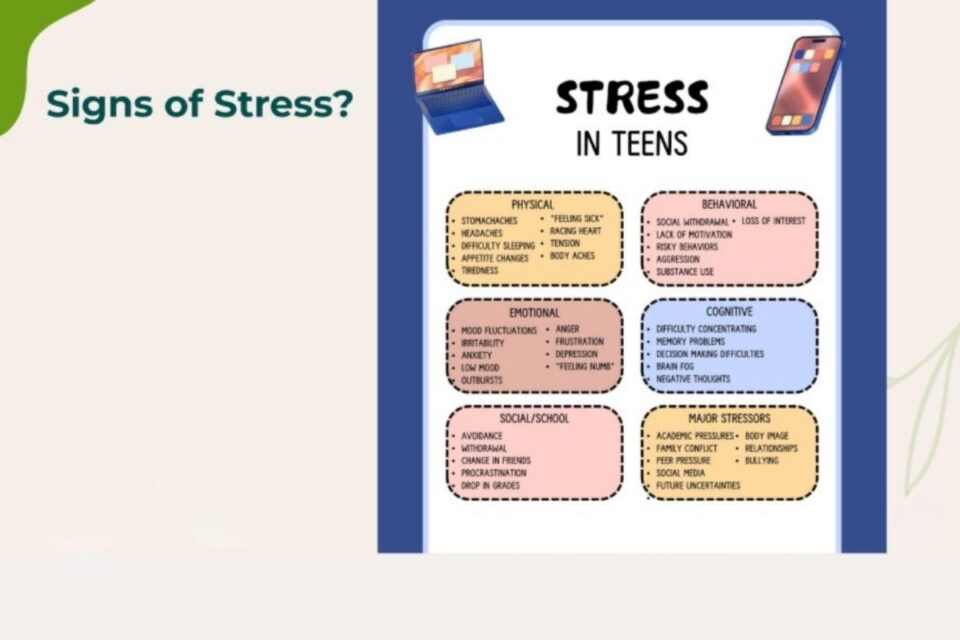
Let’s look at the signs of stress. We like to think of it this way — just as our cars are programmed to alert us when something isn’t working properly, our bodies do the same. When the dashboard lights up, we know something needs attention. Similarly, our bodies send us signals when they’re under stress.
We may notice that our teens complain of feeling unwell, experience headaches or stomachaches, have trouble sleeping, feel constantly tired, or show changes in appetite (either under-eating or over-eating). Many teens we see may also withdraw or isolate themselves. We might notice a lack of motivation, low energy, irritability, aggression, or a loss of interest in activities they once enjoyed.
Emotionally, they may experience mood swings, outbursts, anxiety, or even express feeling numb. Stress can also affect their thinking – leading to negative thoughts, memory problems, difficulty focusing, or trouble making decisions.
This, of course, can spill over into school and academics. We might start to notice changes in grades, increased procrastination, or withdrawal from school and social activities. That’s why it’s so important to be aware of the major stressors our teens are facing.
We’ve listed here some of the most common stressors for teens:
- Academic pressures: the heavy demands of schoolwork, testing, and performance expectations.
- Family conflict: ongoing yelling, fighting, separation, or divorce can all contribute to emotional strain.
- Major life changes: such as moving or changing schools, which can disrupt their sense of stability.
- Peer pressure: the desire to fit in and be accepted or liked by peers.
- Social media: constant exposure to messages, comparisons, and unrealistic expectations can be overwhelming.
- Future uncertainties: questions like “What am I doing after high school?” “Am I going to college?” “Should I get a job or learn a trade?” can cause significant anxiety.
- Body image: how teens feel about their bodies, often intensified by social media comparisons.
- Unhealthy relationships: being taken advantage of, mistreated, manipulated, or neglected can take a serious emotional toll.
- Bullying: which continues to be a growing issue, especially through social media and online interactions. We always recommend monitoring your teen’s online activity, checking their phones, and staying informed about what’s happening at their school.
Stress and the Brain
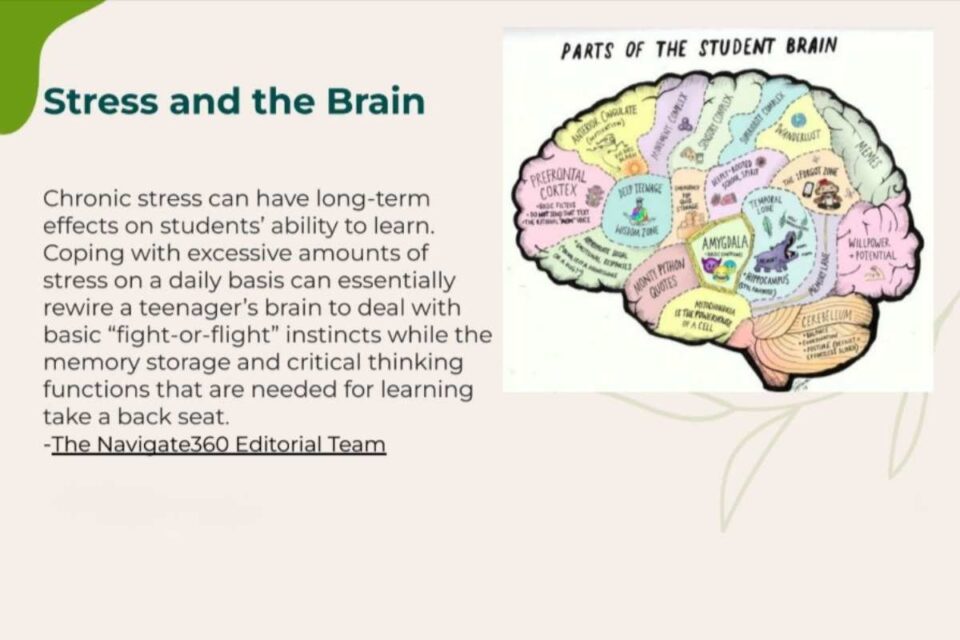
Now, let’s talk about the impact that stress has on the brain. Chronic stress can have long-term effects on a student’s ability to learn. Coping with excessive stress on a daily basis can essentially rewire a teenager’s brain to focus primarily on basic fight-or-flight instincts, while the brain’s memory storage and critical thinking functions, which are essential for learning, take a back seat.
When the brain is overloaded with stress, it can’t function the way it’s designed to. This can lead to memory problems, lack of concentration, difficulty thinking clearly, trouble making decisions, and challenges with problem-solving.
Many of us are familiar with the fight, flight, or freeze responses – the ways we react to stressful situations. For teens, these responses may appear differently than they do in adults:
- Fight: defiance, yelling, arguing, or trying to demand control.
- Flight: being unfocused, easily distracted, procrastinating, or avoiding tasks and responsibilities.
- Freeze: zoning out, becoming unresponsive, or expressing emotional numbness.
If we start to notice these behaviors in our teens, it may be a sign that they are in a stress response and need support to regulate themselves.
We also want to highlight findings from research studies on stress in teenagers. Studies have shown that teens release more cortisol (the body’s primary stress hormone) than adults do. Because of this, their bodies may experience stronger physiological responses such as increased heart rate and blood pressure. As a result, they can experience greater cognitive impairment than adults under similar stress levels. Over time, this heightened response increases the risk of anxiety, depression, and even substance use.
Building Self Awareness

Self-awareness means being able to see the whole picture – noticing what’s happening in the body, scanning for sensations, identifying emotions, and naming what we’re experiencing in the present moment.
Helping our children build self-awareness is an essential life skill. And it all starts with the body.
Body Scan
Sometimes, we like to encourage teens to imagine stepping into an elevator inside their body. Starting at the top of the head, they slowly ride down, scanning for sensations along the way. We can ask questions like: What do I notice in my body? What’s my temperature — am I warm or cold? Do I feel any pressure, tension, aches, or pains?
Movement
Then, we can move to noticing movement: Am I shaking, rocking, or tapping my fingers or toes? By becoming aware of these physical sensations, we can help teens better identify their emotions.
We love the quote, “We truly find ourselves in a body designed for feeling.”
Name It
When we name what we’re feeling – I feel scared, frustrated, confused, or angry – it allows our teens to feel more connected to themselves and to build greater self-awareness.
Sometimes our teens may not be able to name what they’re feeling. We might get the classic “I don’t know” or a little shrug – and that’s completely normal. In those moments, we can help them identify what they might be experiencing.
We can do this by labeling what we observe or offering possible feelings based on what we notice. For example: “Hey, I see you’re holding your stomach and your leg is shaking – I wonder if you might be feeling nervous or anxious?” This gentle approach helps them start connecting physical sensations with emotions. The more awareness they build, the better they’ll become at recognizing and naming their feelings.
Acknowledge Stress
- Get on their Level
- Assess Needs
- Listen and Validate
- Explore Coping Skills
- Support Them in Problem-Solving
When acknowledging your child’s stress, it’s important to first get on their level. If they’re lying on the floor, sit on the floor. If they’re on their bed, sit beside them. If they’re doing an activity, ask to join in. From there, we can assess what they need by starting with the basics: Are they safe? Have they eaten? Are they hydrated? And have they had adequate sleep? If they’re missing out on these basic needs, it’s going to be difficult for them to function at their fullest capacity.
Next, we want to listen and validate. Listen with all your senses – hear their words, observe their body language, and feel their energy. This is their time to feel seen, heard, and understood by us. It’s not the time to jump into “fix-it” mode, offer advice, or share our own life experiences – unless, of course, they ask for that.
Instead, we can explore coping skills together and see what strategies might help them better manage their stressors. (We’ll talk more about coping skills in a bit.)
Lastly, we can support our teens with problem-solving. Encourage them to use their critical thinking to explore possible solutions. Researching helpful resources together can also boost their self-esteem, self-confidence, and sense of pride in their ability to handle challenges.
Effective Communication
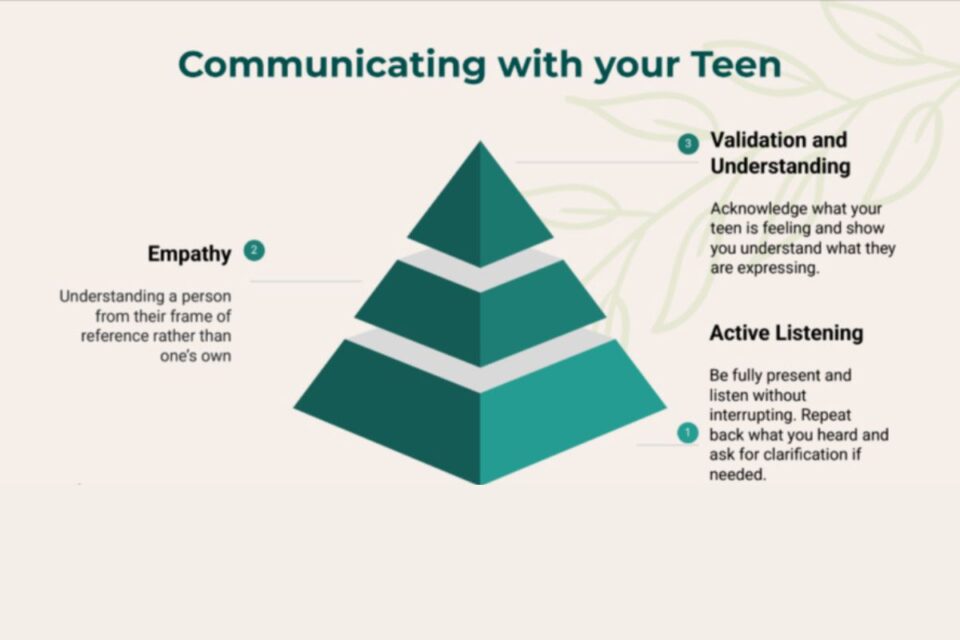
Let’s now look at the three components of effective communication.
- Active Listening – When we actively listen to our teens, we are fully present. We’re not distracted by our phones or multitasking. We give them the space to speak openly without interrupting. We can summarize what we hear and ask gentle, open-ended questions to better understand what they’re thinking or feeling.
- Empathy – Empathy means understanding our teens’ experience from their perspective rather than our own. It’s a practice and a skill – sitting with them in their feelings and being present through it, even when it’s uncomfortable.
- Validation and Understanding – This means acknowledging their emotions and letting them know that what they’re feeling makes sense, even if we don’t agree with their perspective
We can acknowledge what our teens are feeling and show that we understand what they are expressing. Some responses that demonstrate empathy and understanding might sound like:
- “It sounds like that must have been really hard, and I can see why you’re feeling angry.”
- “That’s such a difficult situation – it makes sense that you would feel confused.”
- “It seems like you feel overwhelmed by everything on your plate – maybe you could use a break. Is that right?”
Using these types of responses helps our teens feel truly heard and understood, reinforcing that we are listening and trying to connect with them.
We also want to highlight a few things to avoid when communicating with our teenagers: criticism and minimizing their feelings.
For example, a statement that could be critical or minimizing might sound like:
- “You shouldn’t feel that way.”
- “You’re just being dramatic.”
- “Stop crying.”
It’s important for us to understand how powerful our words are. When we communicate with compassion and empathy, we build a bridge of connection and safety between ourselves and our teens.
Regulating the Body
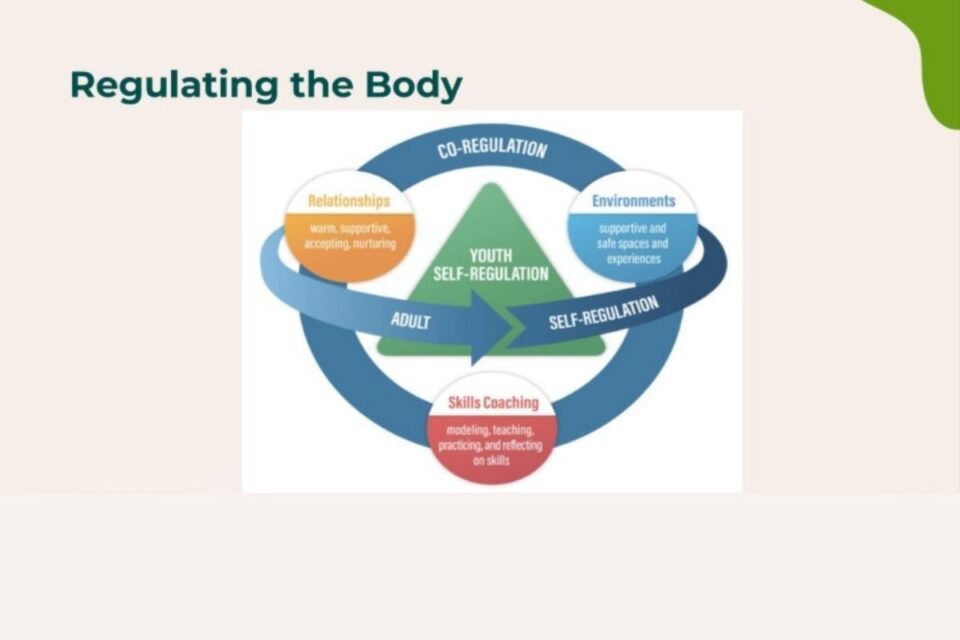
Next, let’s talk about self-regulation — regulating the body.
What is self-regulation? It’s the ability to manage our cognition and emotions to enable goal-directed actions, such as organizing behavior, controlling impulses, and solving problems constructively. The development of self-regulation depends on co-regulation provided by a parent or caregiver.
Co-regulation happens through warm, responsive interactions where we offer support, coaching, and modeling. This helps our teens understand, express, and modulate their thoughts, feelings, and behaviors.
Teens take note of how we handle challenges, and the way we approach life’s difficulties can shape how they respond to stressors and obstacles in their own lives. Self-regulation takes practice, consistency, and support – and our guidance is key in helping them develop these skills.
Self-Regulating Skills
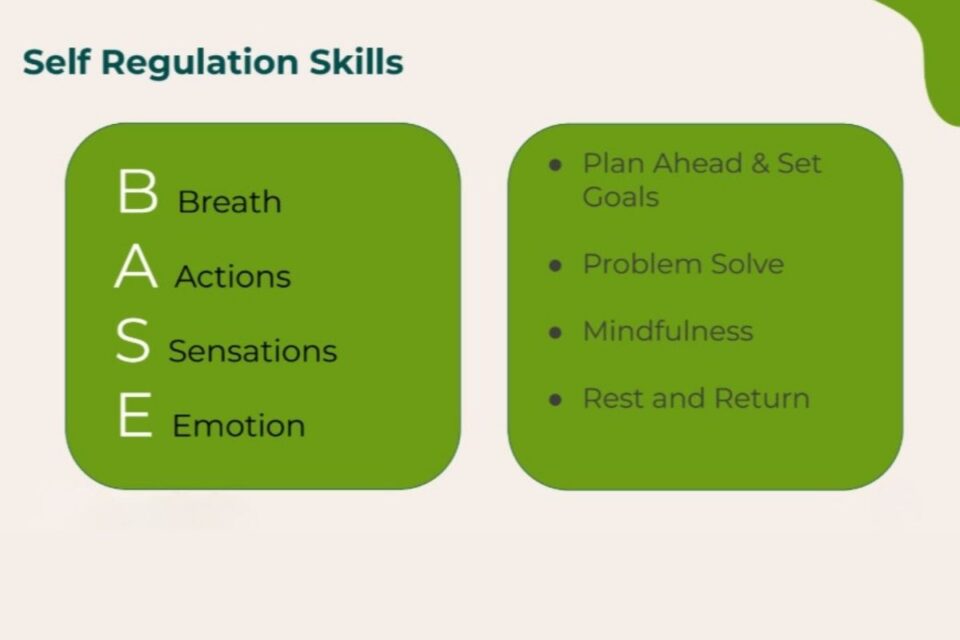
We’ll continue with self-regulation skills using the B.A.S.E. framework, which stands for Breath, Actions, Sensations, and Emotions.
B – Breath: This is about being intentional with deep breathing. Encourage teens to inhale through their nose and exhale through their mouth. Placing one hand on the chest and one on the stomach can help them feel the breath. One technique we like to call “4-5-6” works like this: inhale through the nose for 4 seconds, hold the breath for 5 seconds, and exhale through the mouth for 6 seconds, keeping the hands on the chest and stomach. This can be repeated 2–5 times as needed.
A – Actions: These are the movements we notice in the body that signal stress. Examples include eye twitching, fidgeting with fingers, biting nails, or tapping feet.
S – Sensations: This involves tuning into what’s happening inside the body. Teens can notice tingling, sharp pains, warmth, or other aches.
E – Emotions: Finally, we connect these cues from the body to actual feelings. Teens can name their emotions: I’m feeling sadness, fear, happiness, anger, or other emotions.
Using B.A.S.E. helps teens stay in the here and now, be present in the moment, and feel more in control of themselves and their responses.
Some other skills that can be helpful for our teens include planning and goal-setting. We can show them how to properly plan for tasks, set reasonable goals, and work toward them with specific objectives.
Problem-solving is another key skill – it stimulates critical thinking and encourages confidence in decision-making. The more teens practice problem-solving, the more adaptable they become and the better equipped they are to handle stress.
Mindfulness is a daily practice of being fully present in the moment. Some techniques we can use with our teens include engaging all five senses: naming five things they can feel (touch), four things they can see, three things they can hear, two things they can smell, and one thing they can taste.
Another activity is focusing intentionally on an object and describing it in detail – for example, observing a puzzle piece by noting its color, shape, texture, and any other details.
We can also help teens connect with their body: placing feet flat on the floor, wiggling toes, stomping feet, clenching hands into fists and releasing, stretching arms, or curling and releasing toes. These activities help them notice physical sensations and build awareness.
Lastly, rest and return is a key strategy – taking a break and committing to come back later. This teaches self-care and helps teens return to tasks feeling refueled.
We encourage practicing B.A.S.E. (Breath, Actions, Sensations, Emotions) and mindfulness skills when teens are calm and regulated so they can use them effectively when stressed.
Coping with Stress
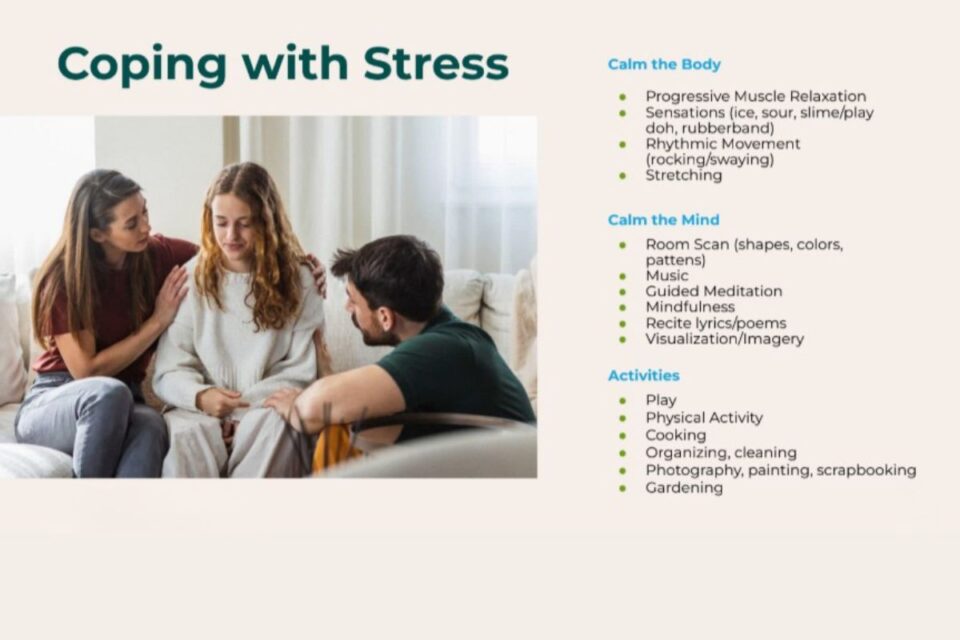
Coping with stress involves several strategies:
Calming the Body
- Progressive muscle relaxation: can be done by flexing muscles for a few seconds and then releasing, starting at the feet and moving up through calves, thighs, core, chest, arms, and head.
- Opposite sensations: If a teen feels hot or angry, using ice, splashing water on the face, or playing with slime, Play-Doh, or a rubber band can help.
- Rhythmic movement: Swaying, rocking, or gentle movement can be soothing, similar to how we comforted them as babies.
- Stretching or yoga is also effective.
Calming the Mind
Calming the mind can involve doing a room scan – taking notice of certain shapes, colors, and textures, and describing them. Guided meditations are also helpful, and there are many great apps online, as well as YouTube videos that are useful for teenagers.
A website called mindfulnessforteens.com has excellent resources for teens, and the Insight Timer app, suitable for ages 12 and up, is also very helpful.
If your teens enjoy reading or music, they can recite lyrics, sing, or read poems. Visualizations and imagery are another technique — creating a mental picture of a relaxing, calming, and soothing place. For example, imagining being at the beach, hearing waves crash against the rocks, seagulls, or even people talking in a calm space can help teens feel more relaxed and centered.
Activities
Activities and play are essential for both teens and adults. Encouraging teens to try new skills or hobbies helps them feel stimulated and engaged. This can include physical activity (bike rides, boxing, aerial arts), creative pursuits (art, photography, painting, scrapbooking), cooking, gardening, or organizing their spaces.
How To Tolerate Distress

Now, we’re going to talk about how to tolerate distress. Distress tolerance is the ability to manage actual or perceived emotional distress. Our level of tolerance can influence how we approach and handle challenging situations.
One helpful framework comes from DBT (Dialectical Behavior Therapy) and is called ACCEPTS. These are skills that help build tolerance:
- Activities: Engaging in anything that can distract from distressing thoughts or emotions, such as hobbies, exercise, or other coping skills we discussed earlier.
- Contributing: Doing something kind or helpful for someone else. Helping others can shift focus away from our own distress and provide a sense of purpose.
- Comparisons: Comparing our current situation to a time when we coped successfully or to someone who is worse off. This helps put distress into perspective.
- Emotions: Engaging in activities that evoke a different emotion, like watching a funny movie or listening to uplifting music. Changing our emotional state can shift our perspective.
- Postponing: Temporarily setting aside distressing thoughts or emotions by mentally pushing them away. This is useful when we can’t address the situation immediately and need a break from intense feelings.
- Thoughts: Redirecting thoughts away from distressing topics by focusing on something neutral or positive. Mindfulness techniques or visualization exercises, which we covered earlier, can be very helpful.
- Sensations: Engaging in sensory experiences that are soothing or pleasurable, such as taking a warm bath, listening to calming music, or using aromatherapy.
Finding small ways to participate in the present moment or self-soothe when distressed is essential for improving emotional experiences.
The Stress Cycle
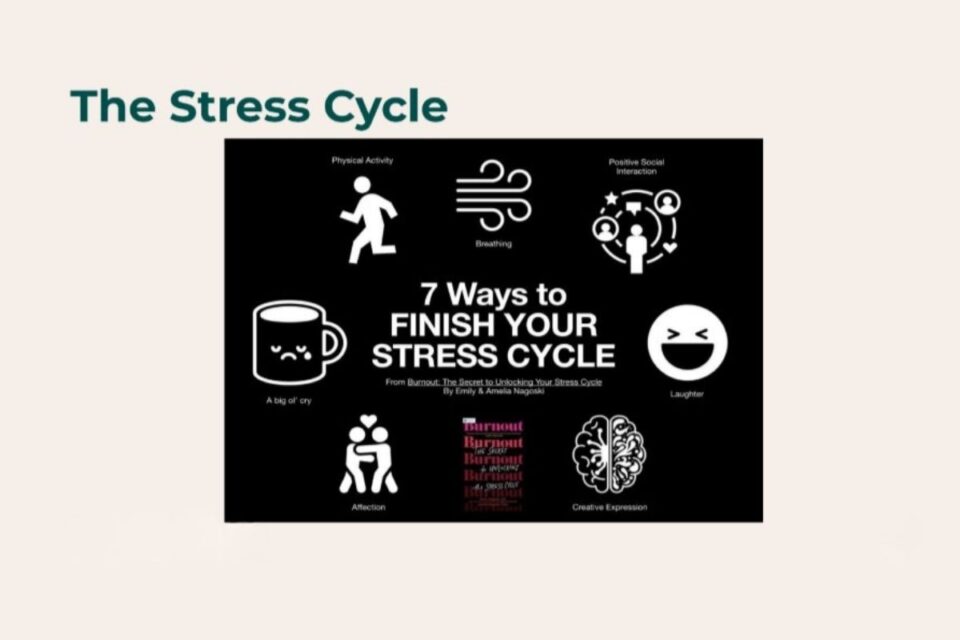
We also want to share a great resource — the book “The Secret to Unlocking the Stress Cycle” by Emily and Amelia Nagalski. The authors highlight seven key elements to help complete the stress cycle:
- Physical activity: Any form of moving the body — stretching, dancing, walking, biking.
- Breathing: Deep breathing techniques we discussed earlier, inhaling through the nose, holding, and exhaling through the mouth.
- Positive social interaction: Connecting with others is crucial. Encouraging teens to have supportive friendships or participate in extracurricular activities is very beneficial.
- Laughter: Laughing with others or watching a funny movie or show helps shift emotions, supporting distress tolerance.
- Creative expression: Encouraging teens to explore creativity, whether through art, making something new, or learning a skill.
- Affection: Hugs and physical touch — research shows that a 10-second hug can boost oxytocin, the “feel-good” hormone.
- Crying: Normalizing crying as a release can be soothing and emotionally restorative.
The human body is naturally designed to recover from stressful and even traumatic events.
By equipping our teens with these skills and creating an open, safe space for them to share their experiences, we enhance their development, strengthen secure parent-child attachment, and help them feel supported as they navigate life’s challenges.
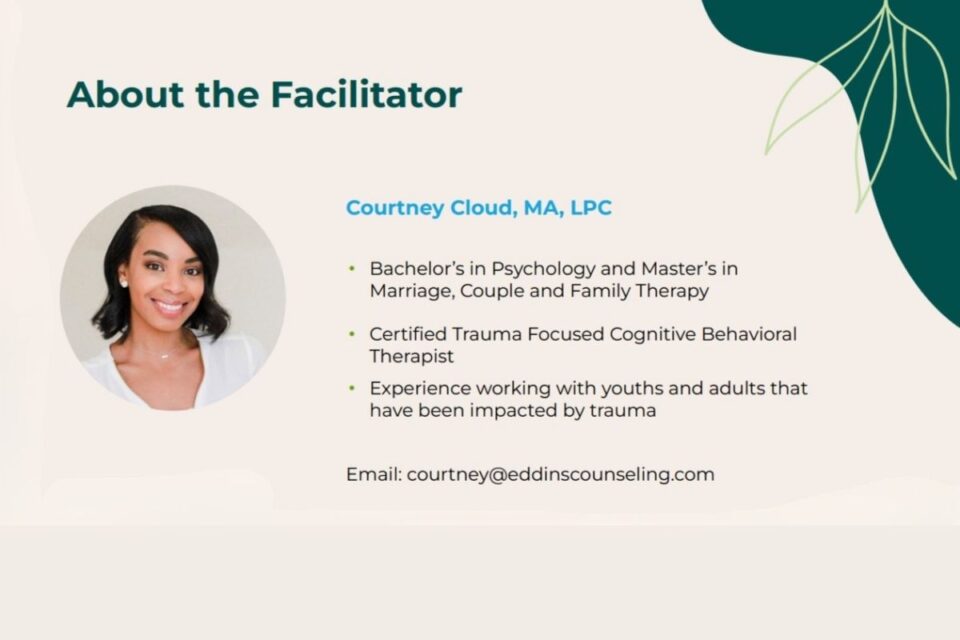
This webinar has been facilitated by Courtney Cloud, MA, LPC.
Courtney is a licensed professional counselor, and she primarily works with adolescents and adults. She is also certified in trauma-focused cognitive behavioral therapy (TF-CBT), a therapy designed for children and adolescents who have experienced trauma. This is a collaborative treatment, meaning the child’s caregiver is actively involved in the therapy process.
If you would like more information about our services at Eddins Counseling & Therapy Group, please feel free to contact our Client Care team. They can also schedule a free 15-minute consultation with one of our therapists. We encourage you to complete the evaluation form provided in the chat, and you are also welcome to email us directly with any questions at [email protected].
Feel free to visit additional resources:
1. Articles on specific topics on our blog.
2. RSVP for one of our free monthly webinars (or view past webinars)
3. Follow us on Facebook and Instagram for additional interviews and tips
4. Take another one of our self-test quizzes
5. Schedule a consult and find out how we can support you.
Whether you’re helping your teen manage daily pressures or supporting them through bigger challenges, you can start to see more calm, resilience, and confidence in their life.
Contact our therapists to learn more about how we can help your teen navigate stress and develop healthier ways to cope with challenges and emotions. To get started now, give us a call to schedule an appointment at 832-559-2622 or schedule an appointment online. We also offer online therapy for convenience and flexibility.