
May 14, 2026
Webinar: How to Find Peace When Life Feels Overwhelming
Written by Guest Author
Posted in Webinars and with tags: overwhelm, positive self-talk, stressed, webinar

How to Find Peace: A Webinar for When Life Feels Too Heavy
There are seasons in life when everything feels like too much. The responsibilities keep piling up, the to-do list never seems to end, and even the smallest frustrations can feel overwhelming. If you’re a parent, caretaker, or busy adult juggling work and family, you may recognize the quiet thought that creeps in: “I don’t feel like myself anymore.”
Maybe you’ve noticed your patience running thinner than it used to. The kids ask one more question, and you snap. A loved one tries to talk, and you shut down. Or maybe you simply feel exhausted all the time—too drained to show up the way you want to. And afterward comes the guilt. You know you care deeply about the people around you, but it feels like you’re running on empty.
For many adults, this cycle of stress, exhaustion, and frustration becomes the new normal. Life keeps throwing new challenges your way, and there never seems to be time to catch your breath. Over time, the weight of it all can leave you feeling disconnected—from your joy, your energy, and even from the person you used to be.
The truth is, you’re not alone in feeling this way—and you’re not stuck here either.
A Path Back to Yourself
The upcoming webinar “How to Find Peace,” led by therapist Nate Taylor, is designed specifically for adults who feel overwhelmed by life’s demands and unsure how to reclaim a sense of calm and balance.
Instead of offering quick fixes or unrealistic expectations, this workshop focuses on practical tools that help you understand what’s really happening beneath the stress. Participants will learn how to recognize what’s fueling their overwhelm, identify the values that matter most to them, and develop coping skills that make daily stress more manageable.
When we begin to understand our stress—rather than just pushing through it—we can start to change our relationship with it.
And that’s when something powerful happens.
What Life Can Look Like on the Other Side
Imagine feeling more like yourself again.
Instead of waking up already exhausted, you feel grounded enough to handle the day. You have more patience with your kids, more energy for your family, and more compassion for yourself. Challenges still happen—because life doesn’t stop—but they no longer knock you completely off balance.
When stress becomes manageable, relationships begin to shift too. Conversations feel easier. Reactions become more thoughtful. Joy, which may have felt distant for a while, slowly starts to return.
This webinar is about helping you move toward that place.
What You’ll Learn
During “How to Find Peace,” attendees will:
- Learn how to recognize the sources of their stress
- Identify the personal values that guide their decisions and priorities
- Develop practical coping skills to manage daily overwhelm
- Gain tools that support healthier responses to stress and stronger relationships
These skills are designed to be realistic and sustainable—something you can begin using right away in your everyday life.
A Message from Nate Taylor
Nate Taylor understands this struggle on a personal level.
There was a time when he felt the same relentless pressure many adults experience today—feeling burned out, unable to take a break, and unsure if relief was even possible. Responsibilities kept moving forward, and putting life on pause simply wasn’t an option.
Over time, Nate began to recognize how much he had been neglecting what truly mattered to him. Through trial, error, and a commitment to rediscovering his values, he developed tools that helped him stay grounded even when life remained busy and demanding.
Today, while stressors still arise—as they do for all of us—he continues to practice and refine the skills that keep him connected to what matters most. In this webinar, he shares the same insights and strategies that helped him move from burnout toward a more balanced and meaningful life.
You Deserve Peace Too
If you’ve been feeling overwhelmed, drained, or disconnected from the person you want to be, this webinar is an opportunity to pause and refocus.
Peace isn’t about eliminating every stressor from your life. It’s about learning how to stay grounded even when life gets difficult—and rediscovering the values and strengths that help you move forward with clarity.
Sometimes the first step back to yourself is simply realizing that change is possible.
“How to Find Peace” is that first step.
Watch a replay of the presentation here.
Welcome to another Eddins Counseling & Therapy Group seminar. Our presenter for today is Nate Taylor. We host a seminar every month for those who would like to join us live. If you are unable to attend the live session, we also upload the recordings to YouTube afterward.
We offer a variety of presentations covering different health topics that we hope you will find interesting. If you think someone else may benefit from the information, we encourage you to share the presentation with friends or family members.
Objectives
- To Explore stress, the effects of stress, and our values
- To Understand control vs. uncontrollable stressors
- To Learn practical coping tools
- Build sustainable wellness habits
Today, we will be discussing how to find peace. When we think of the word peace, one image that often comes to mind is sitting on a beach with a piña colada, listening to the waves and feeling the ocean breeze. For many of us, that represents an ideal sense of peace.
As we reflected on this a few years ago, we became curious about how to cultivate that same mindset in our day-to-day lives while going to work, interacting with family and friends, and managing everyday responsibilities. We recognized that it was often difficult to maintain that same sense of peace throughout our daily routines.
After years of trial and error and discovering what worked best, we realized that some approaches were not particularly helpful in creating a lasting sense of peace. Over time, we developed skills that helped us move toward where we wanted to be, and today we will discuss some of those strategies.
We will begin by talking about stress.
In many cases, stress and emotions serve as indicators that provide us with valuable information about what is happening in our lives.
They can signal that one of our values or personal boundaries is being challenged or overlooked. Throughout this presentation, we will learn more about stress and the effects it can have on our bodies.
Oftentimes, minor events—such as stubbing a toe—do not have as significant a stress impact as more serious experiences, such as being in a car accident or going to a job that we do not like. Stress and emotions are important sources of information we can learn from, and they can also help us better understand our values. In many cases, our emotions and stressors indicate which values may need more of our attention.
As we continue through today’s presentation, we will explore what we can and cannot control. We will look at stressors that we are able to problem-solve and work through, as well as stressors that may cause more discomfort and cannot be directly resolved, where acceptance may be a more helpful approach.
Understanding whether a difficulty is controllable or uncontrollable can guide how we respond to the stressor in front of us.
As we move forward in the presentation, we will then focus on learning practical coping skills. We recognize that what works for one person may not work for another, and what works for a neighbor may not work for someone else. Because of this, we need to identify the tools that work best for each individual.
For some, deep breathing exercises may be beneficial, while others may need something more impactful. We will explore a range of strategies and discuss them throughout the presentation.
Finally, we will focus on building sustainable wellness habits. We will explore how to reach a place where, in our day-to-day lives, we can maintain a sense of peace between the ups and downs of life, including stressors and emotions such as anger, sadness, or frustration. We will consider how we can return to our baseline state of peace.
The goal is that, by the end of this presentation, we can each learn what helps us reach that sense of peace—our own version of sitting on a beach with a piña colada on a regular Wednesday afternoon.
Stressors
Stress: a psychological and physiological response to perceived challenges or threats characterized by mental or emotional strain from adverse or demand circumstances.
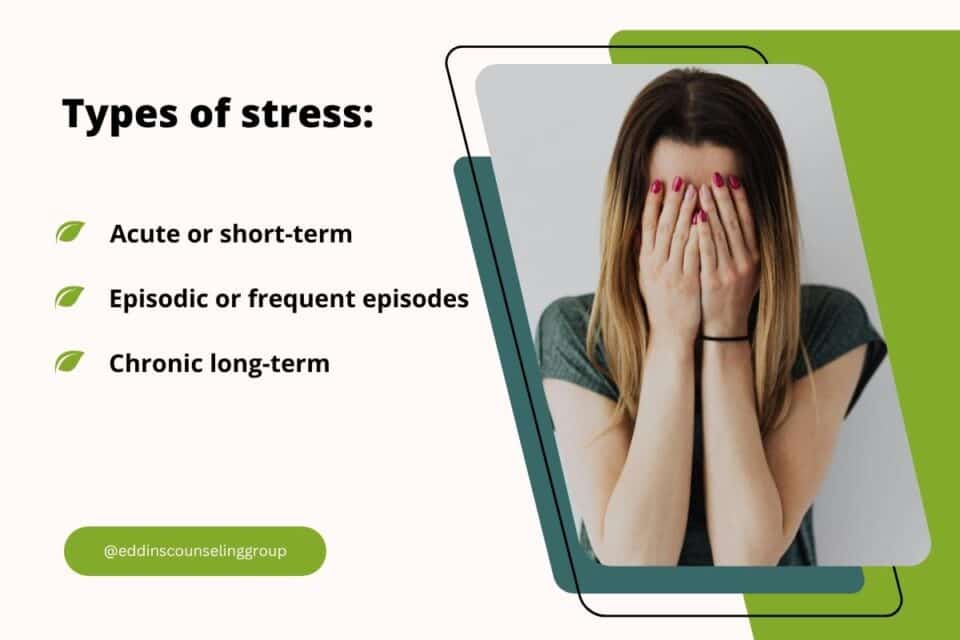
Types of stress:
- Acute or short-term (traffic jams, public speaking)
- Episodic or frequent episodes (demanding jobs, caretaking for others)
- Chronic long-term (job dissatisfaction, financial problems)
First, we will define stress. Stress is a psychological and physiological response to perceived challenges or threats, characterized by mental or emotional strain from adverse or demanding circumstances.
In simpler terms, it refers to situations in which we experience something that our brain interprets as unhelpful, conflicting with our values, or potentially harmful or distressing. Physiological responses to stress may include a racing heart, trembling, or racing thoughts that make it difficult to slow down.
Acute or short-term
There are three types of stress that we would like to outline. The first is acute or short-term stress, which may include situations such as traffic jams—like leaving work at 5 o’clock during peak rush hour with little movement on the road—or experiences such as public speaking, if that is something that feels stressful for us.
We recognize that our heart rate may increase, and we may experience trembling or sweating as we prepare for a public speaking presentation. Some of the physical impacts this can have on our bodies may include headaches.
For example, when we are in a traffic jam and feeling frustrated, we may develop a headache, or we may feel fatigued after public speaking, where anxiety leaves us more tired than we would typically feel during an afternoon.
Episodic or frequent episodes
We also experience episodic or frequent stress episodes. This may include jobs that we worked hard to obtain—such as earning a degree or certifications—that turn out to be more demanding than anticipated. There may be moments when we enjoy the work and feel that it is exactly what we wanted, even feeling excited and engaged. However, there are also times when the job becomes emotionally, mentally, or physically demanding.
Caretaking roles can also fall into this category. There are moments when we genuinely enjoy supporting family members or friends and doing our best to help them through their day-to-day lives. However, there are also times when the person we are caring for may be frustrated or more difficult to engage with, such as when they “wake up on the wrong side of the bed.” During these periods, we may experience frequent episodes of distress in our interactions.
These stress experiences can impact our bodies, including fluctuations in glucose or blood sugar levels, as well as changes in blood pressure in response to stress while caregiving or working in demanding environments. Within episodic or frequent stress, there are moments of joy, but there are also moments of significant distress.
Chronic long-term
We then move to chronic or long-term stress. This may include waking up each morning with ongoing job dissatisfaction, where we do not feel fulfilled in our work and experience sustained emotional or mental distress. It may also include financial difficulties, particularly in the current economic environment, where we may worry about paying upcoming bills or feel that financial flexibility is more limited than before.
These long-term stressors can have a significant impact on our bodies. For example, elevated blood pressure that began during periods of frequent stress may become persistent and require medication. We may also develop anxiety, especially when dealing with ongoing financial concerns or job uncertainty, leading to a more constant state of stress over time.
Depending on whether stress is acute, episodic, or chronic, it can have different effects on our bodies. However, it is important to recognize how we can return to a baseline state of peace, or as close to it as possible.
Understanding our Values
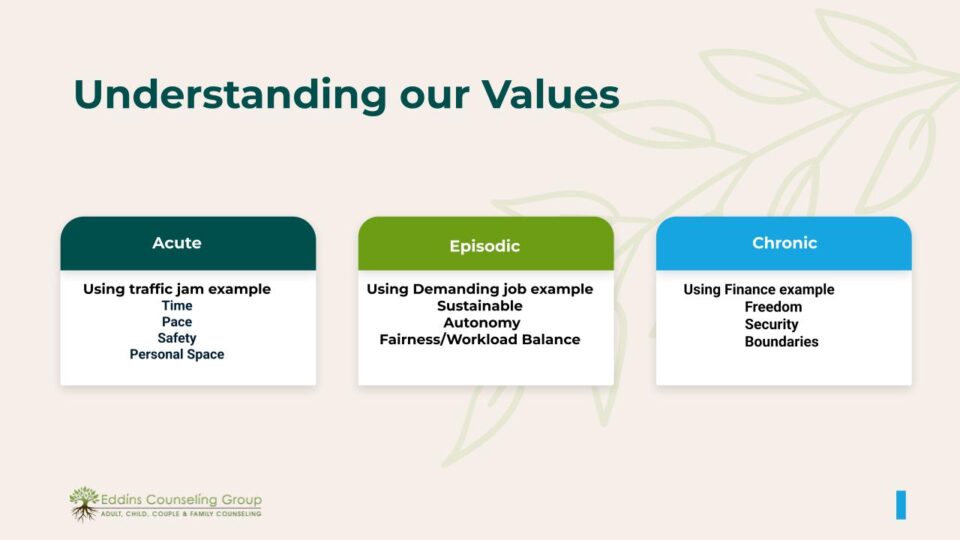
These stressors can also provide insight into our values. For example, using traffic jams as a reference, we may recognize that we value our time and prefer to spend it with family, friends, or ourselves rather than being stuck in traffic for extended periods. We may also recognize that we value pace and efficiency, particularly when we feel rushed due to appointments or obligations, which can increase anxiety when our expected pace is disrupted.
We may also recognize that safety is an important value, particularly when encountering aggressive or erratic drivers who create discomfort. In such situations, we become more aware of our need for security and physical well-being.
Additionally, we may notice that we value personal space.
In crowded or stressful traffic environments, we may feel overwhelmed by noise, including honking or shouting, and become more aware of our need for calm and reduced stimulation.
In this way, acute stressors can serve as indicators that help us understand what we value most, such as personal space, calmness, and reduced overstimulation from the external environment.
We recognize this through our acute stressors. For example, using the demanding job scenario, we may realize that the job is not sustainable in the long term. A position that we initially wanted may begin to take a toll on us, and we may recognize that we cannot continue in it indefinitely. We might be able to manage it for a few more years, but if our goal is to retire from a job, we may begin to consider whether we need to explore a different long-term career path.
We may also recognize that we do not have as much autonomy as we would like in a demanding job. For instance, we may have a new manager who is not particularly effective and has reduced our flexibility. They may have taken more control over our schedule, whereas we may have previously been able to come in and leave at more flexible times. Instead, we are now expected to follow a more structured schedule that does not align as well with our natural rhythm.
In some cases, we may not be accustomed to a PRN or as-needed schedule, and we may experience disruptions such as being called into work during family dinner, which reduces our sense of autonomy. In these situations, we recognize that we have less control over our time than we previously did.
We may also recognize that we value fairness and work-life balance. If a manager is distributing an unequal amount of work, placing more responsibilities on us compared to our coworkers, we may feel that the workload is not aligned with what we originally agreed to or expected.
Through these experiences, we may come to understand that the job is not sustainable for us. We may recognize that we do not have the flexibility or autonomy we need, and that the situation does not feel as fair as we would like it to be.
In the case of chronic stressors, such as financial stress, we may recognize that we do not have as much financial freedom as we once did. Economic changes may mean that expenses such as gas and groceries have increased significantly, reducing our overall financial flexibility. As a result, we may feel that we do not have the same level of financial security, and we may be less able to prepare for unexpected expenses or maintain a financial safety net as we once could.
We may also notice changes in our personal boundaries. For example, we may previously have been able to lend money to others, but due to current financial limitations, we are no longer able to do so as frequently. This may require us to establish stricter financial boundaries.
In addition, coping strategies may change over time. If shopping was previously a coping mechanism, we may find that it is no longer as accessible due to financial constraints. As a result, what was once an episodic financial stressor may become a more chronic stressor.
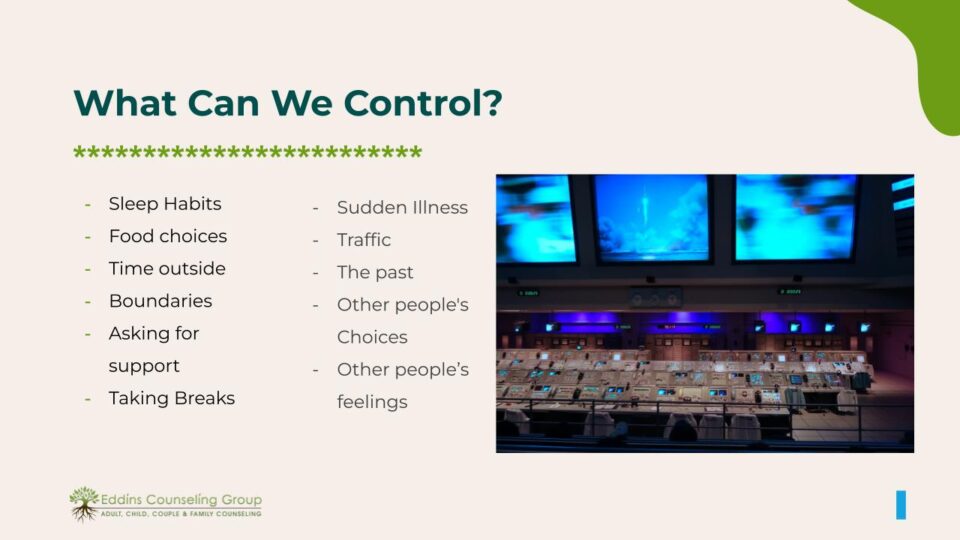
This leads us into the concept of what we can control. We may refer to the analogy of a NASA control center, where there are many systems and responsibilities, but each person has a specific role. When one person is unable to manage something outside their scope, another team member is responsible for it. In the same way, we focus on what is within our control and acknowledge what is not.
There are aspects of our lives that we can influence and work toward, and others that we cannot directly control.
It is important to note that the things we can control are not always easily changed. Rather, they are areas we can gradually work on over time to move closer to where we want to be.
For example, sleep habits are one area we can work on. If we find that we are waking up feeling tired, we may aim to go to bed earlier—such as shifting from 11:00 PM to 9:00 PM. However, this is not always easy, especially if we have children or family routines that follow a different schedule. It may take time and gradual adjustment to build new sleep habits, but it is still an area within our control.
Food choices are another area we can influence. We know that different foods have different effects on our bodies. Diets high in processed foods, unhealthy fats, or sugar can affect us differently than diets that include fruits, vegetables, and protein.
Research shows that nutrition can impact mental health, and we may notice changes in mood or energy levels depending on our eating patterns. For example, if we are beginning to experience depressive symptoms, we may reflect on whether our food choices have been less supportive over recent months.
At the same time, we recognize that financial limitations may affect our ability to make certain food choices. This is important to keep in mind when considering control and accessibility.
We may also notice, as many of us can relate, that if we have adequate sleep but poor nutrition—or vice versa—we may be able to function, but if both are lacking, we are more likely to feel irritable and less regulated in our interactions with others. Because of this, it is important for us to remain mindful of sleep and food choices in order to maintain a more stable baseline in our day-to-day lives.
And then that brings us to time outside. That is something we can work towards. There are statistics that show that standing outside and being in the sun for a few minutes can have a positive effect on our mental health, as well as simply getting a bit of exposure to the outside world. We may have also heard that taking our shoes off and stepping in the grass for a couple of minutes—grounding ourselves in nature—can have a healthy effect on us.
That brings us to our boundaries.
Boundaries are something that we can control.
It is not always easy to stand up for ourselves or to confront someone who has crossed a boundary, but with practice, time, and encouragement, boundaries are something we can learn to manage in order to maintain our values.
Similar to what we discussed, if we have a manager who is not performing well, we can set boundaries such as, “We are going to come in at this time because this is what our contract allows.”
Similarly, asking for help is very difficult for many of us.
We may be used to doing things on our own or may not have people we feel we can rely on for support. However, asking for help is something we do have control over, even though it may require significant internal effort to reach out to someone for assistance.
Taking a break is also something we can do. This does not necessarily mean taking a formal hour lunch break if one is not available. Rather, it may mean taking a minute or two to sit at our desk, close our eyes, and practice deep breathing exercises to bring ourselves back to a sense of peace in our day-to-day lives. The goal is to create small moments that help increase calmness and decrease stress or frustration in the moment.
This then brings us to the side of things we can not control. This side can be very difficult to manage because these situations are often unexpected. We cannot always control the circumstances we find ourselves in, so it becomes important to be curious about how we navigate them. Recognizing what we can and cannot control can significantly influence how we respond to these situations.
In these cases, we lean more toward acceptance rather than problem-solving. When we attempt to problem-solve something we cannot control, we may find ourselves going in circles, which can increase stress, anxiety, frustration, or disappointment when our solutions do not work.
For example, sudden illness is something we cannot control. No one plans to become ill, and we must accept that as part of life. Traffic is another example. We may leave 30 minutes early for a lunch date with a friend or family member, but unexpected events—such as a car accident or even something unusual like ducks crossing the road—can delay us.
These are situations we cannot anticipate, and in those moments, we may need to lean toward acceptance, recognizing that we did everything we could to reach our destination.
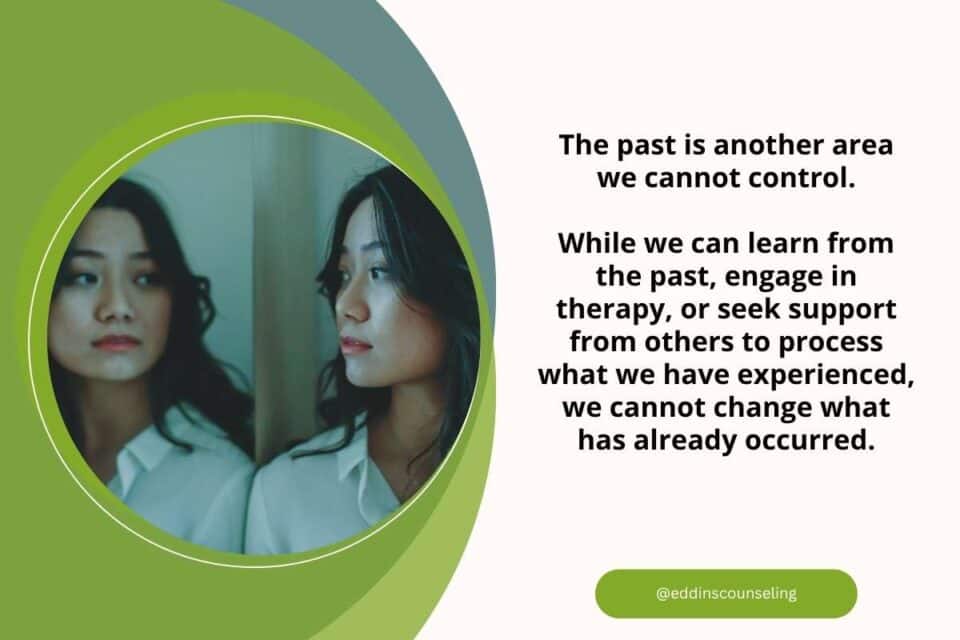
The past is another area we cannot control. Many of us may have moments where we wish certain events had not happened. While we can learn from the past, engage in therapy, or seek support from others to process what we have experienced, we cannot change what has already occurred.
Finally, other people’s choices and other people’s feelings are also outside of our control. In relationships or friendships, we may want others to be happy and have a good experience, but it places a great deal of pressure on us to try to control someone else’s emotions. We can support others and be present for them, but we cannot force someone out of depression or change their emotional state.
Similarly, we may become frustrated when others do not follow our advice. For example, if we provide options A and B but they choose option C instead, it can feel upsetting. However, ultimately, they are making their own decisions.
All of these elements on the right side are not easy to deal with. However, our perspective on the situation can significantly impact how we respond to it.

This, again, is our idea of peace—our vision of what it means to be in a calmer, more grounded mindset.
We want to be curious with ourselves to see what stressors we have experienced.
We ask what is something we can identify that has been more repetitive—whether it is more episodic, or whether it has become a long-term sense of stress, possibly moving into the chronic category. Also, we are curious about what mental barriers may be preventing us from reaching a sense of peace, and why we value that sense of peace.
That is something very important for us to keep in mind: if we do value this, we should also consider why we value it. We include this here to pause for a moment, take a few deep breaths, and reflect on what stressors we are experiencing and what values may not be receiving enough attention.
We are learning where we may need to place more attention, or what we can and cannot control, and how we interact with what is in front of us. Then, we will move on to how we can reach a mindset of peace to the best of our ability. We recognize that for some chronic stressors, this takes time. It is not something that can be changed instantly or with a snap of the fingers. However, we can consider what we can do to bring ourselves as close to that baseline as possible.
Coping Skills
This brings us to the next topic on coping skills.
In the moment Regulation Skills
- Box breathing 4 – 4 – 4 – 4 5 – 2 – 7 – 2
- Name it to Tame it
- Cold water Reset
- Short Walk
- Switching Rooms
Some of these coping skills can be used in the moment. For example, if we are sitting in traffic or working with a loved one and we notice ourselves becoming more upset, we can consider what we can do to bring our minds back to a sense of peace—whether that is sitting on a beach or whatever our personal sense of peace may be. For some of us, it may be sitting on the couch and watching TV, or another calming activity that represents peace for us.
On the left, we have box breathing. If we are not familiar with it, we inhale for 4 seconds, hold our breath for 4 seconds, exhale for 4 seconds, and then hold our breath again for 4 seconds. Some of us may personally prefer variations, such as 5 seconds in, 2 seconds hold, 7 seconds out, and 2 seconds hold. This can help us focus more on our breathing, inhaling through the nose and exhaling through the mouth. In practice, we would count in our head: 1, 2, 3, 4; hold for 4 seconds; 1, 2, 3, 4; exhale for 4 seconds; 1, 2, 3, 4; and hold again for 4 seconds, repeating the cycle as we bring ourselves back to baseline.
These coping skills are not meant to fix everything that is happening. Rather, they are meant to help us return to a baseline so that we can make decisions or shift our perspective on the situation we are in.
Self-Soothing Through the Five Senses
- Sight: Calming images, nature, dim lighting
- Sound: White noise, Music, Nature Sounds
- Touch: Warm Shower, Soft Blanket
- Smell: Lotion, Essential Oils, Coffee, Candle
- Taste: Mint, Tea, something grounding culturally
Another strategy is “name it to tame it.” We may often experience emotions quickly and find it difficult to label them in the moment. However, when we are able to name what we are feeling, it helps our nervous system recognize what is actually happening.
For example, if our thoughts are racing, we might pause and say that we are feeling anxious because we have a job interview tomorrow and are unsure if we are ready. When we slow down and identify the emotion, it can have a calming effect on our nervous system. We still need to prepare for the interview, but we are less likely to remain in a heightened fight-or-flight state.
Cold water reset is another tool that can be helpful for those who do not find breathing exercises effective.
This involves using cold water or ice, such as placing it on the back of the neck or forehead. The cold sensation can help regulate the body by engaging the vagus nerve and reducing physiological arousal.
In practice, this may help bring us down from a 9 or 10 to a 5 or 6, after which we may use breathing techniques to further reduce stress to a 2 or 3. These strategies can work together to help us reach a more regulated state.
Finally, a short walk can also be helpful. If we are in a heightened emotional state—such as during an argument with a partner or when feeling frustrated with ourselves—stepping away for a short walk around the block can help us regulate and reset.
It does not have to be far, and it does not have to be a mile. We may go for a short walk around the block to help ourselves get outside, get some sunlight, and reset our minds a little bit. Or we may even switch rooms.
For example, if we are students and we have been studying for finals for a long time, our brain may start to feel like it is no longer functioning effectively. In those moments, we may switch from the room we are in to the kitchen or living room to give our brain a reset and help regulate ourselves in the moment.
Step by Step:
- Pause
- Notice what I’m feeling
- Breathe and Ground
- Sort what I can control
- Take one small step
We can then move on to self-soothing through the five senses. This is a very beneficial coping skill, and there are multiple ways of practicing it. As long as we are engaging one of the five senses, we are using this strategy.
Starting with sight, we can use calming images. This may include setting a calming image as a screensaver on our phone, looking at pictures of family members, or looking at a picture of the degree we are working toward.
There are many calming images that may work for us. For some of us, nature scenes may be helpful—for example, setting an image of the beach as a screensaver. We may also dim the lights slightly to create a softer, more calming environment.
For sound, we may use white noise, nature sounds, or calming music. This could include jazz, R&B, country, or any genre that brings us a sense of calm.
For touch, we may use a soft blanket or take a warm shower, which can be very beneficial when we are trying to reset and regulate ourselves in the moment.
For smell, we may use lotion, essential oils, coffee, or candle scents. These smells can bring back memories of times when we felt happy or calm. For some of us, coffee may be especially grounding and may bring a sense of comfort. We may also use candles that remind us of family or cultural experiences, or essential oils that feel calming.
For taste, we may use mint tea, culturally grounding foods, or even something sour. Sour tastes, such as lemon or sour candy, can help bring us back to the present moment by creating a quick sensory shift, similar to how cold water can help reset the body.
We are curious what may come up for us and which of these senses might be most helpful—whether sight, sound, touch, smell, or taste—and what we think would be most calming for us.
As with all of these strategies, there is trial and error as we figure out what works best for us. We may also share our thoughts in the chat.
A lot of times, the step-by-step process begins with noticing what is happening. First, we need to pause. If we are in a moment and we are feeling anxious or upset, we pause in that moment. We notice what we are feeling, what our body is telling us, and what our thoughts are telling us, and then we work on breathing and using grounding techniques. Often, when we are experiencing rapid thoughts, it is harder to ground ourselves.
However, using these techniques, we can work toward that goal. We then sort out what we can control. We ask ourselves whether this is something we can control, or whether it is something we cannot control and need to move toward acceptance. Acceptance does not mean giving up. It means recognizing, in that moment, what we are feeling and why we are feeling it, and acknowledging that we cannot change it in that moment.
So we are not accepting it in the sense of giving up on our goals. Instead, we are taking one small step toward whatever that goal may be. Touching something warm or taking a warm bath can be very calming. Aromatherapy is also mentioned, which can be very helpful as well.
Chronic/Episodic Stressors:
- Journaling
- Talking to someone safe
- Prayer/Meditation
- Scheduled Decompression time after stress
- Therapy/Support Groups
There are also additional coping skills for more chronic or episodic stressors. If we are experiencing something prolonged that we cannot work through in a few months, we can journal about it. We can write down all of our thoughts, and it does not need to be structured or make sense. The goal is simply to get everything onto paper.
When journaling, our thoughts often move very quickly, but writing forces us to slow down because our hand can only move at a certain pace. In this way, journaling helps us regulate and slow down mentally.
We may also talk to someone who feels safe to us. This could be a family member, a friend, a therapist, a coworker, or anyone we consider a safe space. Getting things off our mind and sharing them with someone else can be very helpful.
Prayer or meditation may also be helpful, especially if it aligns with our cultural or personal beliefs.
These practices can be used to cope with chronic or episodic stressors.
Another strategy is scheduling decompression time after stress. If we know a stressful or episodic situation is coming, or if we are caregiving for someone and anticipate a difficult day, we can schedule short moments—such as five minutes—to release tension. This may include screaming into a pillow, taking a walk around the block, or sitting down and drinking cold water. These intentional breaks allow us to release built-up tension.
Therapy and support groups are also important. One example is milieu therapy, where a group of people comes together to share their experiences. This can be very therapeutic, as it allows us to connect with others who have had similar experiences. Sometimes, support from someone who has been in our position can be just as impactful as professional support.
Therapy and support groups can be especially beneficial for those experiencing chronic or episodic stressors.
Please watch this short five-minute mindfulness video. This practice involves becoming aware of different parts of the body, such as the legs, arms, or upper body, and noticing where we are holding tension. It is a way of exploring and releasing physical tension within the body. This is a tool we can use to help bring ourselves back to our baseline.
Thank you so much for attending. We will leave it there. Thank you for coming. We hope we were able to learn something today that we can apply in our day-to-day lives to help us return to that “beach mindset” and reach a sense of peace as quickly as possible.
Feel free to visit additional resources:
1. Articles on specific topics on our blog.
2. RSVP for one of our free monthly webinars (or view past webinars)
3. Follow us on Facebook and Instagram for additional interviews and tips
4. Take another one of our self-test quizzes
5. Schedule a consult and find out how we can support you.
If you have any questions or would like additional information, our team is always here to support you. If you’re interested in exploring services at Eddins Counseling & Therapy Group, we offer in-person counseling at two convenient Houston locations: our Heights office near T.C. Jester and our Montrose office on West Alabama. We also provide virtual counseling and therapy services for added flexibility and accessibility.
We offer a variety of services, including individual therapy, play therapy, career counseling, trauma-informed therapy, EMDR, Brainspotting, and many other approaches designed to support children, teens, adults, couples, and families.
Finding peace does not mean eliminating every challenge or stressor from life. Instead, it means developing the skills to respond to difficult moments with greater awareness, compassion, and resilience.
If you’ve been feeling overwhelmed, burned out, or disconnected from yourself, our therapists are here to help. Therapy can provide a supportive space to explore stress, develop coping skills, strengthen relationships, and create meaningful changes that support your overall well-being.
To learn more about our services or schedule an appointment, give us a call at 832-559-2622 or schedule online. We’re here to provide compassionate support whenever you need it.