
July 9, 2026
Webinar: Strengthening Father-Child Bonds
Written by Guest Author
Posted in Parenting & Family, Webinars and with tags: connection, parenthood, parenting

Every father wants to know that he’s making a positive difference in his child’s life. Whether you’re already raising children, preparing to become a father, or hoping to be one someday, there’s a question that often lingers beneath the surface:
“Am I giving my child what they truly need from me?”
Many men assume that providing financially, teaching life lessons, or simply being present is enough. While these things matter, research consistently shows that one of the most important gifts a father can offer is something far less tangible: consistent emotional availability and responsiveness.
Children don’t just need a father who is physically present—they need a father who is emotionally connected.
The Hidden Impact of Emotional Disconnection
Life is busy. Work demands, financial pressures, daily responsibilities, and even the way many men were raised can make emotional connection feel difficult or unfamiliar. As a result, fathers may unintentionally miss opportunities to build deeper bonds with their children.
When children don’t experience consistent emotional availability from their fathers, the effects can reach far beyond childhood. They may struggle with self-worth, have difficulty managing emotions, experience challenges in relationships, or find it harder to develop confidence and resilience.
For fathers, this realization can feel overwhelming. No one wants to look back years later wondering whether they missed the chance to build a stronger connection with their child.
The truth is that meaningful father-child relationships aren’t built through perfection. They’re built through intentional connection, understanding, and responsiveness over time.
Why This Matters More Than Ever
The quality of the father-child bond influences many aspects of a child’s development. Strong emotional connections help children feel secure, valued, and understood. These experiences become the foundation for healthy self-esteem, emotional regulation, communication skills, and future relationships.
When fathers learn how to be more emotionally available and responsive, children are more likely to develop:
- Greater self-confidence and self-worth
- Stronger emotional resilience
- Healthier communication skills
- More secure relationships
- Improved mental and emotional well-being
- Increased confidence in navigating life’s challenges
Perhaps most importantly, fathers have the power to break cycles of emotional disconnection that may have existed in previous generations. By strengthening connection today, they help create a healthier future for their children and generations to come.
Join Us for “Strengthening Father-Child Bonds”
This webinar is designed specifically for fathers, fathers-to-be, and men hoping to become fathers who want to better understand the lasting impact they have on a child’s emotional well-being.
Together, we’ll explore how emotional availability and responsiveness strengthen attachment, improve family relationships, and support children’s long-term growth and well-being. Participants will gain valuable insights into building deeper connections, fostering trust, and creating relationships that help children thrive.
Whether your child is young, growing quickly, or not yet here, this webinar offers an opportunity to invest in one of the most meaningful relationships of your life.
Meet the Presenter: Jennifer Sawyer, MFT Intern
Jennifer Sawyer is a Marriage and Family Therapy graduate student with a passion for helping men develop stronger emotional connections within their families. Her background as an elementary school teacher provided a deep understanding of child development and highlighted the critical role of early attachment, emotional responsiveness, and healthy family relationships.
Through both her educational and clinical experiences, Jennifer has developed a special interest in supporting fathers as they cultivate emotional availability, intentional connection, and greater self-awareness. She is committed to helping men recognize the profound and lasting impact they have on their children’s emotional health and to supporting the development of secure, connected, and resilient families.
Watch a replay of the presentation here.
This webinar is facilitated by Jennifer Sawyer, and she is currently completing her master’s degree in marriage and family therapy. Throughout her training, she has had the opportunity to work with children, adolescents, parents, couples, and families.
Fathers often underestimate just how much they matter in their children’s lives.
When we think about being good fathers, many of us think about providing financially, protecting our families, teaching responsibility, or helping our children succeed. Those things are incredibly important, but research suggests there is another role that is just as important: being emotionally present.
Tonight isn’t about becoming the perfect father. In fact, if we remember only one thing from our time together, we hope it’s this: children don’t need perfect fathers. They need fathers who are emotionally available, consistently present, and willing to reconnect after moments of disconnection.
Whether we are raising a toddler, navigating the teenage years, parenting an adult child, or preparing to become fathers one day, the principles we’ll discuss tonight apply across every stage of life. Before we talk about research or practical strategies, we’d like to begin with one simple question. Let’s start by thinking about the kind of father or father figure we hope to be remembered as.
What Do You Hope Your Child Remembers?
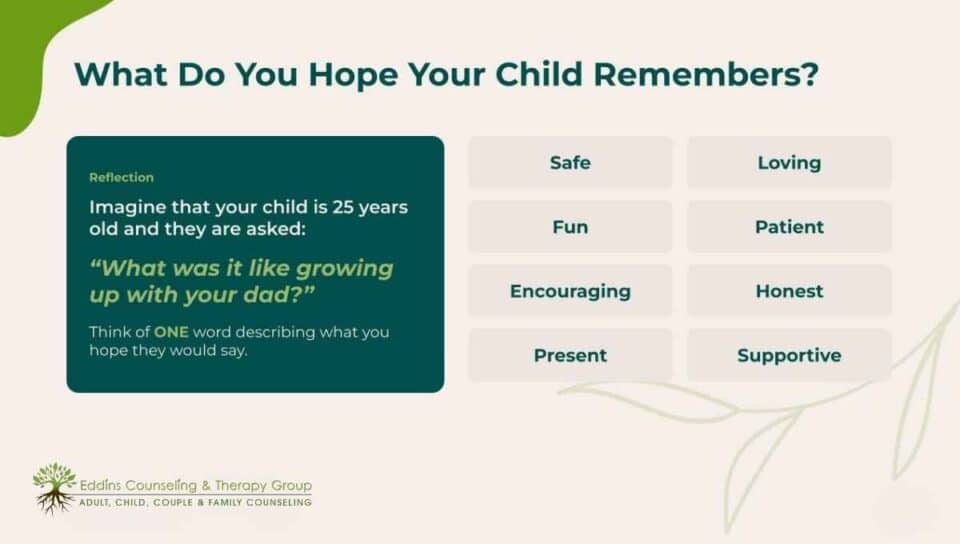
We’d like everyone to take a moment to imagine something. Imagine your child is 25 years old. They are talking with a friend, a spouse, or maybe even one of their own children. Someone asks them, “What was it like growing up with your dad?” What is one word you hope they would use to answer that question?
Maybe it is safe, loving, fun, patient, encouraging, honest, present, or supportive. Or maybe another word comes to mind that reflects the kind of father we hope to be. Take a moment to think about our answer.
As we think about our response, notice that most of these words are not about achievements, money, or material things. They describe how a child feels in the relationship with their father. That is exactly what we will be exploring today. The goal is not to become perfect fathers. The goal is to build the kind of relationship our children will remember long after childhood is over.
Fathers Matter
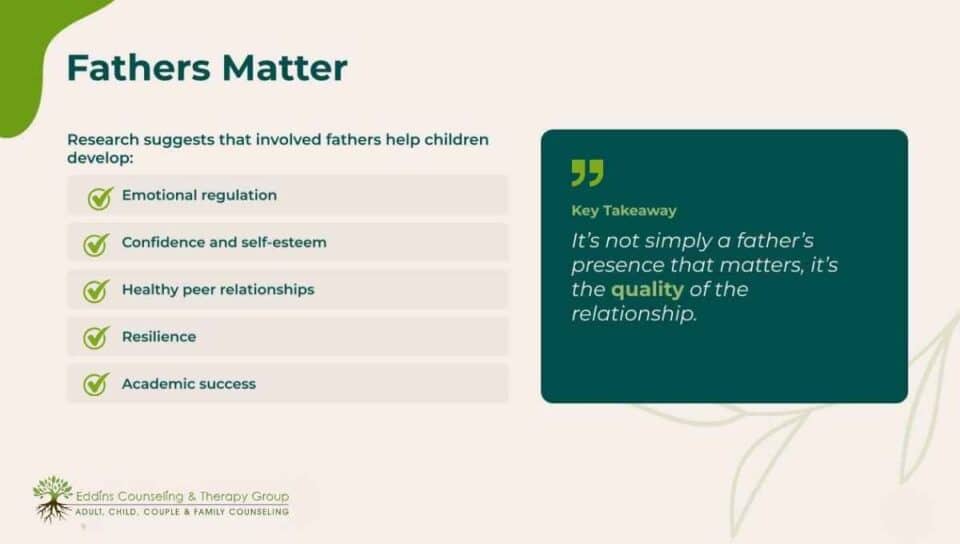
So, does research support the idea that these everyday interactions shape what children remember? Let’s take a look.
For many years, parenting research focused primarily on mothers. Over the past several decades, however, researchers have increasingly recognized the unique and lasting contributions fathers make to their children’s development.
Children with involved fathers are more likely to develop stronger emotional regulation, greater confidence, healthier friendships, resilience, and positive academic outcomes. But here’s an important distinction: research doesn’t suggest that children simply benefit because a father lives in the home.
Rather, children benefit from how fathers engage with them: warmth, responsiveness, encouragement, playing together, listening, and showing genuine interest. Those everyday interactions have a meaningful influence on how children develop emotionally and socially. This can be encouraging because strengthening our relationship with our children doesn’t require perfection or expensive experiences. It starts with ordinary moments of connection.
So why do those ordinary moments have such a powerful impact?
Every Child is Asking Two Questions
- Am I safe?
- Will you be there when I need you?
Everything we’ve talked about so far leads us to one of the most important ideas of the evening. Children don’t think in psychological terms. They’re not asking themselves, “Do I have secure attachment?” Instead, through their behavior, they’re constantly asking two questions: Am I safe? Will you be there when I need you?
A toddler asks these questions by reaching for a parent after falling down. A 6-year-old asks by excitedly saying, “Dad, come look at this!” A teenager might ask by quietly sitting next to you after a difficult day instead of talking. Even adult children ask these questions when they call home after receiving bad news. The behavior changes, but the need doesn’t.
Children of every age want to know, “Can I count on you?” Those repeated experiences of feeling safe and supported become the foundation for how children view themselves, other people, and relationships throughout their lives. So if children are asking those two questions every day, how do they learn the answers?
What Attachment Really Means
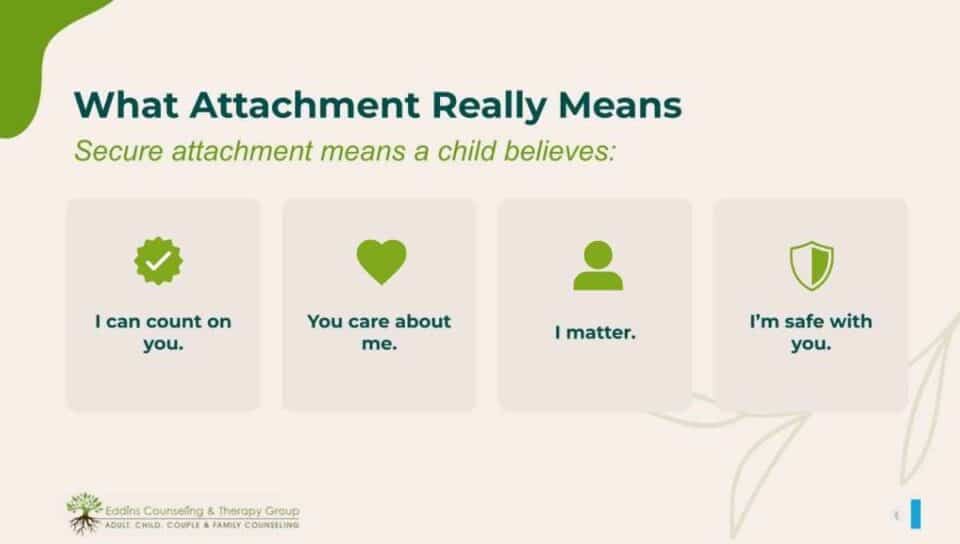
This is where attachment comes in. Attachment isn’t about children becoming dependent. It’s actually the opposite. When children know they have someone dependable behind them, they become more confident exploring the world.
British psychiatrist John Bowlby describes caregivers as providing two important roles. First, a safe haven: someone children can return to when they’re scared, overwhelmed, or hurt. Second, a secure base: someone whose support gives them the confidence to explore, take healthy risks, and become more independent.
Think about teaching a child to ride a bike. A child is much more likely to pedal away when they know someone is nearby if they need help. Relationships work the same way.
When children consistently experience warmth, responsiveness, and support, they begin to believe, “I matter. People can be trusted. I’m not alone.” And those beliefs shape relationships throughout life.
The encouraging part is this: attachment isn’t built through one perfect moment. It’s built through thousands of ordinary interactions over time.
Now that we understand what children are really looking for, let’s talk about what those needs look like as children grow and why connection matters at every stage of development.
Connection Changes as Children Grow
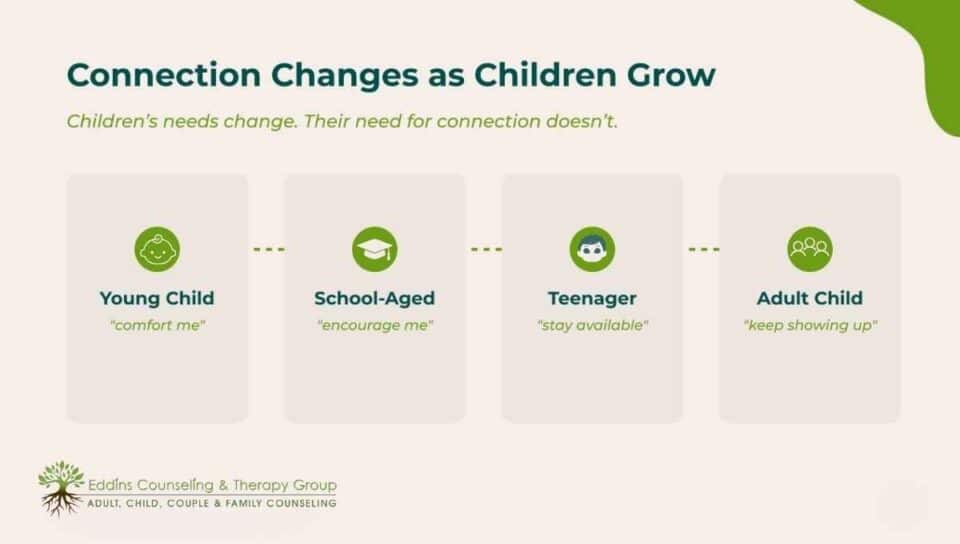
One of the biggest misconceptions about attachment is that it’s only important during infancy. The truth is that attachment doesn’t disappear as children grow. It simply changes how it looks. A toddler might ask for connection by reaching for our hand. A school-aged child may ask us to watch them perform in a school play or tell us every detail about their day.
Teenagers often look very different. Sometimes they’ll push us away. Sometimes they’ll barely say a word. And sometimes they’ll pretend they don’t need us. But underneath that growing independence, it’s often the same question: Will you still be there if I need you?
Even our adult children continue asking this question when they call us after a breakup, a job loss, or when they become parents themselves. Connection doesn’t end; it evolves. Our challenge as fathers is learning to recognize what connection looks like during each season of our child’s life.
So if connection looks different at every age, what does it actually look like in everyday life?
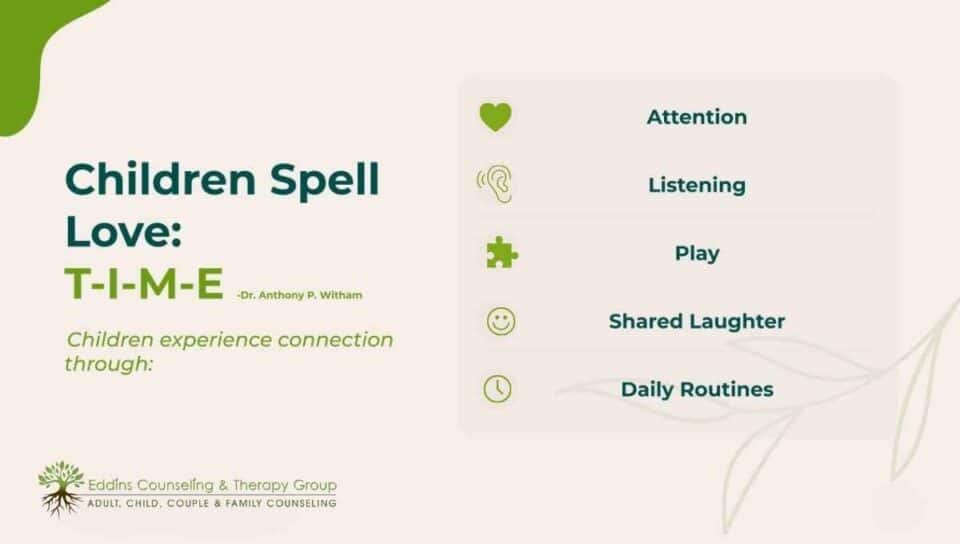
When people hear the phrase “spend more time with your kids,” it can feel discouraging. Many fathers immediately think, “I don’t have more time.” Here’s the encouraging news: research doesn’t suggest children need elaborate vacations or expensive experiences. Children build security through ordinary moments: the bedtime story, the conversation on the drive home, playing catch in the backyard, helping make breakfast on the weekends, or laughing together while folding laundry.
Those ordinary moments send extraordinary messages. They tell children, “I enjoy being with you. You’re worth my attention. I’m interested in your world.” Children rarely remember every toy they received, but they remember how they felt when they were with us.
Sometimes those moments are joyful. Sometimes they’re much harder.
Children Don’t Need Perfect Fathers
This may be one of the most freeing ideas we’ll think about tonight. Many parents believe one mistake can ruin a relationship. That’s simply not what research tells us. Parents lose patience. We raise our voices. Or we misunderstand our children. We’re human.
Psychiatrist Donald Winnicott introduced the idea of the good enough parent. Children don’t need parents who never make mistakes. They need parents who are generally responsive and willing to reconnect after those mistakes happen.
Imagine a father who loses his temper. Later, he comes back and says, “I was frustrated, but I shouldn’t have yelled at you. I’m sorry. Can we try again?” What does that teach?
It teaches accountability, humility, and forgiveness. Most importantly, it teaches that relationships can recover.
If perfection isn’t the goal, what is?
Children don’t need us to have every answer.
They don’t expect us to solve every problem. At their core, children want to know four things: I matter. I’m loved. I’m safe. You’ll be there for me.
Think about those messages for a moment. They’re communicated in very ordinary ways: making eye contact, putting our phones away, listening before giving advice, showing up to the game, or reading another bedtime story even though we’re tired. Those moments may seem small to us. To children, they are answering life’s biggest questions.
So if we know what children need, why is it sometimes so difficult to give it?
Let’s pause here before we move into practical strategies. Everything we’ve discussed sounds wonderful, but many fathers are probably thinking, “I want to do these things. I’m just exhausted.”
Between work, financial pressure, technology, busy schedules, and everything else life throws at us, connection isn’t always easy. This presentation is not about creating guilt. It’s about creating hope because research consistently suggests that small, intentional moments of connection can make a meaningful difference.
You don’t have to become a different father overnight. And you don’t have to do everything perfectly. You simply have to begin noticing the moments that are already available to you.
So what are the biggest barriers that make connection difficult for fathers today? Let’s talk about that.
Most Fathers Are Doing the Best They Can
Most fathers don’t struggle because they don’t care. They struggle because they’re trying to balance:
- Work
- Time
- Financial Pressure
- Technology
- Fatigue
- Family Responsibilities
Let’s pause for just a moment and acknowledge something. Many parenting presentations unintentionally leave parents feeling guilty. That’s not our goal today. Most fathers don’t wake up thinking, “I hope I’m less patient today,” or “I hope I ignore my child tonight.” Most fathers are doing the very best they can with the resources, energy, and time they have.
The reality is that fatherhood today can feel overwhelming.
Many fathers are balancing work responsibilities, financial pressure, family commitments, household responsibilities, and the desire to be present with their children. By the end of the day, there simply isn’t much left in the tank.
If you’ve ever ended the day thinking, “I wish I’d been more present today,” you’re not alone. The encouraging news is that strengthening connection doesn’t require becoming a different father overnight. It begins with small, intentional choices.
As we think about what’s competing for our attention when we’re with our children, one thing becomes clear: you’re not alone. Many fathers are carrying similar burdens.
The Messages Many Men Grew Up Hearing
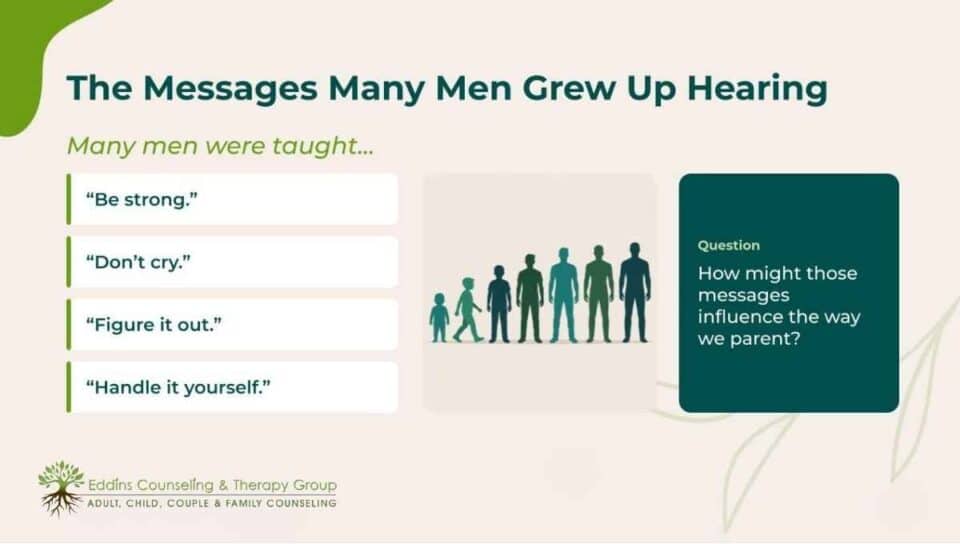
Let’s think back for just a moment. Many of us grew up hearing messages like, “Be strong,” “Don’t cry,” “Figure it out,” and “Handle it yourself.” For some of us, these messages were spoken directly. For others, they were simply modeled.
Now, resilience is important, but sometimes these messages also taught us something unintended: that emotions should be hidden.
Here’s the challenge: if no one helped us understand our emotions, it becomes much harder for us to help our children understand theirs.
Children don’t just listen to what we say; they watch how we respond when we’re frustrated, how we apologize, how we manage disappointment, and how we express love. Whether we realize it or not, we’re teaching emotional skills every single day.
The experiences we had growing up don’t determine who we’ll become as fathers, but they do influence us.
We Often Parent the Way We Were Parented
Our childhood influences:
- Relationships
- Communication
- Trust
- Affection
- Conflict
One of the most important things we’ve learned throughout our educational and clinical journey is this: We often parent from what we experienced.
If encouragement was modeled, encouragement feels natural. If criticism was common, criticism may become automatic. And if emotions were welcomed, we’re often more comfortable with emotions. If emotions were ignored, we may not know what to do with them.
This isn’t about blaming our parents. Most fathers did the best they could with what they knew. It’s simply about becoming aware. Awareness gives us the opportunity to choose something different. One of our favorite sayings is, “Awareness creates choice.” The moment we recognize a pattern, we gain the ability to decide whether we want to continue it.
If awareness creates choice, what choices make the biggest difference?
Children Need Connection Before Correction
When children misbehave, our first instinct is often to correct behavior. That’s understandable. But children communicate through behavior long before they can explain what they’re feeling. A tantrum, silence, defiance, withdrawal. Sometimes those behaviors are asking for something deeper.
Curiosity helps us slow down. Instead of immediately asking, “What’s wrong with this behavior?” we might ask, “What could my child be trying to tell me?” That doesn’t mean there shouldn’t be consequences. It simply means connection often opens the door to more effective correction. Children are much more likely to listen once they feel understood.
So what does connection actually look like in everyday life? Let’s explore five habits that research tells us strengthen father-child relationships.
We want to leave this section with one encouraging thought. If today’s presentation has felt overwhelming at all, take a deep breath. You don’t have to change everything. Research consistently shows that relationships are strengthened through small moments repeated over time. One bedtime story, one meaningful conversation, one apology, one family meal, one phone put away, one hug.
Those moments may seem ordinary today, but years from now, they become the memories your child carries into adulthood. Every father watching can begin with one small change, and that’s exactly where we’re going next.
Five Everyday Habits
Let’s look at five everyday habits that build trust, strengthen connection, and help answer those two questions every child is asking: Am I safe? Will you be there when I need you? These habits don’t require perfection. They simply require intention.
Message #1
“You matter.”
Children feel valued when we:
- Give them our attention
- Make eye contact
- Put distractions away
- Enjoy being with them
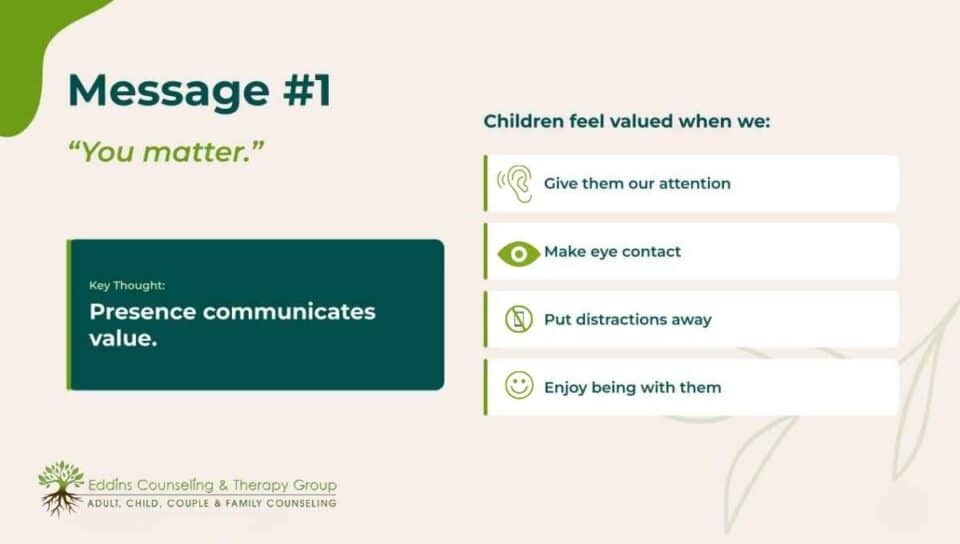
If we asked every parent here, “Do your children matter to you?” every hand would go up. The better question is, “How do our children know they matter?” Children don’t measure love the way adults do. They don’t count the hours you work to provide for them.
They don’t see the bills you paid or the sacrifices you made behind the scenes. And they experience love through attention. When we stop what we’re doing, look them in the eyes, listen, laugh with them, and play with them, we communicate something incredibly powerful: “You’re important to me.” This doesn’t require hours every day. Sometimes it’s five uninterrupted minutes after work.
Sometimes it’s putting your phone away during dinner. And sometimes it’s sitting on the floor and letting them explain a game you don’t fully understand. Presence says, “I enjoy being with you.” That’s a message children never outgrow.
Feeling important is one part of secure relationships. The next message may be even more powerful.
Message #2
“I’m interested in your world.”
Instead of:
- “How was school?”
Try:
- “What made you smile today?”
- “What was hard today?”
- “Tell me more.”
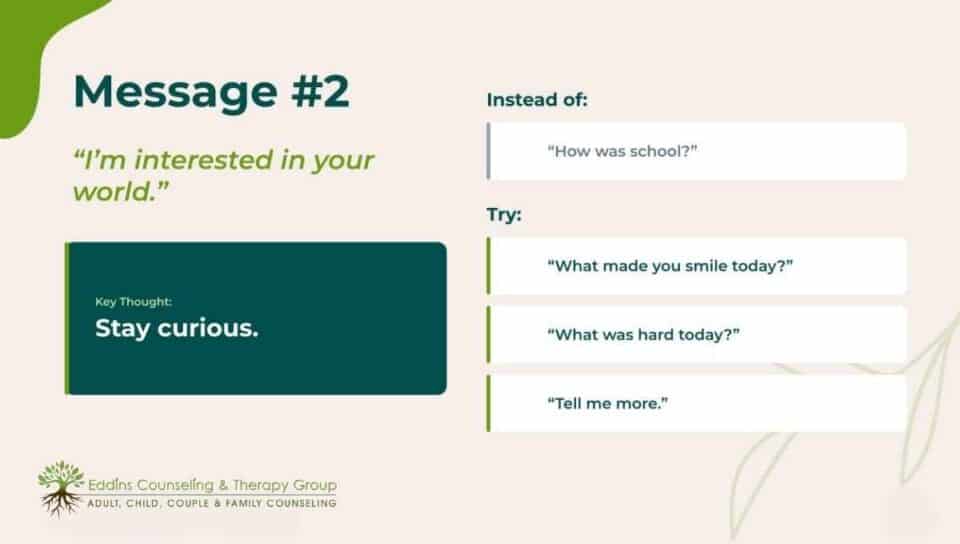
As parents, we often ask questions without realizing they’re difficult to answer. “How was school?” Most children respond with, “Fine.” Instead of asking questions that end the conversation, try asking questions that invite one.
Questions like, “What made you laugh today?” “What was the hardest part of your day?” “If you could change one thing about today, what would it be?” Notice these questions communicate curiosity.
Children feel connected when they believe we’re genuinely interested in their experiences, not simply checking a parenting box. Curiosity also helps us understand what’s happening underneath behavior. When children feel understood, they’re much more likely to continue sharing with us as they grow.
Sometimes our children don’t need answers right away. They need help understanding what they’re feeling.
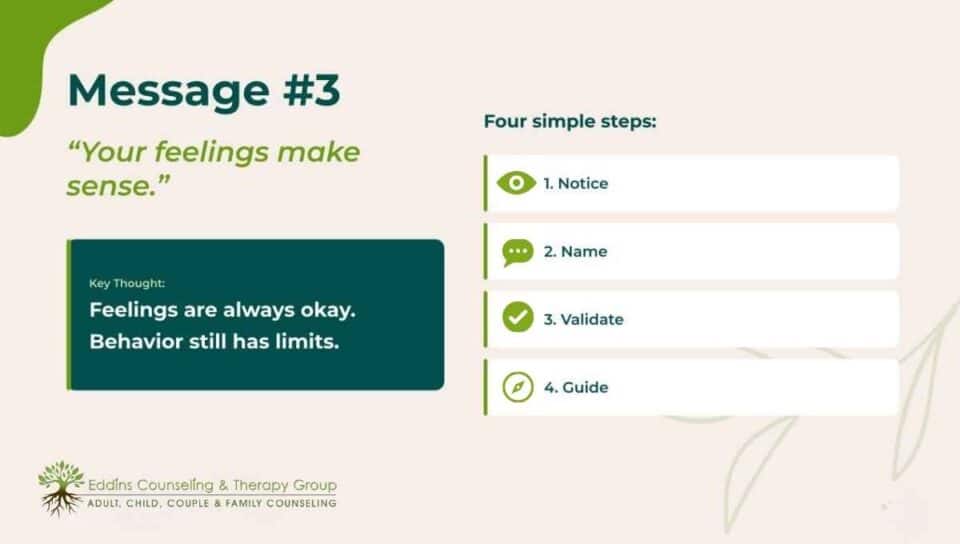
Message #3
“Your feelings make sense.”
Four simple steps:
- Notice
- Name
- Validate
- Guide
Think back to your own childhood. How were your emotions handled? Some of us heard, “You’re fine. Stop crying. Don’t be upset.” Today we know something different.
Children learn emotional regulation when adults first help them understand what they’re feeling. One approach comes from psychologist John Gottman‘s work on emotion coaching. The steps are simple.
First, notice: pay attention. Second, name the feeling: “You look disappointed.” Third, validate: “I can understand why you’d feel that way.” Validation doesn’t mean agreeing with every behavior. It simply means recognizing that the emotion makes sense. Finally, guide: “Let’s figure out together what to do next.”
Children don’t learn emotional regulation by having emotions ignored. They learn it by experiencing calm, connected adults. Even when we do all of these things well, we’re still going to make mistakes.
Message #4
“Relationships can heal.”
Repair looks like:
- “I’m sorry.”
- “I was wrong.”
- “Can we try again?”
- “I love you.”
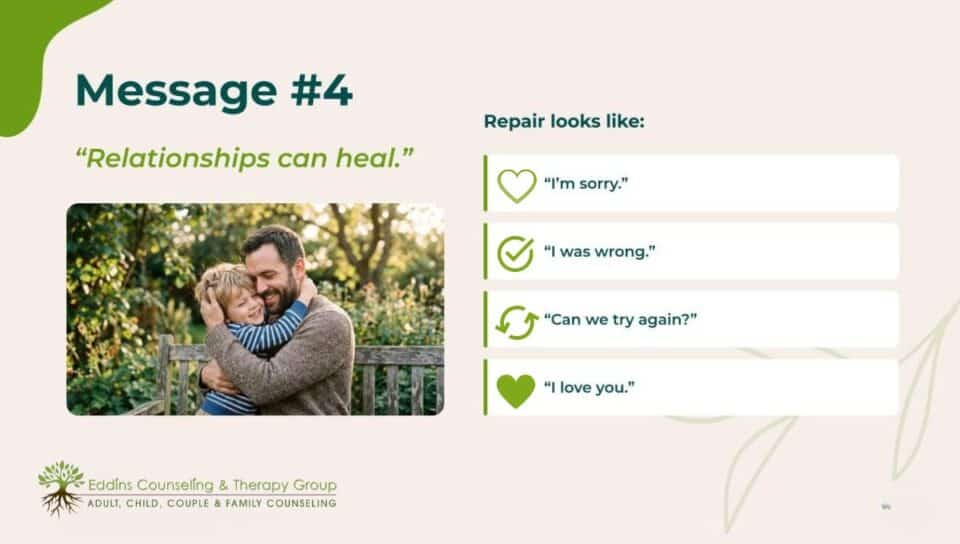
If we had to choose one slide for everyone to remember, it would probably be this one. Healthy relationships aren’t relationships without conflict. Healthy relationships are relationships where people reconnect after conflict. Imagine this: a father comes home after a stressful day. His child spills milk.
He raises his voice. The child begins crying. At that moment, he has two choices. He can pretend nothing happened, or he can come back 10 minutes later and say, “I was frustrated, but I shouldn’t have yelled. I’m sorry. Can we start over?”
That 30-second conversation may teach a child more about healthy relationships than a week without conflict ever could. Repair teaches children: people make mistakes, love doesn’t disappear after conflict, relationships can recover. That’s a lesson they’ll carry into every future relationship.
Message #5
“I love spending time with you.”
Connection grows through simple traditions:
- Bedtime stories
- Saturday pancakes
- Evening walks
- Family dinner
- Game night
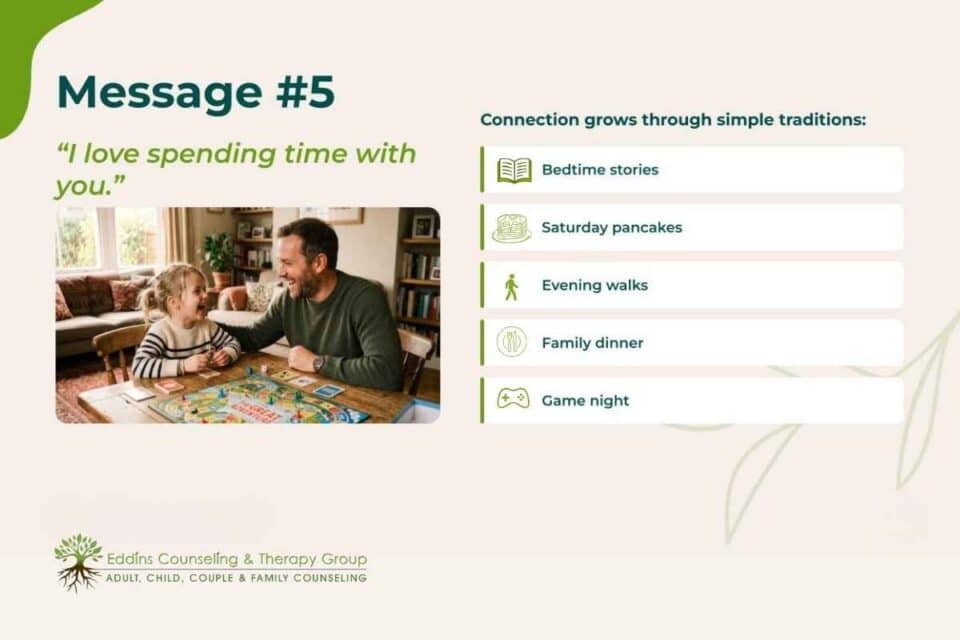
The final message isn’t something children hear. It’s something they experience. When people think about creating memories, they often think about vacations. Children usually remember something much simpler: Saturday morning pancakes, dad reading before bed, walking the dog together, stopping for ice cream after baseball practice. Family traditions don’t have to be elaborate. What makes them meaningful is their consistency. These repeated moments become emotional anchors.
Years later, children often remember the routine far more than the activity itself. Traditions quietly communicate, “I enjoy spending time with you.” That’s one of the greatest gifts we can give.
Five Messages Every Child Needs
So let’s put all five messages together.
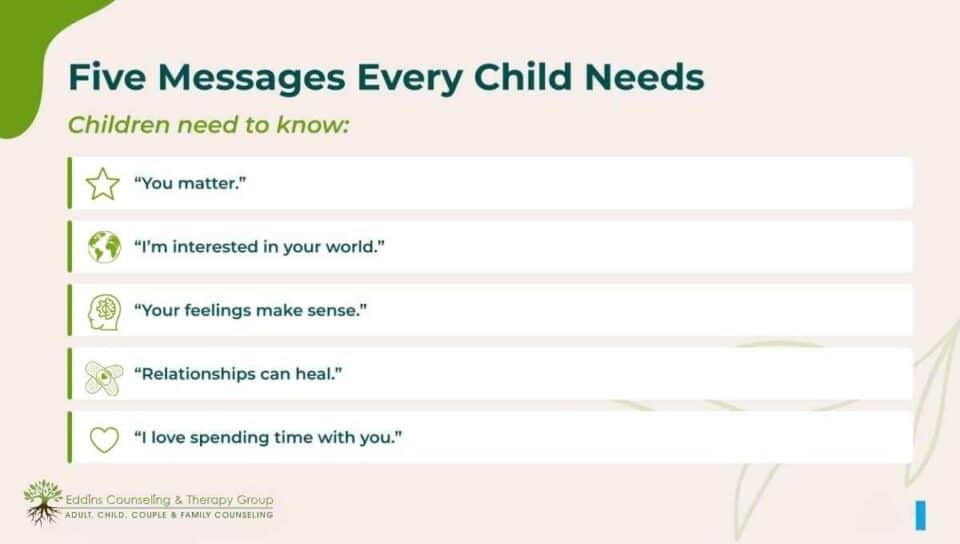
We want you to notice something. None of these messages require you to become a perfect father. None require expensive trips. And none require hours of free time. They’re communicated through everyday interactions: eye contact, curiosity, listening, repair, traditions, small moments, and repeated consistency.
When children experience these messages over time, they begin to believe, “I matter. I’m loved. I’m safe. I can count on someone.” That’s exactly what secure attachment is.
It Doesn’t Have to Be Perfect
Your child doesn’t need perfection.
They need someone who:
- Keeps showing up
- Loves them consistently
- Listens
- Repairs after mistakes
- Enjoys being with them
Many parents carry around the weight of believing they have to get everything right. The truth is, no parent does. Every father has moments they wish they could do over, days they’re distracted, times they’re impatient, and moments they lose their temper. That doesn’t mean you’ve failed.
Healthy relationships aren’t built because conflict never happens. They’re built because fathers continue to come back, continue to love, continue to listen, and continue to repair.
Children don’t need perfect fathers. They need fathers who keep showing up.
Your Challenge This Week
So instead of trying to change everything, we’d like to leave you with one simple challenge.
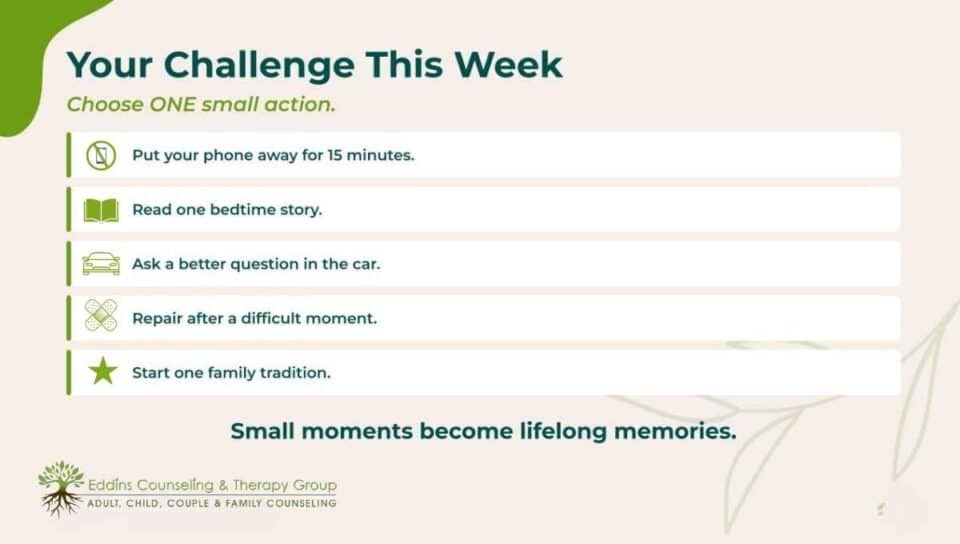
When we leave a presentation like this, it’s easy to think, “I should do all of these things.” But lasting change usually doesn’t happen that way. Research on behavior change tells us we’re much more likely to succeed when we begin with one realistic step. So don’t try to become a different father tomorrow. Instead, choose one thing: one bedtime story, one phone-free dinner, one meaningful conversation, one apology, or one family walk.
Small actions practiced consistently become habits. Habits become patterns. Patterns become relationships. That’s how meaningful change happens.
What Will Your Child Remember?
We’d like to end where we began. At the beginning of today’s presentation, we asked you to imagine your child as an adult. We asked what you’d hope they would remember about growing up with you. As we’ve talked today, we hope you realize something. Children may not remember every birthday present.
They may not remember every family vacation. They probably won’t remember every conversation. But they’ll remember what it felt like to be with you. They’ll remember whether home felt safe. They’ll remember whether they could come to you when life became difficult.
And they’ll remember whether they felt accepted, encouraged, and loved. Those memories aren’t created through one extraordinary day. They’re created through thousands of ordinary moments. And here’s the encouraging part: no matter what yesterday looked like, tomorrow is another opportunity to build connection.
Thank you for allowing us to spend this time with you today.
References
Ainsworth, M. D. S., Blehar, M. C., Waters, E., & Wall, S. (1978). Patterns of attachment: A psychological study of the strange situation. Lawrence Erlbaum Associates.
Bowlby, J. (1982). Attachment and loss: Vol. 1. Attachment (2nd ed.). Basic Books. (Original work published 1969)
Cabrera, N. J., Volling, B. L., & Barr, R. (2018). Fathers are parents, too! Widening the lens on parenting for children’s development. Child Development Perspectives, 12(3), 152–157. https://doi.org/10.1111/cdep.12275
Fiese, B. H., Tomcho, T. J., Douglas, M., Josephs, K., Poltrock, S., & Baker, T. (2002). A review of 50 years of research on naturally occurring family routines and rituals: Cause for celebration? Journal of Family Psychology, 16(4), 381–390. https://doi.org/10.1037/0893-3200.16.4.381
Gottman, J. M., Katz, L. F., & Hooven, C. (1997). Meta-emotion: How families communicate emotionally. Lawrence Erlbaum Associates.
Lamb, M. E. (Ed.). (2010). The role of the father in child development (5th ed.). John Wiley & Sons.
Puglisi, N., Rattaz, V., Favez, N., & Tissot, H. (2024). Father involvement and emotion regulation during early childhood: A systematic review. BMC Psychology, 12, 675. https://doi.org/10.1186/s40359-024-02182-x
Sarkadi, A., Kristiansson, R., Oberklaid, F., & Bremberg, S. (2008). Fathers’ involvement and children’s developmental outcomes: A systematic review of longitudinal studies. Acta Paediatrica, 97(2), 153–158. https://doi.org/10.1111/j.1651-2227.2007.00572.x
Siegel, D. J., & Bryson, T. P. (2020). The power of showing up: How parental presence shapes who our kids become and how their brains get wired. Random House.
Winnicott, D. W. (1965). The maturational processes and the facilitating environment: Studies in the theory of emotional development. International Universities Press.
Feel free to visit additional resources:
1. Articles on specific topics on our blog.
2. RSVP for one of our free monthly webinars (or view past webinars)
3. Follow us on Facebook and Instagram for additional interviews and tips
4. Take another one of our self-test quizzes
5. Schedule a consult and find out how we can support you.
If you have any questions or would like additional information, our team is always here to support you. If you’re interested in exploring services at Eddins Counseling & Therapy Group, we offer in-person counseling at two convenient Houston locations: our Heights office near T.C. Jester and our Montrose office on West Alabama. We also provide virtual counseling and therapy services for added flexibility and accessibility.
We offer a variety of services, including individual therapy, play therapy, career counseling, trauma-informed therapy, EMDR, Brainspotting, and many other approaches designed to support children, teens, adults, couples, and families.
To learn more about our services or schedule an appointment, give us a call at 832-559-2622 or schedule online. We’re here to provide compassionate support whenever you need it.