

June 12, 2025
Webinar: From Selfless to Self-Full: A New Way Forward for Women
Written by Guest Author
Posted in Emotional Eating & Body Image, Self Help / Personal Development, Webinars and with tags: positive self-talk, self improvement, webinar

For generations, women have been told who they should be. The caretaker. The nurturer. The one who keeps it all together—without complaint, without rest. We’re taught to prioritize everyone else’s needs above our own, and even as the world changes, those deeply ingrained expectations still cling to us, whispering that we’re only good enough if we’re giving everything we have.
Sound familiar? You wake up already tired, carrying the mental load of work, family, relationships, and the unspoken rule that asking for help is a weakness. The pressure to do it all (perfectly) never lets up. But the truth is, being everything to everyone is not a sustainable way to live. The cost of staying stuck in selflessness is high: burnout, compassion fatigue, increased anxiety and depression, and relationships strained by unmet needs and unspoken resentment.
It’s time for something new. It’s time to shift from selfless to self-full.
Join Liz Glauser for an empowering webinar, From Selfless to Self-Full: A New Way Forward for Women, and explore how to break free from outdated expectations and rewrite the rules—without guilt, without shame. This event is for women who are ready to stop surviving under impossible standards and start thriving in their truth.
Through honest conversations and practical strategies, you’ll learn how to:
- Express your needs without fear
- Set boundaries that honor your peace
- Embrace self-care as a necessity—not a luxury
Liz brings years of experience supporting women who’ve reached their limit, feeling depleted by the pressure to do it all. As an inpatient therapist on an all-female unit, she’s helped countless women recognize the signs of emotional overload and reconnect with their worth. Her passion lies in helping women pause, reflect, and move forward—before burnout becomes a breaking point.
You deserve more than constant giving. You deserve rest, joy, and space to be fully you.
The shift begins here.
Watch a replay of the presentation here.
This webinar is facilitated by Liz Glauser. Liz has been a licensed social worker since December 2019, beginning her career in the inpatient psychiatric field. Her first week of training took place at the end of March 2020—right as the COVID-19 pandemic began, which presented a unique challenge as she learned to navigate inpatient work while the world was rapidly changing.
For over four years, Liz worked on a female unit where she supported women from all walks of life and at every stage, representing a wide range of educational, economic, racial, and ethnic backgrounds. Many of these women were experiencing some of the darkest moments in their lives, and through her work, Liz noticed a few common themes.
Often, the women she met gave too much of themselves to others without accepting support, asking for help, or finding an outlet to express their frustrations and emotions. This constant giving, without replenishment, frequently led to burnout and, unfortunately, the need for inpatient psychiatric care. Liz found it striking how this pattern transcended all backgrounds and experiences, reinforcing her deep interest in women’s issues and mental health.
This webinar, From Selfless to Self-Full is part of the Focus on Wellness program. The Eddins Counseling & Therapy Group offers a different webinar every second Thursday of the month. For example, in July, the webinar focuses on helping people manage teen stress. Those interested are encouraged to attend. Past webinars are also available for viewing, allowing participants to access recordings of topics that may be relevant to them.
Objectives
- To understand how outdated ideas continue to affect women’s mental health
- To explore the roles we’ve pre-set for ourselves
- To identify ways to break free from these traditions, live authentically, and lessen stress
We need to understand how outdated perceptions continue to affect women’s mental and overall health. It’s important for us to explore the roles we’ve, consciously or unconsciously, set for ourselves and to find ways to break free from these traditions so we can live authentically and reduce our overall stress.
Expectations for Women’s Roles in Society
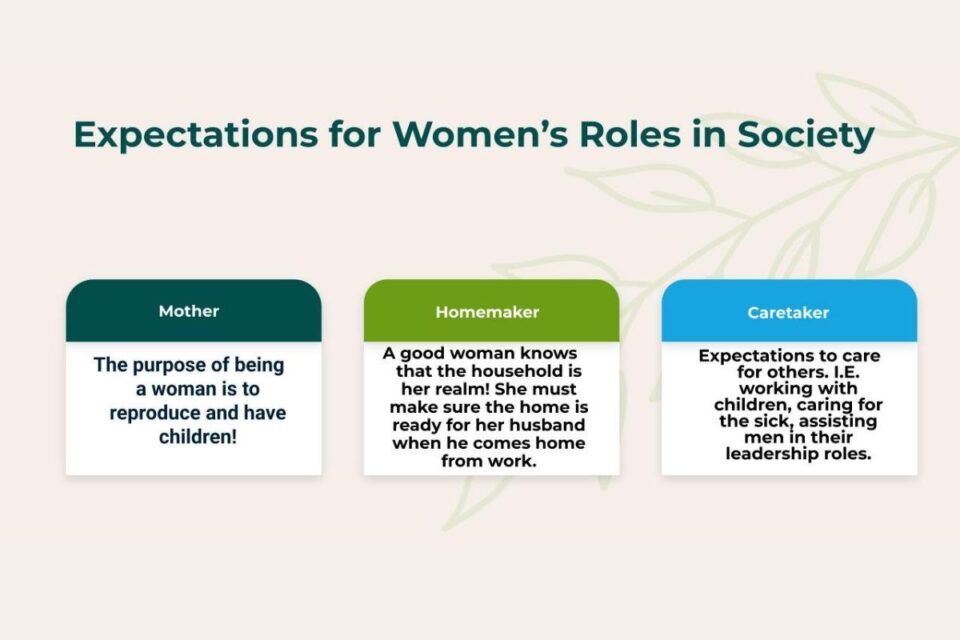
These are some of the outdated ideas about women’s roles in society. For a long time, women were expected to be mothers — our purpose was seen as having children and raising families. Then there was the homemaker expectation — the belief that a “good woman” keeps the household tidy and ready for her husband when he gets home. If we did work outside the home, the roles available to us were usually in caregiving or supportive positions.
Many of our mothers and grandmothers, for instance, were encouraged to pursue careers like teaching, nursing, or secretarial work — jobs that were considered “appropriate” for women at the time. And while these roles are absolutely valuable and meaningful, the key is that we should choose them because we love them, not because we feel pressured into them.
Women in History

The Impact of Societal Standards on Rosemary Kennedy
We can also look back at women in history — some well-known, some less so — to understand how societal expectations shaped their lives. One particularly tragic example is Rosemary Kennedy, sister to President John F. Kennedy and Robert F. Kennedy. She was believed to have an intellectual disability and some cognitive challenges, which became more apparent as she grew older. Yet, growing up, she was known as a bright, sociable young woman — beautiful, full of energy, and a beloved part of the Kennedy family’s social world.
Unfortunately, as Rosemary got older and her behavior became more erratic, her father, the patriarch of the Kennedy family, decided that her situation was not a good image for the family. Without consulting his wife, he took matters into his own hands, and she was tragically lobotomized at the age of 23, leaving her with the mind of a two-year-old. Because she didn’t fit the standards of what the family was “supposed” to look like, her father made a decision that not only bypassed his wife but also destroyed Rosemary’s personality and her ability to function independently.
Katherine Switzer and the Power of Perseverance
A more uplifting story is that of Katherine Switzer, shown in the photo here. In 1967, she faced assault simply for running the Boston Marathon, which at the time was restricted to men. To avoid being discovered, she registered under the name KV Switzer and wore a hoodie for most of the route. At one point, the hoodie came off, and one of the race co-directors jumped from the observation area, ran toward her, and tried to rip her bib off to remove her from the course.
Thankfully, Katherine’s coach and her boyfriend, who were running alongside her, were able to fend off the man trying to stop her, and she was able to finish the race. Something especially interesting is that she eventually became friends with the man who tried to stop her. Over time, she was able to change his perspective on traditional roles and advocate for allowing women to participate in running and marathons — a truly remarkable example of turning a challenge into progress.
Elizabeth Packard and the Struggle for Autonomy
The last story takes us further back in history. In 1860, a woman could legally be committed to an institution by her own husband, and that is exactly what happened in this case. Her husband, who was a preacher, had her committed because she began questioning their religious practices and was no longer acting as submissively as expected. She ended up institutionalized for three years before being released, officially declared “incurably insane” — a label that really reflected her refusal to conform rather than any true illness. Her release came only after her adult children demanded it, highlighting how societal and legal systems once severely restricted women’s autonomy.
Even after her release, her husband continued to imprison her in their home, which was illegal. While it was legal at the time for a husband to have his wife committed, it was not legal to hold her as a prisoner in their own home. They went to court, and she was officially deemed sane. After that, she spent the rest of her life advocating not only for the rights of married women but also for the rights of people in asylums, having witnessed firsthand the mistreatment and abuse that occurred.
These stories highlight just a few of the women who broke traditional roles and faced serious consequences for doing so.
Continuing Problems for Women

On a different note, the photo shown here was taken during a visit to New York. We came across it unexpectedly; it wasn’t a planned stop or an official site. While reading the notes there, we discovered a large sign marking the gate as a place to write letters or leave flowers for loved ones who had been victims of violence.
Violence Towards Women
These were for women who had been victims of violence. As we read some of the notes, it was clear that some of the people had passed, while others had survived and were leaving messages of support for others. One note, in particular, stood out — the one in the top right corner that says, “Please forgive yourself.” It resonates because many women still carry feelings of self-blame for the violence committed against them.
When we look at the bigger picture, the World Health Organization has found that globally, one in three women has experienced physical or sexual violence. The majority of these cases involve intimate partner violence — meaning it’s not usually a stranger, but someone they know, often a romantic partner.
Many of us were taught from a young age to be hyper-vigilant and constantly aware of our surroundings. For example, when we got our first car keys, we might have carried a rape whistle. For holidays like Christmas, some of us received pepper spray, and in some cases, even unconventional items like wasp spray to keep in the car. These early lessons show just how normalized fear and self-protection have been in our upbringing.
Many of us were taught growing up that we always had to be aware, to protect ourselves, and to recognize that we could be a target — that danger could be around every corner. This constant vigilance can take a real toll, creating anxiety and stress. When we compare experiences, it’s clear there’s a huge disparity. For example, our male friends might go for a jog at night or walk alone to their car in a parking garage without a second thought, while many of us learned to carry keys between our fingers or take other precautions in similar situations.
Lack of autonomy
This reality reflects the broader context of violence against women, but it also connects to general issues around lack of autonomy. Many of us have encountered women, both in inpatient settings and in individual therapy, who have struggled to leave unhealthy or unsafe marriages.
Factors such as limited financial resources, manipulative or threatening partners, or being financially dependent can make it extremely difficult for women to safely exit these relationships.
It’s not only marital relationships — this can also apply to other partnerships. Usually, there can be a power disparity, and unfortunately, a lot of the time, it’s the woman who has less power in that situation. Many of us have worked with people trying to figure out how to leave a relationship without being left with nothing or being deemed unfit to be a parent because they don’t have the resources. Questions like, “Will this person give me anything if I were to divorce them?” often come up, so leaving a relationship can become very complicated.
There’s also, without getting too political, the issue of new laws that are stripping women of bodily autonomy. There’s a definite lack of autonomy in other ways, too. For example, childcare is still very much expected to be the woman’s responsibility in a relationship.
Misogyny
Studies show that moms are almost always the first ones schools call when a child is sick to come pick them up — not dads. Childcare itself is often difficult to find, inaccessible, or unaffordable, adding yet another layer to the challenges women face.
And oftentimes, it’s the mom who has to figure that out or who feels more pressure to take on the responsibility — not every time, obviously, but quite often. It’s interesting, so let’s look at the men’s side for a moment. There’s a lack of paternity leave, or the amount of time men are allowed to be home with their child is much shorter than what women get.
Even in very equal relationships, men sometimes aren’t given the opportunity to create the same bond with their child, and the shorter leave time means it’s often expected that women will take on the majority of childcare while men go to work. So there’s a clear disparity there as well.
Body and Self Image
Then there are the continuing issues with body image and self-image that women have been struggling with for decades. For this presentation, we looked at some of the old ads from the 1950s and 1960s, showing all the ridiculous things women were told they had to do to look better, feel better, or tighten their waist. If you take a moment to Google ads for women from the ’50s and ’60s, it’s wild — and it really shows that these pressures are nothing new.
The issue has become even more prevalent with the rise of the internet and social media. Many of us know people — or have experienced ourselves — the struggle of seeing what’s posted online and feeling the need to compare ourselves. Rationally, we know that what we see isn’t necessarily real or an accurate representation of someone’s life. Emotionally, though, it’s easy to feel self-conscious: Have we reached the same milestones as others? Why don’t we look like that person? Why haven’t we found the right partner? Why haven’t we reached certain goals?
Comparing ourselves to others continues to be a major issue, especially regarding body image and self-image. The internet has amplified this because we now have access to endless images, videos, and opinions from everyone, everywhere. It makes it even easier to feel inadequate or behind.
Mental Health Disparities
There are also ongoing mental health disparities to consider. For example, research shows differences in how men and women are treated in mental health care. A man and a woman could describe the same symptoms to a psychiatrist or mental health professional, but the woman is more likely to be diagnosed with depression.
Women are more likely to be prescribed psychotropic drugs, such as antidepressants, compared to men. We are also less likely to disclose alcohol use or a history of violent victimization unless directly asked — two critical pieces of information for effective mental health care. This often ties back to self-image issues and a reluctance to reveal anything that might be judged.
Human Giver Syndrome
There are some terms that help describe these patterns. One is Human Giver Syndrome, first coined by feminist philosopher and author Kate Mann. It’s discussed heavily in the book Burnout: The Secret to Unlocking the Stress Cycle, which is a great read.
Human givers must, at all times, be pretty, Happy, calm, generous, and attentive to the needs of others, which means they must never be ugly, angry, upset, ambitious, or attentive to their own needs. Givers are not supposed to need anything. Your body, with its instinct for self-preservation, knows on some level that human giver syndrome is slowly wearing you down.
We can think of Human Giver Syndrome as the feeling that no matter how much we do — at work, for our kids, or around the house — it never feels like enough. Constantly feeling like we have to make sure everyone else is okay before we are okay can be a sign of human giver syndrome. This isn’t an official medical diagnosis, but rather a concept to help us understand certain patterns.
Not accepting help when it’s offered can also be a sign, because many of us see it as weakness: “No, I should be able to do this on my own. I don’t need help from anyone else.” Another sign is fearing or avoiding talking about our negative emotions because we are constantly pushing ourselves to the limit.
Human Giver Syndrome can lead to a couple of serious outcomes: compassion fatigue and burnout.
While they are similar, there are some differences. Burnout is usually caused by workplace stress, long hours, demanding workloads, or a lack of resources. Compassion fatigue, on the other hand, arises from the emotional toll of constantly witnessing or hearing about others’ suffering.
We saw compassion fatigue discussed a lot during COVID, especially in reference to what nurses and other frontline workers were going through. We know this happens a lot in any role where we are trying to help others — nurses, teachers, therapists, and really any caregiver role. It could even be a stay-at-home mom or anyone who regularly sees other people struggling.
Burnout tends to develop more gradually over time as stressors accumulate, while compassion fatigue can have a quicker onset. Compassion fatigue may result from witnessing a single traumatic event or from experiencing a series of smaller, emotionally taxing events. Burnout often brings feelings of exhaustion, cynicism, and reduced efficiency. Compassion fatigue, on the other hand, centers on the emotional residue of helping others, which can make us feel more detached or reduce our empathy. Sometimes it feels like we brush things off more than we normally would, unless someone is experiencing an extremely distressing event.
Both burnout and compassion fatigue can affect our ability to cope, and unfortunately, that can lead to unhealthy coping mechanisms such as substance use, self-harm, or suicidal ideation. It could be impulsive spending, maxing out a credit card, or turning to any number of unhealthy outlets when we have no other way to release stress.
Steps We Can Take
So, what can we actually do about it? This is probably the part we’re most interested in — practical strategies to manage stress and protect our well-being. Here’s a list to consider:
- Advocate for your rights and the rights of others
- Completing the Stress Cycle
- Self-Care
- Verbalizing and Enforcing Boundaries
Advocate for your rights and the rights of others
- Stand up for yourself in every environment – at work, at doctor’s appointments, in school, in public
- Notice the disparities around you and ask how to help
- Volunteering can be rewarding (just don’t overdo it)
- Get involved in causes you care about
Advocating for ourselves is key. Many of us, especially women, have experienced situations in the medical field where symptoms are brushed off as anxiety, PMS, or something minor. I’ve met many women who needed to actively advocate for a correct medical diagnosis because their concerns were dismissed or minimized.
Advocacy also applies to work, school, or other areas of life. If we notice disparities in treatment compared to male counterparts, pay inequities, or disrespectful behavior, it’s important to speak up. Learning to stand up for ourselves and assert our needs is a crucial part of protecting our mental and emotional health.
We might notice disparities around us and wonder how we can help, even in small ways. Volunteering can be especially rewarding — it’s a form of advocacy because we’re helping others. It’s important, though, to put a little star by this idea: we don’t want to overdo it. The focus is on caring for ourselves, not taking on too much for others. Still, if we find a cause we truly care about, volunteering or getting involved can feel very rewarding and give us a sense of, “I’m actually doing something about this.” This is where the idea of advocacy comes in.
The Stress Cycle
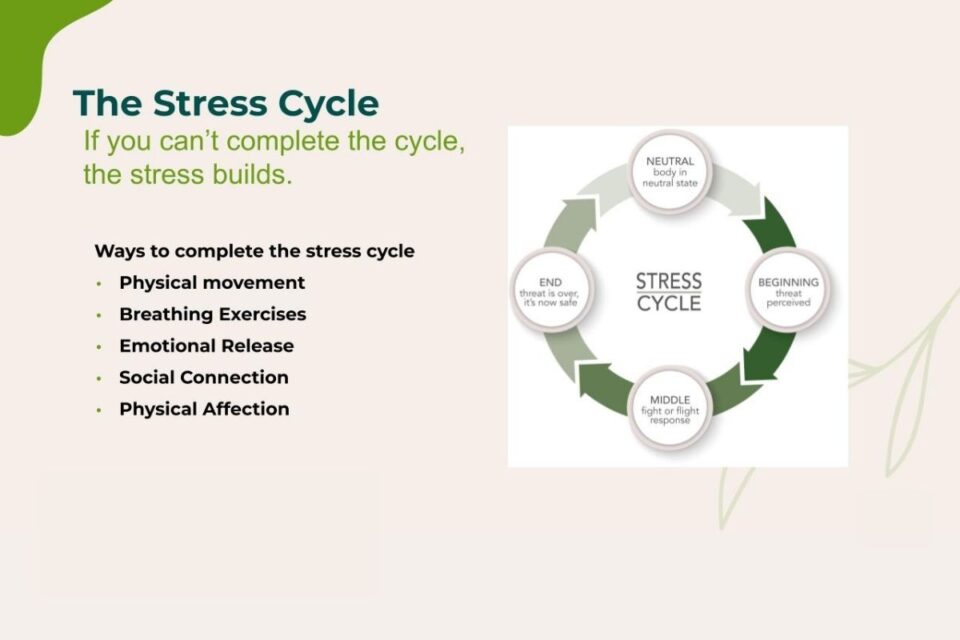
Next is the stress cycle, which is discussed heavily in the book Burnout that we mentioned earlier. As shown in the little clip, our bodies start in a neutral state. Then a perceived threat occurs – this could happen at work, for example. We get to work and something’s already off: maybe the computers are down, and we don’t know what to do. At that moment, we start to move into the fight-or-flight response.
We might find ourselves thinking, “Do I just bail on work and get out of here, or do I try to figure something out to get through the day?” Sometimes, even if we make it through the workday, the problem isn’t resolved — maybe the computers are still down, or things didn’t go as planned. When that happens, we haven’t actually completed the stress cycle. The threat isn’t over, and our bodies haven’t experienced the release of the stress. The cortisol continues to build up, and the stress lingers.
There are several ways we can complete the cycle. Physical activity is a big one — even little stretches or exercises can help release excess adrenaline and cortisol. Ideally, we aim for 20 to 60 minutes of activity daily, especially after a stressful event. Breathing exercises are another powerful tool. There are many different techniques, and some work better for different people. Sometimes just thinking about doing the exercises can help, but the key is taking deep, slow breaths to physically regulate our nervous system. It’s not just a couple of quick breaths; sitting mindfully for at least five minutes can have a real physiological impact.
Emotional release is another important method — what we might call a good old-fashioned cry. Some of us may feel embarrassed about crying, but it’s perfectly natural and can be physically healthy. Crying allows pent-up emotions to be released, helping reduce the cortisol that has built up. Of course, if someone is crying all day, every day, or is hypersensitive to everything, that may indicate a bigger issue. But when stress has piled up and emotions are bottled up, allowing ourselves to cry can be an important part of completing the stress cycle.
Many of us don’t realize that when we cry, we’re actually releasing cortisol, the stress hormone, through our tears.
At the same time, crying increases endorphins and oxytocin in our brain — the “happy chemicals.” Physically, this helps us feel better by reducing stress hormones and boosting neurotransmitters that make us feel good. Crying also activates the parasympathetic nervous system, which helps return our bodies to a neutral, calm state. This makes us feel relieved, relaxed, and ready to rest, while releasing some of the built-up stress. So if anyone ever tries to shame us for crying, we can confidently say, “This is good for me.”
Social connection is another important way to complete the stress cycle. This doesn’t have to be a big emotional discussion — it could be as simple as meeting a friend for a quick coffee, grabbing a bite after work, stopping by a friend’s house, making a phone call, or doing a FaceTime. Even small moments of connection help reassure our brains that things are safe and give us a sense of emotional support. Again, these strategies help reduce stress hormones and can make a big difference in how we feel.
Another effective method is physical affection. This is something many of us may not realize: a 20-second hug can significantly decrease physiological stress. Whether we see our child, partner, or a friend, a simple 20-second hug can make a noticeable impact. Physical affection signals to our bodies that we are safe and loved, helping to communicate that the perceived threat is over.
Self-Care
Put on your oxygen mask first before you help others
- Carve out time for doing what YOU love, doing what relaxes YOU, doing what heals YOU
- Remember, it is not selfish to take a break
- Take time off when needed
- Ask for help when it’s available
- It’s okay to not be okay
Self-care is equally important. We’ve all heard the phrase about oxygen masks on airplanes: we need to put our mask on first before helping others. This is not just a cliché — it’s essential. Carving out time to do what we love helps us relax and heal. Focusing on activities we enjoy and excel at can release stress, boost confidence, strengthen self-esteem, and allow us to reconnect with our identities. It reminds us to focus on what truly heals us, rather than constantly prioritizing the needs of others.
We need to remember that it’s not selfish to take a break. There’s almost this pride that comes with being exhausted all the time, or pride in doing too much, overworking, or constantly pushing ourselves. We’ve all had mornings where we drop the kids off at school at 7:00, have a meeting at 7:30, stay on the phone all day handling tasks, and then rush home to take care of everything else before finally getting a few hours of sleep. It can feel like a badge of honor to live like that.
We see how the perception of “hustle culture” is taking hold, so we have to remind ourselves: it’s okay to take a break. Some of us skip lunch and work straight through, while others push themselves to come to work even when sick because we feel we can’t take the time off, or worry about being judged if we do. But we need to take time off when it’s necessary. If we need a longer period to recharge, we can utilize FMLA, the Family and Medical Leave Act, for burnout or mental health needs.
If we feel like we need an extended time off from work, that’s an option available to us. We’ve helped many people fill out the paperwork for that. We could take up to 12 weeks, depending on how the paperwork is completed, the provider who fills it out, and how much time we actually need, since we usually have to put an end date on the request. If we need to take time off, FMLA can help protect our jobs.
In Texas, our company doesn’t necessarily have to pay us while we’re on leave, which is something to keep in mind. But we can take our leave knowing our job will be waiting for us when we return.
We need to ask for help when it’s available; we can’t stress this enough. So often we hear people say, “Does anybody offer to help me?” and the answer is yes, but we think it’s something we should handle on our own. The truth is, we don’t have to do it alone. It’s okay to accept help from a friend or family member if we need it.
It could be something logistical. Maybe we’ve gotten behind on things at home, and having someone come over to help clean could make a big difference. It could be as simple as someone bringing us coffee or giving us a ride to the airport. If someone offers help, or if we know someone who might be willing, we can even ask for help ourselves.
It’s okay to not be okay.
We can make the choice to stop saying we’re fine when we’re not. If someone asks, “Are you okay?” we can be honest and say we’re not really okay, depending on the situation. Of course, if it’s a coworker or an acquaintance, we might still just say, “Fine.” But if it’s a friend asking, we can share that we’re struggling, and we often find their responses incredibly supportive. Sometimes all they do is say, “Just let me know if you need anything,” and that simple offer can be so comforting.
It can start with accepting within ourselves that it’s okay to not be okay. Then, if we feel comfortable, we can share that with people we trust. For many of us, it takes time—sometimes decades—to realize it’s okay to tell others we’re struggling. When we get to that point, being honest with someone supportive can be really powerful. We can simply say, “I’m having a really hard day,” and be surprised by how heartwarming some responses can be.
Boundaries
- No more people pleasing!
- Assertiveness Respect
- Example Phrases:
- “I’m not comfortable with that”
- “I can’t do that for you”
- “Please don’t bring up that subject”
- “No”
- Therapistaid.com for free boundary worksheets and exercises
Another important topic is boundaries. We could probably spend a week talking about them because it’s such a huge subject with many different types and styles. Some of us have passive or porous boundaries, sharing too much with anyone and often unintentionally pushing others’ boundaries. Others have rigid boundaries, keeping people out and struggling to form personal connections.
The goal is to find a balance. Many of us, both in inpatient and individual settings, describe ourselves as people-pleasers, saying yes to avoid upsetting others, even when what we’re agreeing to isn’t beneficial for us and doesn’t serve our well-being.
We can practice saying no and learning how to verbalize our boundaries. It’s important to be assertive while still being respectful, which makes it easier for others to understand and accept. Some example phrases we can use include: “I’m not comfortable with that,” “I can’t do that for you,” “Please don’t bring up that subject,” or simply, “No.” Many of us have heard that “no is a complete sentence,” and it truly is. Admittedly, it can still be hard to say no, and sometimes we feel the need to add a little explanation—but the more we practice, the easier it becomes.
There’s a helpful resource many therapists recommend: TherapistAid.com. It’s a website with free handouts and worksheets, including plenty of material on boundaries. If we struggle with setting boundaries, we can use these worksheets to guide us. The site also has resources on other important topics like anxiety, coping skills, and emotional regulation, making it a valuable tool for self-care and personal growth.
Recommended Reading
A great resource is the book Burnout: The Secret to Unlocking the Stress Cycle. It covers a lot, including Human Giver syndrome and issues that often affect women. It explores topics like body injuries, sleep, and other practical information that can be really helpful. A workbook that accompanies the book was released a year or two ago, and we can use it alongside the book.
Many of us have found it very helpful when experiencing burnout. The book is full of highlighted sections, and when we ran groups at a psychiatric hospital, we would read from it and even order the workbook to make copies of the worksheets for patients. It’s been an incredibly useful resource for guidance and self-care.
Understanding the Stress Cycle and How to Break It
When it comes to the stress cycle and getting stuck in it, we recommend the book Burnout: The Secret to Unlocking the Stress Cycle. If we Google “how to get out of the stress cycle,” we’ll find tips similar to what we’ve discussed. One of the biggest ways to break the cycle is usually through physical exercise. Think of it this way: back in the day, humans had to hunt for their food, facing real threats like wild animals.
They had to fight for their prey, protect their village, and handle real, tangible danger. Once the hunt was over, the stress ended, and the cycle was visibly complete. Today, our stress often comes from things like a dying car battery or other problems that don’t have a clear beginning or end. That’s why it’s so important for us to do something that actively releases stress and cortisol, like physical exercise, crying, connecting socially, or practicing affection. And of course, maintaining our boundaries plays an important role in managing stress, too.
The Importance of Boundaries for Self-Care
We sometimes engage in self-sabotage because we don’t hold to our own boundaries, even though we want others to respect them.
It can be confusing—if we aren’t maintaining our boundaries, how can we expect others to honor them?
This is a question we hear often: What do we do if people continually disrespect our boundaries? It’s a common struggle, and it starts with understanding that respecting ourselves is the first step to having others respect us.
Boundaries are such a big topic that we could easily spend a week discussing them, and they take a lot of practice. The first step is really thinking about what our boundaries are. Sometimes we don’t even realize them until someone pushes us to that point. Once we have a clear understanding of our boundaries, the next step is learning to communicate them effectively.
Practicing and Enforcing Boundaries in Everyday Life
Being assertive yet respectful is key. One helpful approach is to use “I feel” statements—for example, “I feel [emotion] when [action happens].” It may feel a bit cheesy or stereotypical, but framing it this way makes it easier for others to digest. Even so, there are times when people will continue to push our boundaries, despite our clear communication and repeated requests. That’s when it becomes crucial to reinforce our boundaries consistently and protect our own well-being.
Sometimes it’s time for us to reevaluate certain relationships. The nature of the relationship matters; maybe this is someone we need to put some distance from. Other times, it could be a boundary where there’s room for a little compromise or patience. And then there are boundaries that are repeatedly crossed and are very important to us, where we may ultimately need to disconnect from the relationship to protect our well-being.
Boundaries can be especially challenging if people are used to us saying “yes” all the time.
It can be easier to start practicing with someone we feel might be more receptive and open. We can approach them by saying something like, “Things have been building up lately, and I feel like I can talk to you. This is something that’s been going on that has made me uncomfortable. Could you stop this action, or maybe not bring up this subject?” Practicing in a supportive context helps us build confidence in maintaining our boundaries.
We can start practicing boundaries with people we feel are more receptive and then gradually work our way to more challenging situations. It can be difficult because people may be used to us being the people pleasers, the one who always says “yes”.
Flipping that dynamic can feel strange, and others may react with surprise. Learning to set and enforce boundaries is a process—it doesn’t happen overnight. Practicing consistently is key, and resources like worksheets on TherapistAid.com or books on boundaries can be very helpful. If we are in therapy, boundaries are often a common focus, including verbalizing them, anticipating how others may react, and learning to advocate for ourselves and our needs.
Even when we communicate boundaries clearly, like telling family, “I’m going away for the weekend for self-care, please only call for medical emergencies,” people may still reach out about non-emergencies. It’s important to remind ourselves that answering these questions is not respecting our boundary; it’s not enforcing it. We have to consistently enforce our boundaries, even when it’s difficult.
For example, if someone calls about something minor, we can simply respond, “That’s something you’ll need to handle when I get home. I’ve got to go,” and hang up if needed. Enforcing boundaries takes practice, especially if we’ve spent decades being the person everyone expects to say yes.
This is a challenging issue for many of us, but with awareness, practice, and support, we can learn to set and maintain boundaries more effectively.
Thank you all for participating today, sharing your thoughts, and engaging in the discussion. We appreciate your input and hope these strategies help you in practicing self-care and boundary setting.
Feel free to visit additional resources:
1. Articles on specific topics on our blog.
2. RSVP for one of our free monthly webinars (or view past webinars)
3. Follow us on Facebook and Instagram for additional interviews and tips
4. Take another one of our self-test quizzes
5. Schedule a consult and find out how we can support you.
Learning to prioritize your own needs doesn’t mean becoming selfish—it means nurturing a healthy balance between giving and receiving. Whether you’re working on building self-love or addressing deeper emotional barriers that keep you from feeling fulfilled, you can begin to experience more peace, clarity, and confidence in your daily life.
Contact our therapists to learn more about how we can help you reframe your understanding of self-worth, boundaries, and emotional patterns. To get started now, give us a call to schedule an appointment at 832-559-2622 or schedule an appointment online. We also offer online therapy for convenience and flexibility.