

June 13, 2024
Webinar: How to Harness Motivation & Keep It: The Power of Solution-Focused Thinking
Written by Rachel Eddins
Posted in Career Planning, Self Help / Personal Development, Webinars and with tags: positive self-talk, self care, self improvement

How to Harness Motivation & Keep It: Are you tired of setting goals only to see them slip away? Do you struggle with motivation and find yourself relying on others to pull you out of your rut? You’re not alone. During this webinar, therapist Jennifer Oates will help us explore practical strategies to overcome obstacles related to goal-setting, depression, and burnout. Here’s what you’ll learn:
- Solution-Focused Thinking: Discover how to shift your mindset from problems to solutions. We’ll explore practical techniques to break free from cycles of hopelessness and self-doubt.
- Motivation Enhancement: Learn how to reignite your motivation, even when faced with difficult circumstances. Our expert presenter, Jennifer Oates, draws from Motivational Interviewing (MI) techniques to guide you toward positive change.
- SMART Goals Framework: Understand the power of setting Specific, Measurable, Achievable, Relevant, and Time-bound goals. We’ll help you create a roadmap for success, one step at a time.
Our webinar host, Jennifer Oates, a certified Motivational Interviewing practitioner, brings her expertise to help you navigate life’s toughest transitions. Whether you’re dealing with relationship challenges, addictive behaviors, or depressive episodes, Jennifer’s strengths-based approach will empower you to find your way forward.
Watch a replay of the presentation here.
This webinar is facilitated by Jennifer Oates. She is today’s presenter on the Focus on Wellness webinar, which is related to motivation and solution-focused thinking. Jennifer is a licensed professional counselor associate, and her supervisor is Heather Murphy, a licensed professional counselor supervisor.
This presentation is part of a monthly series of presentations delivered by a therapist at Eddins Counseling Group. These webinars are always free and they’re always delivered virtually. Participants include current clients of the practice who are invited via email, members of the general community, and other therapists. We’ve presented pretty much anything that you would ever want to know about, from couples’ communication strategies and parenting to grief, and symptoms of anxiety. You can access any of our past presentations by going on to the Eddins Counseling Group website, as well as signing up to attend upcoming presentations.
Objectives
- Shift your mindset from problems to solutions
- Learn what it takes to reignite motivation even in difficult circumstances
- Use the SMART goal framework to build a roadmap for success
Today’s objectives are pretty small when we look at them like this, but they’re big. When we look at them on a larger scale, we’re looking to shift our mindset from problems to solutions today and learn what it takes to reignite motivation, even in difficult circumstances. Sometimes it’s hard enough in regular circumstances, but we’re going to look at difficult, especially, and use the SMART goal framework to build a roadmap for success so you can feel confident meeting goals in the future.
What is Solution-Focused Thinking?

Solution-focused thinking is thinking that considers strengths and exceptions to a problem instead of fixating on the problem itself and where it came from.
When we think about problem-based thinking (problem-focused thinking), which is in mind how psychotherapy, psychiatry, and psychology have typically been conducted and evolved up until about the last three decades, it tends to feel more natural when we’re thinking about issues that we have to consider problems and barriers rather than naturally what our solutions and strengths are.
A good example is our medical system, which is very problem-focused and treatment-focused instead of preventative. In this example that we wrote, we tried to encapsulate that as clearly as possible.
So this first example of problem-focused thinking: “I’ve been depressed my whole life, and I just can’t imagine feeling any other way.” The related feeling when you hear that or say that is probably defeated. “I can’t imagine any other way. It’s been this way forever. I don’t really know what to do about that.” You may be hearing that as a therapist, hearing that as a client, or feeling that yourself.
When we look at it from a solution-focused thinking perspective, we think that you’ve been depressed your whole life, but you still found ways to get up each and keep on living, keep on doing what you’re doing.
How did you do that? And the hope would be that the feeling related to that different method of thinking of you’ve still found ways to get up and you’ve still found ways to do things. How did you do that?
The related feeling is typically more hopeful than defeated. Just addressing this first example, solution-focused thinking might sound initially like toxic positivity, which it can become if we’re not practicing it correctly. And so solution-focused thinking is actually a tenet of the positive psychology movement. But sometimes reframing our thinking into positive statements is inherently invalidating, and that’s what makes it toxically positive, and we have to recognize when we’ve gone too far.
Here are examples of ones that we hear a lot, which are: “Well, it could be worse.”, or “At least I don’t have those problems.”, like comparing to somebody else. We also hear comments that berate the person, essentially, for having them at all. And to say: “Oh, everything’s actually fine.” You’re just overreacting or just focusing on the positive.
That statement validates whoever this is, their lived experience, and doesn’t question it. But that acknowledgment and validation do coexist with the statement: “You’ve still found ways to carry yourself through because you’re sitting with me today.” This is going to be a key element throughout the presentation we want to encourage all of you to practice sitting with this idea that positive and negative don’t entirely barely negate each other in order for solution-focused methods to be effective. It’s more the mindfulness or that attention that pain can be validated and in the same breath, simultaneously motivate somebody, that it helps someone believe they can make their desired changes, but also acknowledges where they’ve been and how they’ve suffered to get there.
Train Your Brain to Think Differently

How do I make my thinking solution-focused?
- Reframe thoughts from what you can’t do to what you can do.
- Work with the exception, not the rule.
- Remove judgment from the picture.
- Treat trying to achieve goals like an experiment.
- Look to the future instead of the past.
- Practice, practice, practice!
How do we train our brains to think this way and do that on our own instead of having somebody correct us? The first one, which we’ve already covered is reframing, which is focusing on what we can do or what we do have instead of what we can’t do or don’t have. It’s challenging our assumptions and inferences about a situation like: “Oh, this performance review is going to be terrible.” instead of: “I’ve done a good job showing up on time”. So, focusing on what we do have to demonstrate that we are a good employee and that that’s all we can take with us to that performance review.
When it comes to emphasizing, exceptions instead of the rule is really important.
When we’re working with, like that example said, maybe you’re depressed all the time or you have been your whole life, but you’re still doing stuff. You’re still active. You’re still going places. Sometimes I even ask outside of that: “When was a time that you did feel happy? Maybe you were depressed most of the time, but you still encounter feelings of happiness or joy.”
We wonder what was happening during those times. That trains us away from the problem and into that strengths-based fold of: “Oh, I have felt this way before, and I can access that again because I did it and didn’t even know I was.”
In terms of removing judgment from the picture, that’s very much a second commitment therapy concept, the mindfulness concept. When we are sitting with ourselves, then it creates this aversion to what we’re trying to do because there’s so much pressure on ourselves, either internally or externally, to do it a certain way.
When we’re clouded by that pressure on ourselves, it makes it a lot harder to follow through with solving a problem. And so if we are thinking like one of those “it is what it is” phrases. Like, “I’m going to do my best, or these are the tools I have, and I’ll use them the way that I can.” Tying back into the reframe can help remove judgment from the picture when we’re talking to ourselves about getting something done.
Treating goals like an experiment also stimulates motivation because when we’re thinking of goals like experiments, it helps remove the problem like one step away from ourselves.
So that’s when we say externalization, like sometimes when we encounter a problem, it’s really easy to tie the problem to our own identity, to ourselves.
“If I don’t achieve this goal, then I’m a failure.” This kind of judgmental thinking is familiar. However, if we approach it with the mindset of, “I’ll try it this way for a while and see what happens,” then any mistakes are seen as part of the experiment, not a reflection of personal failure. This perspective helps us distance ourselves from self-judgment.
The last point here may seem to contradict the second point, which is we’re working with the exceptions, so we’re looking usually back into the past when things have gone maybe the way we wanted them to or thought we wanted them to.
Look to the future instead of the past.
We think of that more as an acceptance of what was the past story, the past struggles, and looking forward to what could be. An example would be looking back and telling yourself: “Well, I’ve never been able to do this before. Why would it work now?” And so that doesn’t really allow room for the acceptance that we’re in a different space now.
As much as those pieces of us are trying to warn us against messing up if that’s the only thing informing us on whether or not to try something or do it differently, then we’re not even giving ourselves a chance to embrace this new place that you’re at, whatever slight changes may have occurred between then and the last time the goal was set.
The biggest thing is to practice, practice, practice these things! These are not ways of thinking that societally we are promoted to think like. We’re promoted to think about problems and to focus on problems. And not think about how to do this differently. How could you use past experiences that went well to help this? So practicing this as much as you can to catch these reframing opportunities, working with exceptions, removing judgment, treating things like an experiment, and looking to the future, will really help make this line of thinking a lot more inherent.
Solution-Focused Language in Practice
Common Questions:
- Scaling Questions
- “From 0 to 10, how confident are you that you’ll try this at home? Why did you say 4 and not 2 or 6?”
- What exactly was different/better about that time compared to this time? Is there anything from that time you can translate to now? Why or why not?
- How did you do that?
- How can you say that again without using judgemental language?
Here are more examples of what solution-focused language looks like, how to emulate it for yourselves, and see how that pushes you to feel more confident or comfortable meeting or making goals.
Scaling Questions
One thing that we do a lot of is scaling questions with clients. So this example is from zero to 10, how confident are you? You’ll try this at home. And why did you not say two or six and you picked four? Because that requires whoever we’re asking that question to consider a little more deeply. Don’t just pick an arbitrary number. Do you feel this confident or not this confident for a reason and to examine what that reason might be a little more tangibly?
One of our favorite things to ask clients is actually to tell us how they intentionally made their week better with intentional being a really specific driving word. We’ll ask: “Did you just wake up and this guy was blue and your problems were solved? Or did you do something to make the changes? You’re in a better mood today than last week. And you’re talking about your relationship is better. You’re talking about your job. How is your relationship with your boss or your job? And how did you change that? How did you do something about that?”
There is a responsibility to enact the changes you wish to see.
It’s crucial to acknowledge that even as things improve, it doesn’t diminish the effort expended to reach that point, nor should it discourage ongoing efforts to maintain those improvements. Many have experienced cycles where they feel good, only to suddenly feel bad again. Understanding how these shifts occur is vital. People often notice changes such as skipping activities like attending church, neglecting breathing exercises, or altering routines. These shifts contribute to the journey from feeling well (A) to feeling differently (B).
Another of our favorite questions is: “How did you do that?” This is testing for insight. So it does require an enormous amount of insight and attention to self. But sometimes that means that people are just letting their life happen to them. We ask that question to force some consideration of insight.
Everything here touches back on judgment and how that uproots goals faster than almost any other factor that we could discuss. If a client or anybody is judging themselves or someone else is, and they’re perceiving that judgment, like a partner, or a parent, for not achieving a goal fast enough or well enough, then the goal becomes tainted with this negativity and repels the client from wanting to continue to work on meeting it.
Often, we help individuals step back from those critical inner voices that tell them they can’t or won’t succeed.
These parts of ourselves have historically served to protect us by preventing risks or negative feelings. However, they can now hinder us from achieving the changes we desire in our current circumstances.
So our role is just to encourage whoever we are talking to. A little change is better than no change at all, or a little awareness is better than no awareness at all, no matter how small. And that can help stifle that judgmental thinking and thoughts toward themselves. We’re not changing fast enough or good enough or getting where we want to be in the way that we should. And just tamping that down a little bit to say, that you are making changes. They are happening. Even if it’s not the speed that you expect, it doesn’t mean that it’s not occurring at all.
Motivation as Cyclical

Source: https://www.youtube.com/watch?v=ayjXMix-nMw
This is the part of the presentation where we start moving from the solution focus language and tying that into how we harness motivation to do things. Here is an image of the stages of change diagram. We included this one specifically because not every stage of change model. For those of you who are not familiar with the stages of change model, it is primarily used to work with clients who have an addiction or experience addiction.
We use this to pretty much work on any behavior that anybody wants to change. And it has grown into that over time with more behavioral work. Because it is so effective. As we look at this, it has a circle or a stage just dedicated to relapse or lapse, and not every stage of change model. Most of the dated ones don’t include this because there was an assumption that once we reach maintenance, maintenance is the end.
It’s more compassionate and realistic to recognize that lapses are a natural part of progress.
Expecting anyone, regardless of their expertise in therapy or self-improvement, to consistently maintain a new behavior without any challenges is setting a very high bar.
We believe in all of them, but we still coach them to anticipate a relapse. And this is not because we don’t believe in them, but because it is so much harder. We found that the more people beat themselves up when they fall off this proverbial wagon, with the behavior that they’ve been trying to sustain or follow through with, that it’s less likely they’re going to get back up again and try this goal again, but in a different way, or try it again in the same way or whatever.
Because there is just that feeling of misery of failure. Again, it’s easy to incorporate the goal into the perception of self and say: “Oh, this failed because I failed. I am a failure, and extrapolate that to identity again.” But really, what’s happening is the experiment failed, or the fail-safe of each coping strategy or specific mechanism failed.
Clinging to judgment complicates moving beyond setbacks and returning to a reflective state conducive to retrying behaviors. That’s why confidence and self-esteem play pivotal roles in goal setting and achievement. Believing in ourselves and incrementally boosting confidence through small actions, though seemingly minor, is essential for fostering behavioral changes. If we can’t rebound from minor setbacks and recommit to the change process, how can we expect to tackle more significant challenges, like breaking long-standing habits such as drinking alcohol or engaging in difficult conversations with loved ones? These are high-stakes endeavors where lacking confidence can significantly hinder our motivation and progress.
SMART Goals

So this brings us to SMART goals, which some of you may have heard before. Most people have heard of this framework, especially in the workplace. If you could take any letter in here and make it the most important, I would say that achievable, the A is the most important. When clients perceive their goal as achievable, this is the greatest predictor of success in maintenance.
Achievability is the most important of these letters that you could focus on for yourself.
Sometimes in a client or an individual’s eagerness to make these goals and see change and get themselves going, they’ll make smart goals that are still not smart enough. Sometimes we will go so far as to restrict the goal that they’ve created to maximize the confidence they accrue in meeting it. If we fall off the horse and we’re judging ourselves for doing so, it’s going to take longer to get back on or we might not get back on at all because we’re internalizing that sense of failure or shame that we couldn’t do it.
When setting goals, it’s crucial to ensure they feel attainable.
If you think a goal is achievable, consider scaling it back a bit or discussing it with a loved one. They might remind you of your habits, like not enjoying early mornings, and suggest adjusting your goal from five days a week to three. Seeking external insights during your motivated phase can help make your goals more realistic and sustainable in the long run.
Suppose you’re aiming to lose 10 pounds in two months. Regardless of your past experiences with weight loss or goal-setting, we might suggest adjusting the target to 6.5 pounds in two months or 10 pounds in three months. This provides more flexibility and reduces pressure, making the goal more manageable. That way we’re ensuring as much as possible that the goal is going to be achievable and boost that confidence so that when we’re working on smaller goals, then we have the confidence to start working on bigger goals.
We have to make sure that the goal is not something that we’re actively doing already because then that’s not helpful. We’re already doing it, and it’s not something that we’re looking to grow from. These are growth-oriented things that we’re looking for. So they have to be pushed just outside of our window of tolerance. When we say the window of tolerance, I mean that place before you get so agitated or anxious that you shut down and can’t continue, but also above your comfortable baseline.
We’re not going to dive headfirst into the deep end and say, “I’ve always been afraid of the water, but I’m going to learn to swim by starting in the ocean,” which is one of the hardest places to learn. Instead, we’ll take a few steps back and make the goal as achievable as possible.
The other letters of the acronym serve as guidelines to support you in achieving your goal.
They provide metrics for measuring your progress and ensure that the goal originates from you, not someone else. If we’re using a scale from zero to 10, with 10 being the highest level of confidence, and you feel like a 10, then we won’t downplay your goal—you go for it! The rest of the letters in the acronym are meant to support the achievable aspect of your goal. Keep these in mind as you work towards your SMART goals, harnessing your motivation, identifying your stage of change, and accepting it for what it is.
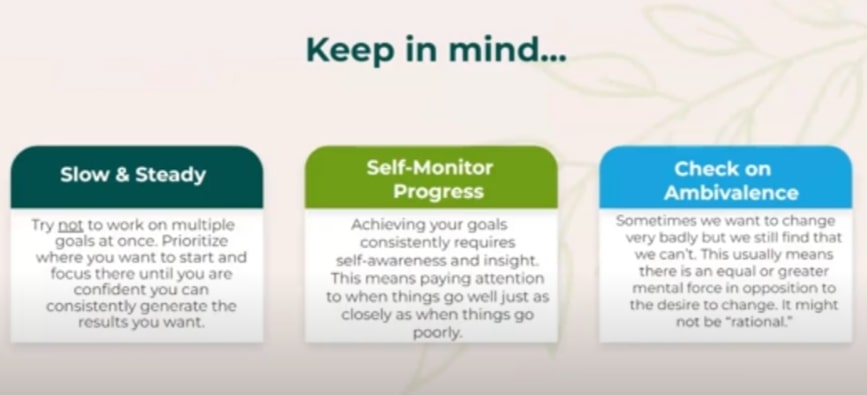
Focus on one goal at a time, even if it’s a small one.
If we try to tackle multiple goals at once and falter on one, it could impact our progress on the others. The aim is to build confidence by progressing slowly and steadily. As you achieve your initial goals, you’ll gain momentum and feel more confident tackling subsequent ones at a quicker pace.
As you’ve been seeing that change and you know you can do it consistently and you know you won’t get thrown off by stress, that’s when we start to up the ante. But only after we’ve been tested, only after we’ve formulated completely and as concretely as possible what that goal is just outside the window of tolerance, but not too much. That’s why it’s so important to be slow and steady.
And then we talked about self-monitoring, that insight of ourselves, that maybe we should knock it down a peg. Maybe we don’t know what’s causing these changes for things to be good or bad.
It is super, super, super important to pay attention to when things are going well.
For example, we were discussing making a change with a client, and we wanted to draw a comparison. We said, “It’s great that you know what it looks like when things go wrong. But what does it look like when what you’re working on goes right?” She looked as if we were speaking another language and asked, “What do you mean when it’s going right?”
We explained, “Think about it like this: when we put on our pants in the morning, we don’t usually think about which leg goes in first—we just do it. But if we start to pay attention, we might notice we’re more comfortable putting our right leg in first rather than our left. It’s just a little bit of awareness.”
This shows that there’s intention behind everything we do, no matter how small. It’s like when someone asks you to cross your arms the opposite way than you’re used to—it feels odd. The point is, that paying close attention to the positive things that happen when things are going well allows you to replicate them more often because you understand exactly what’s contributing to your success.
You know what it takes to reach the positive because you’ve built that awareness just as much as when you’re aware that things are negative.
The last word is a new vocabulary, which is ambivalence. Sometimes we want to change, and we want to change really bad, but we find that we can’t. This usually means that there is some equal or greater mental force in opposition to the desire to change.
We do want to emphasize that this opposition is probably not rational. People that we’ve talked to, get very upset at this irrational barrier to change. As you’re going through these processes of formulating your goals, assessing whether the experiment worked or didn’t work, getting your motivation geared up and that confidence in yourself as you meet after small goal to check on…
Before addressing ambivalence, consider whether you made your goal as achievable as possible given your circumstances.
Reflect on factors like your work situation, stress levels, marital status, parenthood, or any other relevant conditions. If you conclude that the goal was indeed realistic and should have been attainable, then it’s time to examine any ambivalence.
Ambivalence often arises in discussions about addiction, such as wanting to quit drinking or smoking but relying on these habits as the most effective way to cope with stress. It’s like a tipping scale where on one side, there’s a desire to quit, but on the other, these habits provide significant comfort. The question becomes: why would I give up something that helps me cope, even if it’s not the healthiest choice? This dilemma underscores the importance of addressing maladaptive coping strategies. Even when we know it’s better for us to change, the challenge lies in finding alternative coping mechanisms that can effectively replace what we’re accustomed to.
As we explore ambivalence and give space to both ends of the scale, consider reframing the perspective towards change.
For instance, reversing the sentence order can shift the focus towards a readiness for change. Instead of saying, “I want to quit drinking or smoking, but it helps me cope with stress better than anything,” say, “Drinking and smoking help me cope with stress better than anything, but I want to quit.” This reversal highlights a shift towards embracing change rather than remaining entrenched in old patterns.
A practical approach to navigating ambivalence is to notice the scales tipping one way or the other. For example, phrases like “I want to do this, but it makes me feel like that,” or “This is my barrier, but I know this is important to me,” can be reframed by placing what’s important and desired at the end of the sentence. This simple adjustment can help clarify your feelings and intentions towards achieving your goal.
Applications for Couples
- Understanding your partner’s motivation (or lack thereof) to make changes in your relationship.
- Checking in with each other.
- “How could we get from feeling like we are at a 5 to a 9 in our relationship?”
- Resolutions become geared towards preventing future conflicts and not just “feeling better”.
- “Quality assurance for your relationship.”
Applications for couples are tricky. Motivation in couples’ work is tricky in general because the emotion of an argument or a difficult period strongly impacts motivation to stay in a relationship. The most important thing related to motivation and solution-focused work with couples is acknowledging those changes made, however small. A little change is better than nothing.
Sharing these acknowledgments as partners, not just therapist-client, but client-client in the relationship usually is a source of invigoration for the partner to keep trying towards that change and for the relationship. The solution-focused approach generates more hope than the problem-focused approach.
Everyone wants to believe partners inherently know or expect each other’s needs.
Solution-focused and strength-based thinking can be likened to quality assurance for your relationship. If your boss asked you to find a more efficient way to complete a task, you’d likely seek clarification on their vision or experiment with different approaches instead of repeating the same method.
Similarly, as an outside observer, we notice that couples often become stuck when they don’t realize they’re repeating ineffective patterns. They break free from this cycle when they start asking each other strengths-based and solution-focused questions, enabling them to understand how they arrived at their current situation and how to move forward. These conversations do not happen in that hyper-emotional state of the general conflict.
These check-ins aim to orient resolutions towards preventing future conflicts, emphasizing a quality assurance approach rather than simply moving past current issues. It involves asking: How can we proactively avoid this in the future? What commitments are we both willing to make? And how confident are we in our ability to follow through?
Applications for Neurodivergent Individuals
- Neurodivergence impacts how the brain’s reward center works and, therefore, the ability to harness and maintain motivation.
- Typical positive and negative reinforces utilized by the societal majority may not help stimulate motivation for neurodivergent individuals (i.e. good grades, performance reviews).
- Encouraging autonomy is the goal-setting process that typically generates a greater sense of empowerment and increases the likelihood of meeting set goals.
Here are some applications for neurodivergent individuals. These are individuals with ADHD or individuals with autism spectrum disorder. It’s super important that judgment plays a crucial role in the ability of a neurodivergent individual to feel motivated.
Our society is not constructed to accommodate a neurodivergent person.
As a result, those individuals typically carry a disproportionate burden of comorbid mental health conditions along with them throughout their lives, like depression, and anxiety.
And so, coupled with the executive functioning capability of lagging years behind the chronological age, also paired with these comorbid conditions. This leads clients to face significant frustration from authority figures, teachers, parents, bosses, and even partners.
As we work with neurodivergent individuals, we increasingly find that self-monitoring and discovering their methods to complete tasks and achieve goals enhances their chances of success, free from the pressures of neurotypical norms and expectations (“shoulds”). For instance, resisting thoughts like “I should do it this way because that’s how others do it” or “I must work without breaks like everyone else” becomes less relevant when individuals find what works best for them.
We often encounter societal constraints that influence our success, such as time limitations. This underscores the importance of using solution-focused thinking in our approach, where experimenting becomes crucial. By externalizing these experiments from our self-worth and fear of failure or success, we can discover unique approaches that work for us.
We often liken this situation to fitting into a cookie cutter, where individuals with ADHD or autism might feel pressured to conform. In attempting to fit, they may metaphorically “lose a finger or slice their ear off,” illustrating the challenges they face in conforming to societal norms.
The constant struggle and discomfort of trying to force oneself into the cookie-cutter shape highlight the pain it causes. Imagine instead designing a mold that closely resembles the cookie cutter shape but allows enough space to prevent your ear, finger, or toe from being sliced off as you fit into it.
The typical negative positive reinforcers might not help stimulate motivation.
That autonomy in this process is super important because, again, knowing how the interactions with neurodivergent individuals usually are with authority figures can make them feel more motivated to meet these goals and things that they’re trying to strive for as a result.
Motivation via Values Work
What if I’ve never been able to meet my goal before?
- The alternative to solution-focused thinking to harness and maintain motivation is values work. Values work entails reflecting on what set of values drives you to be the person you are despite the challenges you’ve faced in life.
- Making choices and striving to achieve goals based on how in line those are with your unique values system often makes those goals easier to achieve than by simply trying to motivate yourself intrinsically or extrinsically.
If I’ve consistently struggled to achieve my goals, especially with low self-esteem, how can I effectively use solution-focused thinking?
You’re suggesting I need confidence and other qualities. The approach in such cases is to view motivation through a lens of personal values. This perspective is integral in Acceptance and Commitment Therapy (ACT), emphasizing its importance for individuals working on personal development.
For instance, consider values such as stability, compassion, integrity, and adventure. When our choices and actions don’t align with these core values that define us, it creates a sense of tension akin to a rubber band stretched to its limit, on the verge of snapping. This tension is felt both mentally and physically, causing significant discomfort. Therefore, when we reflect on our values and actively choose to prioritize them, it helps alleviate this discomfort. I personally engage in these exercises myself.
There are worksheets online you can find that have a long list of values. It’s usually 40 to 60, an incredible amount. Some of them seem like synonyms. But to select those values that are most important to you right now, not in the past, not in the future, that you’re ideal values, but right now, and how you’re living towards those at the moment or how you can make decisions and goals based around living towards those now.
Sometimes, when we’re reflecting on new values we can stimulate change and motivation in a way that extrinsic and intrinsic motivators cannot.
An example would be if you’re eating a favorite meal during a stressful week to motivate yourself to keep going, or if you’re withholding a negative reinforcement, withholding time from a friend or a partner so that you can complete homework for the week, or something like that.
Both extrinsic and intrinsic motivators may not always sustain us in the long term or help us overcome initial challenges, such as lacking confidence or feeling unable to change our thoughts. In such cases, we often need to uncover deeper motivations: how did someone who has struggled with depression their entire life manage to get up every day and accomplish tasks?
Typically, when confidence is lacking or we struggle with externalizing our identity from our ability to achieve goals, a values-based approach can be the solution. For example, instead of thinking “I lack motivation,” one might reframe it as “I value my work ethic, so I’ll get up and go to work.” Similarly, feeling accountable to family can be reframed as “I value my role in my family and their well-being, so I won’t let them down.” Those values can be examined to harness our motivation sometimes when we’re lacking in other reinforcers at the moment.