
October 9, 2025
Webinar: Building Emotional Resilience
Written by Guest Author
Posted in Emotional & Mental Health, Self Help / Personal Development, Webinars and with tags: emotional regulation, mental health, self care, self improvement, webinar

Feeling Emotionally Drained? Discover How to Regain Control and Build Resilience
Do you find yourself meeting deadlines, checking off tasks, and keeping life running smoothly—but still feel emotionally exhausted? Maybe your mood swings feel unpredictable, small stresses hit harder than they should, or you sometimes shut down just to get through the day. You’re not alone—and more importantly, you don’t have to accept this as your “normal.”
Join us for “Building Emotional Resilience,” a practical and compassionate webinar designed for high-functioning individuals who are burned out, overwhelmed, or living in survival mode. In this session, you’ll learn how unmet physical needs—like sleep, nutrition, and illness management—can directly impact your mood, and how you can use evidence-based tools from Dialectical Behavior Therapy (DBT) to take back control of your emotional well-being.
Led by Luryn John-Miller at Eddins Counseling & Therapy Group with deep experience helping highly empathetic and emotionally sensitive clients, this webinar will guide you through simple, actionable steps to stabilize your mood and respond to stress without spiraling. You’ll leave with personalized insight and one practical self-care action you can implement immediately—so you can show up more fully in your life, handle stress with confidence, and prioritize what truly matters to you.
If you’re tired of feeling like your emotions control you, this webinar offers hope: the ability to regulate your mood, reduce internal chaos, and experience a greater sense of calm and clarity in everyday life.
Watch a replay of the presentation here.
This webinar is facilitated by Lauren John-Miller, a counselor at Eddins Counseling & Therapy.. Today, we’re going to be talking about building emotional resilience. This is part of our Focus on Wellness, a monthly webinar series where we have conversations about mental health topics and how they affect us, based on our different areas of expertise.
Objective: Apply Skill to Daily Life
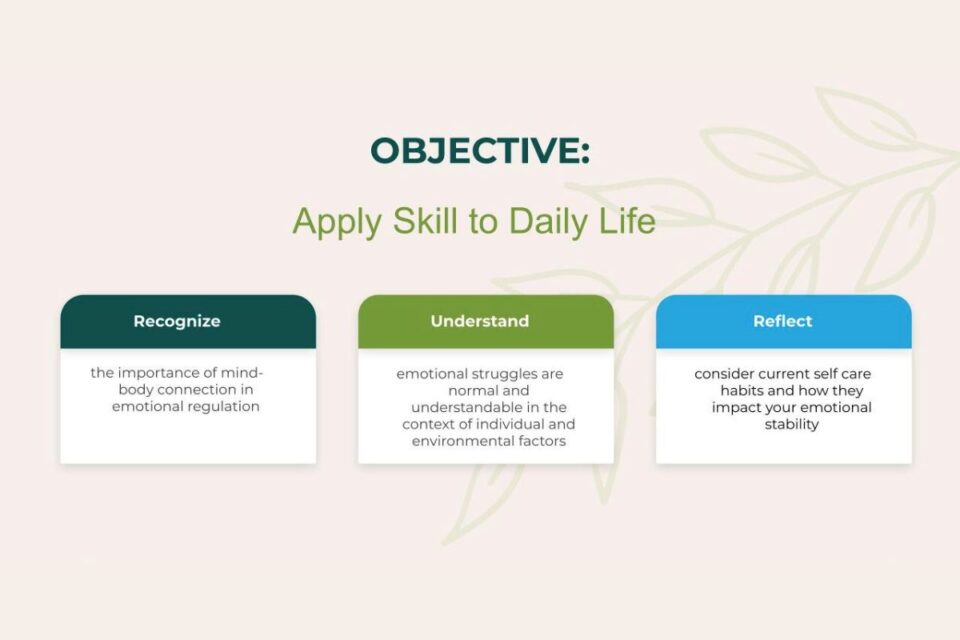
Without further ado, we’re going to move into our topic for today: Building Emotional Resilience. Our objective in today’s conversation is to try to understand how we engage with something we all experience – big emotions. Whether it’s stress, sadness, anxiety, anger, or just feeling overwhelmed in life, we want to explore how to navigate these experiences together.
We have all had those moments where we feel out of control. Essentially, by the end of today’s talk, our hope is that you will be able to recognize the importance of the mind-body connection when it comes to emotion regulation, as well as understand that your emotional struggles are completely normal and understandable in the context of individual and environmental factors.
We think that sometimes when we are experiencing stress, anxiety, or anger, there is this very common feeling of “I’m out of control, there is something wrong with me, I don’t know why I react like this.” We hope that by the end of today’s talk, you will be feeling a little more normal and a little more compassionate toward yourself in the midst of everything that you are going through.
We also hope to reflect and consider what things we can do right now that would help us prepare for the things that life doesn’t prepare us for, and that we are able to engage with that in a way that helps us feel grounded and able to face the day. That is what we will be focusing on.
Can You Relate?
- You take it “too far” in an argument and feel guilty later
- You feel anxious or on edge when interacting with others most of the time
- You overeat, oversleep, or scroll on your phone for hours to avoid
- You cry easily or completely shut down when things get stressful
Have we ever had an experience where maybe we take it too far? We are having a conversation, it has been a really long day, and maybe we get a call, or maybe we come home, and the kids have what feels like 10,000 things they want to say to us. Or maybe we end up talking to our spouse and we say something that honestly we did not really mean, but it comes out anyway. Then we feel a bit guilty.
Can we relate to going out and feeling anxious, feeling like there is something on our face or something wrong with us, and having this strong desire to disappear? If the ground were to open up and swallow us whole, that is how we are feeling, on edge, super anxious, not really feeling comfortable in our own skin.
Or maybe that is not us. Maybe we are someone who notices that we find ourselves mindlessly doing things. Maybe that is overeating, and we find ourselves eating more than we mean to, or maybe not eating as much as we would like to. Maybe we have been sleeping a lot more and not really feeling very rested even after that. Or maybe it is not that.
Maybe we find ourselves just constantly scrolling, scrolling, and scrolling. And before we know it, two and a half hours have passed, and we think, “Where has the time gone?” Is that us? Or maybe none of that feels familiar.
Maybe we find ourselves in situations where we seem or feel like we’re fine, and we’re trying to communicate. Maybe we’re at work, and the next thing we know, we are breaking down in tears, not quite sure where that is coming from or why it just happens. Or maybe we’re driving home and notice ourselves just shutting down. Those are all experiences that we can relate to.
Right now, it might feel like we are not in control, like our emotions are controlling us. We want you to know that you are not alone, and that is very common. These experiences are normal.
Why Does this Happen?
- Emotion Regulation
- Emotions are complex
- Life Experiences
- Current Habits
We may be asking ourselves, “Okay, so it’s normal, but what is going on? I don’t quite understand why I’m having these emotional ups and downs.” There are a number of different things that could be contributing to that. One of them is emotion regulation, which is essentially what it sounds like.
How do we engage with the intensity as well as the duration of what we are experiencing at its onset? When it comes, how do we deal with it? How are we engaging with it? Where does it go? Where does it take us? That is something that is particularly complex.
Some of how we understand how to deal with emotions, or even how we feel about emotions, whether we dismiss them entirely or throw ourselves completely into them, is shaped by our life experiences. We all come from different backgrounds, and we have different stories, cultures, meanings, and values tied to the way that we engage with and understand emotions.
Whether we see emotions as something we should be addressing or something we stuff down because we feel we do not have time for it or cannot afford to engage with it right now, all of that is shaped by our life experiences as well as our current habits.
Maybe there are stressors or things going on that make it feel as though we cannot engage with our emotions the way we want to, or that make them feel so much louder in the moment. And maybe we even feel like we are the problem.
When we are not able to take care of ourselves, it actually makes it harder to manage these emotions when they come. That can actually make the feeling of being out of control even stronger, as if it is something completely separate from us or something we cannot control. This is something we have to consider: where is this coming from?
Biosocial Theory
Biological Sensitivity
- Increased sensitivity
- Genetics
- Temperament
- Brain chemistry
Invalidating Environments
- May have sounded like
- “You’re too sensitive”
- “I’ll give you something to cry about”
- “Why can’t you just get over it”
We are going to be drawing from DBT today, which is dialectical behavior therapy, which has a theory about where the way we engage with emotions comes from. This theory is called biosocial theory.
Biological Sensitivity
In biosocial theory, one idea is that biological sensitivity is one way that we can be particularly prone to responding in certain ways in different situations.
Thinking back to some of those earlier scenarios, like snapping at somebody or randomly shutting down, some of us have increased sensitivity. That can be genetic, related to our temperament, or brain chemistry. All that means is that biologically, there are different components of how we came into this world – our genetics, our genes, or even family history – that contribute to the way we show up in the world around us.
We can think about it this way: some people just naturally feel things in different ways. We also all react to stress differently. A little picture to consider is that of a sensor. We don’t know if you’ve ever lived in an apartment complex, but some of those sensors are particularly sensitive. You can have a little smoke coming up, maybe from the steak we are cooking, and the whole thing goes off. Then there are others where you wonder if they are even on, because the smoke floats up and nothing happens. That might be a helpful way to think about sensitivity. Some sensors are particularly sensitive, and some are not.
The same goes for us and our relationship to our emotions. We may feel things more strongly than others. Maybe someone else’s baseline is where they are aiming to get to, and they find it hard to regulate to that point. That is one theory tied to biological sensitivity.
Invalidating Environments
The other aspect is invalidating environments. We have included a couple of quotes that illustrate what that may have sounded like. “You’re too sensitive,” or “I’ll give you something to cry about,” or “Why can’t you just get over it?” These are a couple of examples.
We hope that these do not sound too familiar in terms of the kinds of environments we may have grown up in, or even relationally as adults, that consistently reinforce the perspective that there is something wrong with the way we show up or the way we relate to the world around us.
With that in consideration, when we are in an environment where our emotions are consistently dismissed, ignored, or seemingly punished just for being there, it can be really hard to understand how we are supposed to relate to our emotions. The myth that ends up being reinforced in these situations is that we are the problem, that there is something wrong with us, or that there is something wrong with the emotions we are experiencing. That can make it difficult to understand how to relate to our emotions.
These patterns can be ingrained. They can develop during childhood, but they can also occur in relationships as adults. The relationships we form with others help us understand more about ourselves and how we relate to our emotions.
Being in invalidating environments, either where there was no ability to co-regulate or no one who could acknowledge what we were feeling, or where our emotions could not be engaged with in a positive way, can make it so that when we do have experiences where our emotions begin to rise, we are not entirely sure how to engage with them.
If we are already biologically sensitive, with a proclivity or temperament that causes us to feel emotions strongly – whether due to lineage, genetics, temperament, or biology – and we find ourselves in environments that consistently dismiss, ignore, or punish us for it, that can be particularly challenging.
Another way to think about invalidating environments is simply when there is no space for our emotions.
It may not have been as overt as “You’re too sensitive” or “I’ll give you something to cry about.” It may have just been that there was no real engagement with our emotions. That, too, can be invalidating.
It makes sense, then, that our emotions might now feel overwhelming. We might ask ourselves, What are we supposed to do with them? Where do they go? What does it mean that we are feeling this way? That can feel like a Herculean task, trying to piece through something that we may not have the capacity to deal with in the ways we would want to. The good news is that it does not always have to be this way. We hope that this is something being communicated even now. These may be things that were true or are true, things we have experienced.
But the good thing is that learning to manage our emotions is a skill. It is not a personality flaw. What we mean by that is if we have never been able to ride a bike, we would not be given a bike and be expected to hop on and automatically know what to do. Sometimes, when it comes to our emotions and being able to engage with them, there has to be space for compassion. Maybe we were never really taught how to do this, either because those around us did not know how or were not able to teach us. Many of us did not fully understand how we were supposed to engage with life when these emotions came up.
And so now it is coming up, and it feels overwhelming, and we would like to learn. We would like to learn how to relate to this in a different way. It does not have to mean that there is something wrong with us or that we are the issue. It can mean that we are people who are learning, at this stage of our lives, whatever that stage may be, a new way to relate to others when we are upset or stressed or feeling anxious, or overwhelmed. It is essentially about recognizing the power we still have.
When we see it as a personality flaw or think, “It is just me, I am just an angry person, I ruin all my relationships, I am not able to hold myself together,” that is very disempowering. What could we do if that were truly the case?
This perspective and this approach to engaging with our emotions are meant to give us back some of that power. It invites us to engage with the strengths we already have and to consider the capacity we have to continue to grow and develop new skills.
Emotional Resilience
“The ability to weather the storm”
- We don’t want to turn our emotions off; we want to develop tools to manage them when they do come!
- Reduce biological sensitivity!
With that in mind, we think it is helpful to define what we are looking at when we talk about emotional resilience. When we are speaking about emotional resilience, we think it is helpful to consider it as the ability to weather the storm.
As a result of having to engage with very big emotions that feel disruptive, that hurt our relationships, that make it hard for us to manage stress, and that make it seem as though our emotions take over, we can start to develop a perspective toward our emotions where we wish they would simply turn off. We may think, “I wish I did not feel anything. I wish it would all just go away.” It can feel as though the emotion is the antagonist and that getting rid of it is the goal.
But we want to maintain a different perspective. Emotions are part of the beauty of life. Even sadness, anger, or grief, which can be so difficult to experience, holds value. They allow us to reflect and to see what matters to us. All emotions are valuable. We do not want to turn them off. We want to be able to engage with them in a way that allows us to stay grounded and bounce back from feeling as though these emotions take over or feel separate from who we are.
We simply want to develop tools to manage them when they come. Thinking about weathering the storm, if we grew up in an environment where we were not prepared for rain, then anytime we stepped outside and it rained, we might feel panicked. What we are trying to do is practice naming and identifying what the emotion is, recognizing what is going on, and then intentionally and practically preparing for when this “rain” comes. We may not be able to stop the rain, but we can prepare ourselves to engage with it. It does not have to be as derailing as walking around in wet socks, because that is terrible. What that looks like today is reducing our biological sensitivity.
DBT Please Skill
Taking Care of Your Body To Support You
- Emotion Regulation through Skill Building
- Increasing the Mind-Body connection
We do that through a DBT skill called P-L-E-A-S-E. This skill acknowledges, through its implementation, that part of how we deal with our emotions depends on recognizing that we often disconnect our emotions from our human experience. We act as though our emotions are here and our bodies are somewhere else.
We are here today to tell you the two are very much connected. If we can identify ways to regulate through those skills and increase the connection that we see between our mind and our body, then that is a way we can use our body to support us as we navigate our emotions. And that is a skill. So, going back to everything we said before, it is a skill. It is not something we inherently know how to do. It is something that is modeled to us, demonstrated, and told to us.
Sometimes we make these connections on our own, and sometimes it is helpful to revisit the foundations or principles that would help us be successful with the things we are trying to navigate.
When we are thinking about the ways our body and mind are connected, then if we cannot change the emotion or are not able to intervene at that level, what can we do? DBT PLEASE would indicate that by using and considering the ways our body is showing up, it can actually impact our ability to adjust to what is going on emotionally.
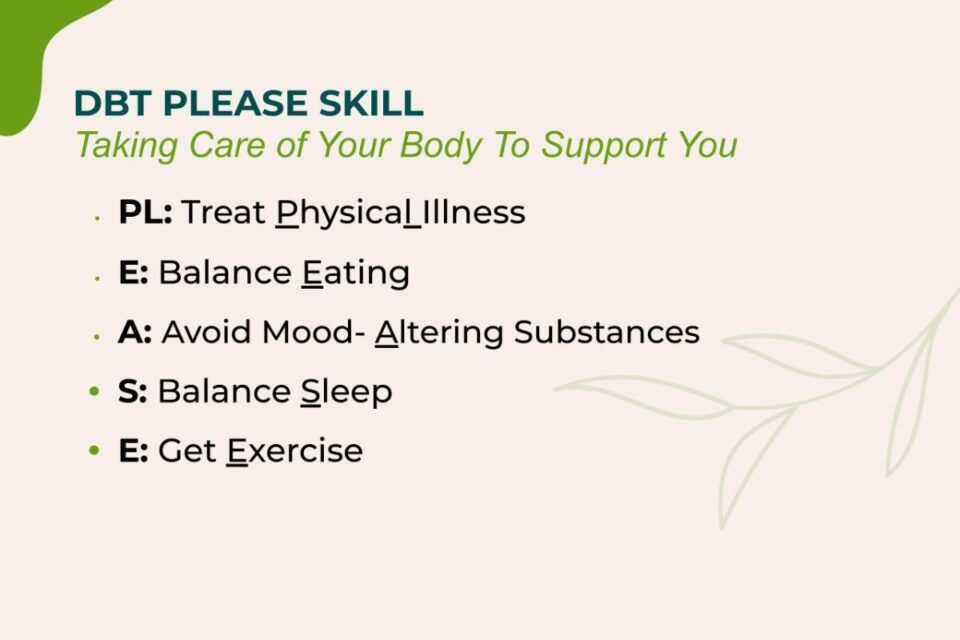
What does that look like? PLEASE, if you see it up there, it is actually an acronym. DBT, which was created by Marsha Linehan, is a skill-based cognitive therapy that is empowering because it gives us tools and skills that can be used and applied to help us take back control over what may feel overwhelming when we are dealing with our emotions.
PL: Treat Physical Illness
The first one is the PL. She was very creative in creating this acronym. That is treating physical illness. What that looks like is choosing intentionally to take care of our bodies. We say that plainly because it is something we do not always think about first when we are experiencing deep emotional dysregulation or feeling overcome by our emotions.
But there are things we experience, like brain fog, anxiety, and depression, where there may actually be another cause, and we may be trying to navigate the stress in a way that could be managed differently. So this looks like choosing to take care of our bodies and seeing a doctor when necessary. Sometimes we do not see a doctor for many different reasons.
It may be a sign to see what can be done, to be able to see a professional, and to consider what medications may be necessary, and to recognize when we need to take care of the illness. There may be something underlying that we are reacting to, and we are fighting the wrong fight. That can be really helpful to identify, or at the very least rule out, those other medical things that may be going on.
E: Balance Eating
The next part of that is balanced eating. When we consider food as fuel for our body, I do not know if you have heard that terminology before, but essentially, what we put into our body does impact our output. I am sure we have had a time before where we ate something that looked delicious, it was so tantalizing, and then after we ate it, it felt like someone hit a power-down button on us. It is an acknowledgement that what we put into our bodies does have an impact on the way that we show up.
Food in and of itself is meant to fuel us as we are engaging with the rest of our lives. And when we are experiencing a lot of emotional stress, one of the first things that can go is that we either end up not eating at all, or we end up eating or making choices that are reflective of our emotional state, which then can actually perpetuate the way that we feel.
And so, although it can be hard, it is like, well, we are eating that because we feel terrible, and so this is where we feel that we get our joy. We would encourage ourselves to also consider what we can do. Then there is something else going on, and if we want to be able to navigate what is happening, then we would want to try to isolate what is truly affecting us. If we can work on even just one aspect of the food, we are not saying that we have to go and think that balanced eating, because of the messaging in the media, looks like grass or something that is not particularly appealing.
But even if it is looking to try and incorporate more protein or trying to have some fruits or veggies, or looking into staying hydrated, that is a part of balanced eating. How much water are we consuming? Are there any available supplements? Are we getting our vitamins? Are we engaging with what our body needs to be able to repair itself? Because that can also impact the way that we feel.

A: Avoid Mood-Altering Substances
A refers to avoiding mood-altering substances. As we know, substances can really impact the way that we feel, and they can deplete the hormones and the neurotransmitters that contribute to the way that we feel.
Essentially, alcohol, marijuana, and other substances are things that we can gravitate towards as a result of wanting to numb our emotions. It could be a way to cope. But in the long run, it actually keeps us from being able to learn how to do that within ourselves. Then it makes us more dependent upon these mechanisms to be able to cope. Then, not only that, but it affects our brain chemistry as well. That then affects our sleep and a number of different things.
One thing that we do not often talk about that can also fit into this category is caffeine. Maybe it is just the amount of sugar or caffeine that we are engaging with and how it affects our brain chemistry, and how we show up in the spaces we are in. When we notice that maybe we are using substances to escape or to cope, it would be helpful to try and have a moment of reflection on how we feel after using them.
Is this something that we move toward as a way to avoid something? Are we trying to reduce the experience of something? That in itself can be a sign of a dependence that may actually be perpetuating the difficulty in regulating our emotions.
S: Balance Sleep
And so the next one would be… it would be S, which is balancing sleep. That is something many of us grew up hearing – I’ll sleep when I’m dead. We’ve heard that terminology where we treat sleep as almost optional. That can come from prioritizing work or feeling as though it simply isn’t feasible considering all of our responsibilities.
Maybe there are different things that disrupt our sleep. That can be a number of relationships, substances, or different experiences that make it hard, maybe even pain. That would be a situation where we try to identify and investigate what is contributing to what makes it hard for us to sleep. And based upon what that answer is: if it’s insomnia, there are treatments and therapies for that as well. Identifying this with support can be helpful, whether that looks like seeking a therapist, going to a doctor, or trying to find ways to engage the community or build a support system to help us prioritize sleep or to sleep more.
Maybe it’s looking at sleep hygiene. What is going on before we sleep? Are we on our phones? Are we putting ourselves in situations where we’re not actually able to focus on sleeping, so that by the time sleep comes, it’s much later? Sleep is the time when we’re able to feel refreshed. It’s when our bodies go over all the things of the day, and – since we’re not focused on digesting food or being alert – our bodies can focus on repairing. And so if we’re not sleeping, that can contribute to us feeling worse as we continue on, because our bodies aren’t getting the rest they need.
E: Get Exercise
And then the last one is exercise. This is another one that can sometimes feel like a luxury depending on the hours we’re working. And when we say exercise, we often equate it to going to the gym or getting a pricey membership. But that’s not necessarily what’s needed. Exercising can simply look like choosing to incorporate some movement that we enjoy, so that we’re able to move for at least 20 minutes or so.
If that’s walking back and forth inside our living room, if that’s gardening, or if that’s just making sure our bodies are moving the way they were made to move, it matters. Our bodies have all these muscles and ligaments, and they experience a sense of liberation when we move in the way they were designed to move.
We want to try to aim for at least 20 minutes or so, at least 3 to 5 times a week, and that may feel like a lot. But even just acknowledging and allowing our bodies to move can help support us and shift us into a different mood or state, just as a result of the natural chemicals that are released during movement.
Why Does This Matter?
Your brain isn’t operating in a vacuum…
- Your brain needs the fuel
- Decreased Reactivity
- Sleep as Repair
- Preparing the body to handle emotions more effectively
- YOU MATTER!
It’s like, okay, we are being told to focus on these things, and if we could just do these things, we probably would have already done them. We want to acknowledge that our brains aren’t operating in a vacuum. Doing these things doesn’t mean that our depression will immediately disappear or that we won’t feel anxious anymore. But what it does mean is that we would have more control over these situations when they do occur.
Just like this little penguin we see right here, who is sitting in the fire and saying, “This is fine”, when we are in that state where everything feels on fire, with the smoke and the heat, it can be overwhelming. We want you to imagine trying to patch up something on the roof while the house is on fire. That would be quite hard to do. There are things that have more immediacy in that particular situation.
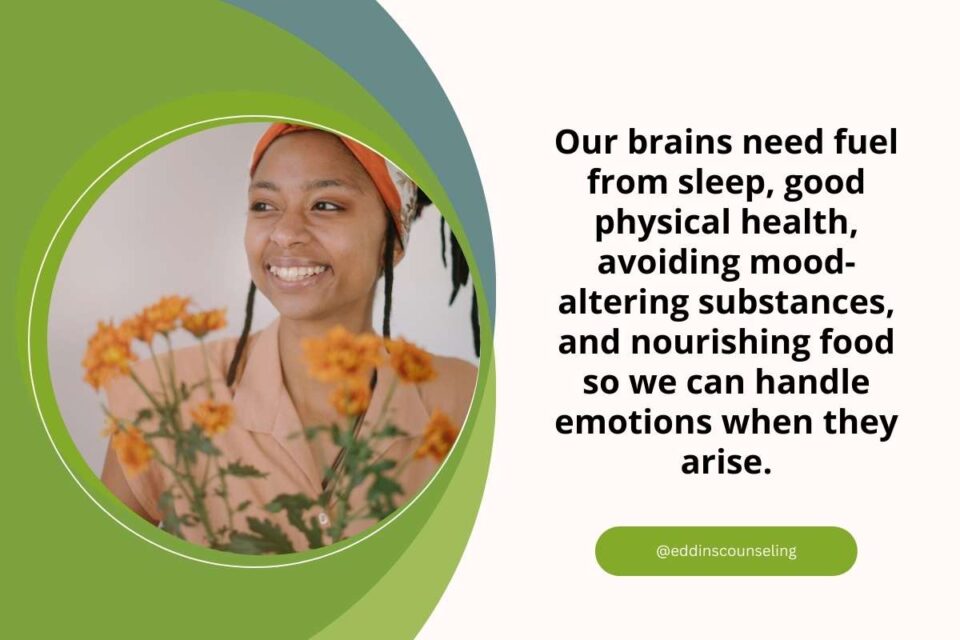
Our brains need fuel. Our brains are in our bodies, and they need the fuel that comes from sleep, from treating physical illness, from avoiding mood-altering substances, and from the food we eat in order to deal with our emotions when they arise.
That is what helps us have decreased reactivity. Sleep helps repair and work on all the things that our bodies are not able to address in the same way when we are awake. We are preparing our bodies to handle stress and our emotions more effectively.
Think of situations where we have tried to use our phones when they freeze up, especially here in Houston, where it is always so hot. It’s not that our phones don’t have the ability to open maps or call someone. It’s that in that particular state, they are inhibited from functioning at their best because of the external environment.
That is what we are focusing on. It’s about asking ourselves, “What can we do to increase our ability to deal with the situations at hand?” We do not want to make it harder for ourselves. It’s not that we have been trying to; sometimes we’re just not aware of how our physical health translates to our mental health.
By engaging in these tasks, we are also reminding ourselves that we matter. Often, in the midst of difficulty, stress, and all these different emotional states, there can be a pervasive thought pattern where we judge ourselves and struggle to be compassionate toward ourselves.
But when we intentionally decide to take care of ourselves – going to the doctor, eating well, trying to sleep, setting boundaries, intentionally seeking out certain kinds of food, booking appointments instead of putting ourselves last – we are reinforcing that we matter. This helps build self-esteem and reminds us that our lives are important, which can also increase our ability to handle negative circumstances when they arise.
Think Back To… A “BAD” Day
On that line, we can think back to a bad day, when we’ve had one. Typically, a bad day is influenced by a number of different factors. Maybe we notice that we haven’t been to the doctor in a couple of years. Maybe we find ourselves coming to Domino’s more than we’d like, and they know our regular order. Or maybe we are eating foods that don’t feel like real food, very processed or fatty, which makes us feel lethargic or slow.
Maybe we are drinking a bottle of wine each night and notice ourselves falling into more arguments or fights with the people we love, and our sleep is disrupted. We are not able to sleep through the night, waking up periodically, and even if we try to sleep through the day, we still feel exhausted.
And when we do not leave our house, we are not able to go outside, and we do not engage with people very often, which can make us feel particularly unwell and unhealthy. That feeling itself can make it really hard to climb out of any other feelings that may arise. If we are too dysregulated to take care of all these areas, that is okay. But we want to identify what we can do to get some of that power back, because otherwise it can feel like everything is spinning out of control.
Think Back To… A “GOOD” Day
Now contrast that with the days we’ve had a good day. What typically happens on those days? We probably are able to get something to eat. We probably have breakfast. Maybe we notice ourselves feeling more alert. We probably would say that we got some sleep, the sleep that we needed, or that we went to the doctor and everything was fine.
On those good days or bad days, or through the experiences we have, we sometimes make these connections unconsciously: we had a good day, we got sleep last night; we had a bad day, we didn’t really eat much, and we are feeling hungry. We sometimes make these connections, but they are deeply connected to the way we are taking care of our bodies.
We can assure ourselves that on a bad day, if we are to have a conversation that is particularly stressful, it is going to feel different than how we would handle it on a day when we were able to sleep or engage more directly with what was important to us.
RECAP: Taking Care of our Body IS Taking Care of our Emotions
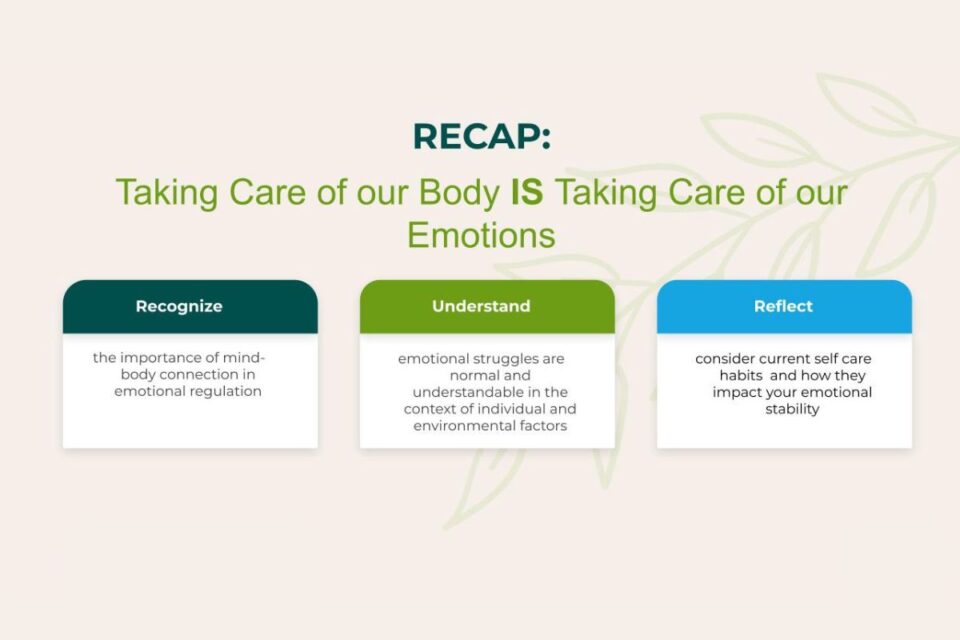
Just to recap, taking care of our bodies is taking care of our emotions. It is one of the ways that, when we are not able to control how our emotions appear or show up, we can intentionally choose to move toward a life that allows us to practice some control over what is happening. What we are doing is reducing our vulnerability to being overwhelmed by emotions.
The emotions will still come, but they do not have to overcome us. That is because we have been able to identify and take care of our bodies, which helps us manage our emotions, because the two are deeply connected. When our bodies are taken care of – just like we mentioned earlier with the phone – if they are not in a heated or stressed state, they are still able to navigate and deal with the task at hand.
But it is almost impossible to do so when we are not caring for that environment. It is not about trying to accomplish a list of things. We hope that is not what we take from today – that we just need to do all of these things. It is about practicing curiosity about what we can do, even if it is just one of these things, and considering how we can work toward that to help navigate our situation and our emotions so that we feel more prepared to engage with our emotions day to day.
As we talked about, emotions come. Everybody experiences emotions, and there are many factors that can contribute to why our emotions feel as strong as they do when they appear. That comes from our biology, our temperament, our genetics, and also our environmental circumstances.
There can be things, even presently, that do not seem to regard our emotions, that dismiss them, or that continually communicate that what we feel does not matter or is too much. That alone can exacerbate the strength of our emotions. It is like a match in gasoline. What we want to do is reduce our vulnerability to that and acknowledge what we can do to make ourselves less vulnerable, one step at a time.
We hope that in this conversation, it has helped to start a dialogue – maybe a conversation we have had before, thinking, I should do this, but I just don’t know how. We want to consider our current habits and how they may be impacting our emotional stability, and to give ourselves the courage to consider what can be done to regain control.
We will leave you with one challenge: focus on one part of that, please. It does not have to be something huge. Sometimes we have the idea that change has to be a massive overhaul, but it can look like taking an intentional step in a direction we recognize will benefit us.
Identifying one thing we can try this week that could potentially help, noticing those small changes – whether that is journaling, noting down thoughts, or having a conversation about how it is helpful – is one step toward building emotional resiliency and being able to weather the storm as it comes.
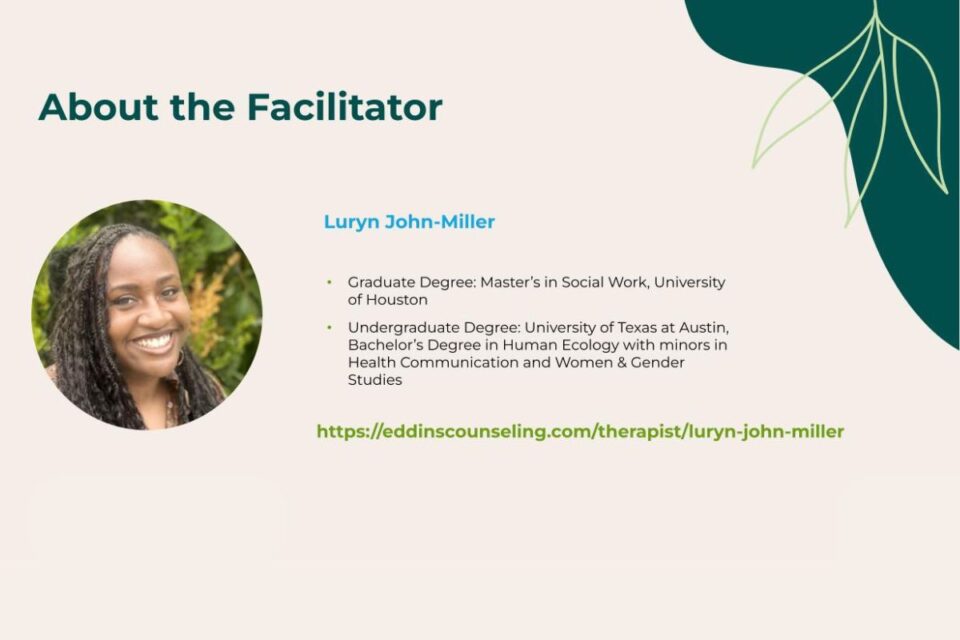
This webinar was facilitated by Lauren, LMSW, here at Eddins Counseling & Therapy Group, and we use DBT as a part of our work. If we are ever interested in those services, we can book with one of our counselors, or we can call Eddins Counseling & Therapy Group, where we are able to match ourselves with counselors who can help.
If we need support understanding what that would look like for our situation, if this conversation was helpful, or if we need more guidance, it can be helpful to have someone walk through that with us and identify how those changes would be beneficial. We can call the numbers listed here.

Feel free to visit additional resources:
1. Articles on specific topics on our blog.
2. RSVP for one of our free monthly webinars (or view past webinars)
3. Follow us on Facebook and Instagram for additional interviews and tips
4. Take another one of our self-test quizzes
5. Schedule a consult and find out how we can support you.
Whether you’re learning how to navigate big emotions or building new habits that help you feel more grounded in daily life, emotional resilience is something you can strengthen—one small step at a time. With the right support, you can begin to experience more clarity, steadiness, and self-compassion, even when life feels overwhelming.
If you’re ready to explore how to better understand your emotional experiences and create healthier ways to respond to stress, anger, anxiety, or sadness, our therapists are here to help. To begin, give us a call at 832-559-2622 or schedule an appointment online. We also offer online therapy for added convenience and flexibility.
Why You Feel This Way
Get instant access to your free ebook.
Blog Categories
Join a Therapy Group
Events
List of events in Photo View
-
Adult DBT Skills Evening Group | Eddins Counseling
Virtual Event -
-