

July 11, 2024
Webinar: Working With Your Inner Critic: Transforming Self-Doubt into Self-Empowerment
Written by Rachel Eddins
Posted in Self Help / Personal Development, Webinars and with tags: positive self-talk, self improvement, self-talk

Do you ever find yourself second-guessing your decisions, feeling held back by that nagging inner voice? You’re not alone. Join us for a transformative webinar on the topic of “Working With Your Inner Critic: Transforming Self-Doubt into Self-Empowerment” where we’ll explore the impact of self-criticism on personal and professional growth. Our goal? To empower you to overcome self-doubt and step into your full potential.
Understanding Your Inner Critic: In this nurturing and insightful session, we’ll delve into the workings of your inner critic. That relentless voice that questions your abilities, judges your actions, and keeps you from embracing your true power. Together, we’ll uncover the roots of self-doubt and learn how to break free.
Planting Seeds of Change: Imagine a life where self-empowerment replaces self-sabotage. Our skilled therapist, Rachel Eddins, will guide you through practical strategies to manage and transform your inner critic. You’ll gain tools to silence the negativity, boost your confidence, and embrace your unique strengths.
Meet Rachel Eddins, LPC-S, CGP: Our compassionate host, Rachel Eddins, brings years of experience in helping individuals claim their worth and trust themselves. As a therapist in private practice, Rachel specializes in supporting men and women on their journey toward purposeful living. Her warm and empathetic approach creates a safe space for growth and healing. Rachel’s insights will inspire you to rewrite your inner dialogue and step into a brighter future.
Watch a replay of the presentation here.
This webinar will focus on managing our inner critic. We’ll begin by defining the inner critic and then explore ways to transform the self-doubt it brings into something empowering. While we can’t completely eliminate our inner critic, we can learn strategies to work with it more effectively and constructively.
What is the Inner Critic?
- A harsh inner voice that is constantly questioning, judging, and making statements, such as:
- What’s wrong with me?
- Why can’t I…?
- I should have done more.
- I’m not enough – I need to do more.
- What if they think I’m dumb?
- Can be extra harsh when you are stressed, insecure, unhappy, exhausted, or unclear.
- Or when, you say something you wish you would have said differently, or do something differently yourself than how you teach it.
- Driven by fear (of judgment) and anxiety.
When you reflect on it, there’s an ongoing dialogue happening in your mind behind the scenes. Some of these thoughts might seem familiar and give you an idea of what is an inner critic. Often, it feels like our own voice, but it’s actually a critical part of us, serving a purpose for our growth and well-being.
That voice questioning, feeling anxious, or expressing uncertainty—like “I’m not sure” or “I don’t know what to do”—as well as more judgmental thoughts such as “I should do more” or “I should be better,” is what we refer to as the inner critic. It’s the running dialogue in your mind that brings these critical or doubtful thoughts.
The inner critic can become harsher in stressful situations, whether due to physical or emotional stress, insecurity from recent events, vulnerability, exhaustion, burnout, or a lack of clarity about what to do next. During these times, the voice of the inner critic often becomes louder and more demanding.
The inner critic can also emerge when you regret something you said or did, like thinking, “Why did I say that?” or “Why did I act that way?” You might relate to these feelings. It can also be triggered when you deviate from your usual standards, leading to thoughts like, “Why can’t I follow my own advice?” Generally, the inner critic is driven by fear—fear of judgment and anxiety about how others perceive us.
A lot of times we think some people are immune.

If you’re human, you’ve likely experienced a sense of inadequacy or feeling not good enough at some point, which is connected to your inner critic. The feeling of inadequacy represents the emotional aspect, while the inner critic represents the cognitive aspect.
Triggers can be anything from someone’s disapproving look to a comment that hits a nerve, or even situations where you feel compared to others. These triggers can amplify negative thoughts. This sense of inadequacy undermines our self-belief, increasing fear and intensifying the inner critic. Our goal is to address and work through these issues.
How Does the Inner Critic Hold You Back?
- Stifles your inner voice; not trusting your decisions/gut.
- Holding yourself back believing you need to prove yourself.
- Working harder to feel worthy, capable, or significant.
- Worth coming from accomplishment – outside of yourself.
- Thinking you have to do it all and feeling overwhelmed.
- Playing small, not believing in yourself or that you could do more.
Next, consider how your inner critic holds you back. One major way it does this is by stifling your inner voice and undermining your trust in your decisions or intuition. Your inner voice acts as an inner compass, guiding you with thoughts like, “Yes, this is the right decision,” or “I’m going to move forward,” or “I’m going to partner with this person.” While it may feel like intuition or a gut feeling, it’s actually based on data points from numerous experiences and external information. This process happens so quickly that we often fail to recognize it.
It’s crucial to have that inner voice to guide us, helping us make decisions and move forward. However, when this inner voice is overshadowed by an external critic or someone yelling at us, it becomes much harder to hear and follow our true guidance.
That’s what happens with the inner critic. We have the information that we need inside, but the inner critic can get so loud that it can be hard to listen, it can be hard to hear, hard to trust ourselves. That’s why we want to be able to identify it and recognize that it’s not true. It is just another voice.
It can certainly hold us back by fostering a belief that we need to constantly prove ourselves. We might think, “I need to do more,” or “I can’t make this decision or take this step until I…” This mindset can lead us to feel that we have to work harder, exercise more, or meet certain standards just to feel worthy, capable, or significant. This could include changing how we dress or other superficial adjustments, all in an effort to validate our own worth.
Another point is that it can also mean that your worth then comes from the outside instead of from the inside of who you are as a person. The worth is externally measured. It can also lead to you playing small and not believing in yourself, when you could do more, holding back your own potential.
Take a moment to reflect on the extent of your daily responsibilities and the things you’ve mastered so far in your life. Consider the responsibilities you have in your personal life, home life, and work life, as well as the people who rely on you.
Just think about all the things that you already have to offer that you already are as a person, and imagine what it would feel like to feel good in your own skin, and to feel less exhausted from trying so hard. Instead of playing small and giving up on dreams or goals or turning to the outside world for affirmation and feeling that from the inside out.
Take a moment now and breathe in some compassion for all the things and the person that you are now and remind yourself in this moment, at least, that you are enough and worthy in this very moment.
Take a minute and just breathe that in: “I’m worthy. I’m enough.”
Perfectionism
The other thing that goes along with the inner critic (in some cases, not all cases, but can’t go along with that) is perfectionism. Perfectionism can be a way of protecting ourselves from that judgment or that fear. It can seem like a good idea on the surface. But instead, it’s really “if I do it perfectly or I look perfectly, I can avoid …” It’s a false promise because then you can never get there. It leads you to be that if you do certain things, then you will no longer feel inadequate.
But of course, if you’ve ever experienced that, that it doesn’t really work that way because the end continues to move further and further away. It also protects us from being seen, and it puts your happiness or joy or fulfillment or your peacefulness beyond the current moment.
You are allowed to be a masterpiece and a work in progress at the same time. – Sophia Bush
What Does Your Inner Critic Say?
Post your response here:
You can see we all carry this inner critic, this negative voice inside. You’re not alone. I wonder what that means. What does that tell us? The biggest thing, really, honestly, is that it tells us that we want to be connected. We want to be connected with others. We want to belong. That’s really the truth in it.
We have to learn how to work to transform our inner critic because we can’t really get rid of it.
These negative thoughts, worries, and fears are actually expressing a deep desire to belong and connect. It’s an integral part of being human. However, we can channel these feelings positively, using them to foster growth and connection.

What Can We Do To Transform That Inner Critic?
Strategy #1: Share
The first strategy we can use is to share. By expressing our thoughts, even in a private space where it feels safer, we engage in vulnerability, which is a powerful antidote to the inner critic. It’s important to recognize that this inner critic often stems from feelings of shame, which we can address through openness and sharing.
Here’s the first example to illustrate the difference between shame and guilt:
- Guilt: “I yelled at my kids. I feel bad that I yelled at them.” This reflects guilt – feeling regret over a specific action.
- Shame: “I yelled at my kids. I’m a bad parent.” In this case, we’re attributing the action to our worth as a person, which is what shame is. This is often driven by our inner critic.
Our inner critic voice is the voice of shame. And vulnerability or sharing with others is the antidote to that.
Negative thoughts often thrive in a dark, hidden space, much like a monster under the bed when you were a child. Turning on the light – sharing these thoughts with others – can make them less daunting. Imagine confiding in a trusted friend, therapist, or family member, saying something like, “I yelled at my kids today, and I feel like a bad parent.” Such a person might offer compassion and help reframe your perspective, shedding light on the situation and reducing its power. Having that vulnerability then brings that shame to light. When something’s in the light, it goes away.
Name it to tame it.
A well-known psychologist and researcher discovered that one of the most effective ways to manage a difficult emotion is to name it. By simply identifying and vocalizing the emotion, we can contain it, which helps regulate and reduce its intensity. That’s the first strategy here.
The inner critic is often very harsh and condemning, but it usually contains a kernel of truth—though this truth might not be what you think.
For example, with the statement “I yelled at my kids; I’m a bad parent,” the kernel of truth isn’t that you’re a bad parent. Instead, it might be that you deeply care about your children’s confidence, well-being, and self-esteem.
The real truth is that these aspects matter to you, which is why the situation feels significant. This is why it can be challenging to deal with, as there is some truth in the criticism, even if it’s not the whole picture.
The inner critic often brings in fear, suggesting that because you yelled at your kids, they might not develop the confidence or feel loved that you want for them. This fear can amplify the inner critic’s harshness. Essentially, what you truly want is for your children to have confidence, and self-esteem, and to feel loved. The fear is that your actions might prevent this from happening.
At the end of the day, the truth isn’t about judgment or condemnation; it’s about recognizing that these values are important to you. The key is to acknowledge these values and find constructive ways to support them, rather than letting fear and self-criticism dominate.
We need to give ourselves grace, which means showing empathy, compassion, and understanding towards ourselves. If we’re struggling to do this on our own, sharing our experiences with others can help. By reaching out, we can receive the empathy and support we need, making it easier to extend grace to ourselves.
What would be a way that you could respond with some grace, some compassion, some empathy, or understanding?
As humans, perfection is not an option. Our feelings and circumstances can vary greatly from one moment to the next. We might feel great at one moment and then stressed, hungry, or tired the next. For example, dealing with a hurricane and a power outage can significantly affect our mood and well-being. It’s important to recognize and accept these fluctuations as part of being human.
You react based on the situation. It’s not about your child. It’s not about you. It’s just the situation. And that’s exactly. Get to the whole story. Point out that they were stressed or what might have pushed them over the edge. It’s about doing what you can to process your feelings so they don’t bubble out when you don’t want to. Let’s process their feelings so they don’t bubble out later.
The truth behind our inner critic often stems from a core value we hold. Instead of getting lost in the critic’s harshness, we can recognize and use that value constructively. For instance, if the inner critic arises because you want your children to feel loved and connected, focus on how you can model that behavior going forward. This shift allows us to turn the critic’s message into something positive and actionable.
Take a moment to pause and reflect on your intent. Your intentions are good, and you’re a good parent—your kids know this. This example can be applied to many situations. The key is to identify the underlying value that is important to you and consider how you can work with that value constructively in your actions and decisions.
We need to be mindful of how our inner critic operates. It can attack us internally, putting us in a one-down position, or it can direct negativity outward, attacking others.
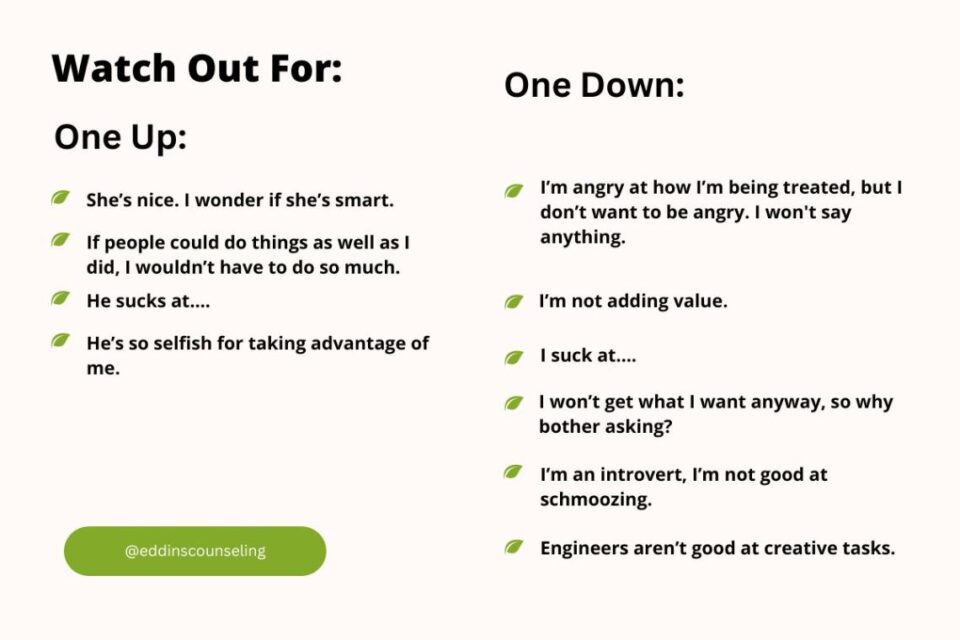
It’s not just about the negative voice towards ourselves; it can also manifest in judgments towards others. For example, thinking, “She’s nice, but I wonder if she’s smart,” carries judgment and reflects how the inner critic can influence our perceptions of others.
Thinking, “If only people could do things as well as I do,” might seem like a valid belief at first. However, holding onto that mindset can impact you negatively later. This kind of thinking often redirects itself back towards you, reinforcing the inner critic’s negative influence, even if it starts as a judgment towards others.
When we hold ourselves back, thinking, “I don’t want to be angry, so I won’t say anything,” we’re allowing the inner critic to keep us in a one-down position. It’s important to recognize these thoughts as the inner critic’s voice, separate from your true self. When you notice these patterns, you can begin to work with them, rather than just accepting them as truth.
Often, we unconsciously merge with these thoughts, believing them without question. By recognizing how they show up, both in how we treat ourselves and others, we can begin to shift them into something more constructive.
Strategy #2: Self (& Other) Compassion
Notice & PAUSE the Inner Critic
The next strategy is that we are going to notice the inner critic, and then pause it. We want to use compassion for ourselves and compassion for others, the way that we did in that first example. We’re going to notice that you’re triggered by the critic. That’s the negative voice that you’re hearing, or it could just be towards the outside world.
We’re going to pause, slow down, and get curious: “What am I really feeling right now? What’s going on?” It’s important to accept who we are in that moment and accept our feelings as they are. Acceptance often gets misunderstood as resignation, as if we’re giving up or settling. But true acceptance isn’t about resignation; it’s about acknowledging our current reality without judgment, which allows us to move forward with clarity and compassion.
What it means is that we’re accepting ourselves as we are with a full range of positive, and negative emotions.
It’s not necessarily about being defeated. It’s just more of a more open-hearted feeling. Then we’re going to choose compassion, and we’re going to use some of the examples that we just practiced. You can consider: “What would I say to a friend who’s really struggling with this? How can I say that to myself?”
Practicing forgiveness is crucial when dealing with the inner critic, which often latches onto a kernel of truth – whether it’s a deeply held value or something else. The inner critic is unforgiving and rigid, always ready to attack.
Learning the art of forgiveness helps us break free from its grip and actually enables us to grow and change.
If you’re stuck in a shame spiral, thinking, “I yelled at the kids; I’m a bad parent,” the overwhelming guilt can prevent you from moving forward. Forgiving yourself allows you to acknowledge the situation, learn from it, and approach future moments with greater compassion and understanding. It can be difficult to separate from that guilt, but if you can practice forgiveness, you can start thinking, “Next time, when I’m feeling tired or hungry and haven’t made dinner yet, this is how I might handle the situation.” Forgiveness gives you the space and opportunity to change.
First, we need to notice the critic, then pause and slow down, because thoughts move very quickly. That’s why it’s important to take a breath and slow down. After that, practicing compassion and ensuring we forgive ourselves is crucial. This practice can extend to how we relate to others as well.
Overcoming Hurdles
How the Critic Shows Up & the Antidote
One of the biggest challenges in dealing with the inner critic is realizing how hard it can be to let go of it. On the surface, the idea of silencing the critic seems appealing, but then you start to recognize the role it plays or the grip it holds on you. For some, the inner critic feels like a necessary motivator – the voice that pushes you to get out of bed, put on your shoes, and get things done. It can seem like you need that voice to drive you forward.
You might feel like there’s yourself, and then this voice on top, yelling at you. It might seem like motivation on the surface, but in reality, it’s not. Instead, it’s like running in place—you’re expending energy without really getting where you need to be. The inner critic actually creates more fear and shame, which can hinder true motivation and progress. When you find yourself saying, “I’m too busy, I don’t have time,” it’s a signal to pause and consider how you can ask for help.
Seeking assistance is a way to show self-love and care.
Additionally, this touches on the broader topic of setting boundaries. Learning to be selective about what you take on is an essential aspect of establishing healthy boundaries. One common hurdle is the belief that “my effort speaks for itself,” expecting others to notice your hard work—whether it’s at home, at work, or elsewhere. It’s important to own and acknowledge your contributions without waiting for others to recognize them.
Another related hurdle is the expectation that others should automatically know what you need. This often ties into setting boundaries. Being specific about your needs and communicating them clearly is crucial. When you expect others to guess what you need and don’t get it, it can lead to feelings of inadequacy or self-blame.
Clear communication helps ensure your needs are met and reduces the influence of the inner critic.
Action is one of the most powerful antidotes to fear. The inner critic often operates from a place of fear or shame, leading to thoughts like “I can’t do it.” Taking action, even in small steps, builds confidence and demonstrates willingness and courage. Sometimes, it might involve taking risks. Keeping an “I Did This” journal can be a helpful way to remind yourself of your accomplishments, reinforcing the fact that you can take action and make progress, no matter how small the steps may seem.
In a workplace setting, thoughts like “I don’t have time to think about what I want” or “Nobody would support me” reflect the inner critic’s influence. To counter this, focus on building relationships as a means of connection and support. Developing a network of colleagues and allies can provide the encouragement and backing you need, making it easier to address your goals and challenges.
Strategy #3: Challenge Limiting Beliefs
Exercise

Think of an area in your life you want to feel better about. Write this down.
Start by identifying a specific area in your life where you’d like to improve how you feel. Instead of general categories like “relationships,” “health,” or “work,” try to be more precise. For example, you might focus on “improving my work-life balance” or “feeling more confident in social situations.” The more specific you can be, the clearer your goal will be.
Describe and list how you WANT to feel about this area of your life.
Examples: Passionate energized, ecstatic, inspired, calm, at ease, relaxed, confident…Write this down.
Next, consider how you want to feel about this area of your life. Use descriptive words to capture your desired emotions. Don’t worry if these words seem unrelated or even contradictory—such as wanting to feel both excited and calm. The goal is to generate a comprehensive list of feelings you aspire to experience.
Think of what new or alternative belief/s you would need to have to feel this way. Write these down.
To address the inner critic and develop alternative beliefs, start by reflecting on the negative thoughts or criticisms you face in the area you want to improve. For example, if your inner critic often says, “I’m a bad parent,” recognize this as a limiting belief.
Next, create positive, affirming beliefs that counter the negative thoughts and align with how you want to feel. If you aim to feel relaxed and confident, you might adopt beliefs such as, “I am a loving and dedicated parent,” “I am doing my best, and that’s enough,” “It’s okay to make mistakes and learn from them,” “I have a lot of love and care to give,” and “It’s okay if others don’t always agree with me; I can learn and grow from different perspectives.”
Acknowledge that these negative beliefs often arise from a place of care or concern. For instance, feeling like a bad parent might stem from your deep desire to be a good one. Use this understanding to reframe your beliefs positively by recognizing that your feelings of inadequacy are rooted in your commitment to being a good parent and that caring deeply means you are invested in doing well.
Focus on the positive aspects of your efforts and actions. Instead of dwelling on what went wrong, affirm the positive contributions you are making. Remind yourself that you are making a difference through your actions and that you are contributing positively to your family.
Understand that it’s natural to experience a range of feelings, including those that might seem contradictory. Embrace both excitement and calm as part of your overall experience. Approach yourself with self-compassion and kindness. Recognize that everyone has strengths and areas for growth, and this is a normal part of being human.
Integrate these new beliefs into your daily life by regularly reminding yourself of them, especially during challenging moments. By focusing on positive beliefs and acknowledging your inner critic with compassion, you can gradually shift your mindset and approach to the areas you want to improve.
What do you make of these Beliefs? Can you believe them?
Take a moment to review the new beliefs you’ve written down. Reflect on whether you truly believe these statements. Picture the situations where your inner critic’s negative beliefs might arise and then imagine those situations with your new, positive beliefs in place. Consider how these new beliefs resonate with you in these scenarios. Are they believable? Do they feel right?
If you find it challenging to fully embrace these new beliefs, consider adjusting them slightly to make them more relatable and achievable. Think of them as a step toward something that feels both practical and inspiring to you.
It’s common to understand new concepts intellectually but find it harder to integrate them emotionally. Change often happens at the pace of our deepest emotions, especially when dealing with significant issues like shame or trauma. Allow yourself the time to fully absorb these new beliefs and how you want to feel.
When working with your inner critic, acknowledge it without dismissing it. Imagine it as a persistent distraction—like a child or a pet seeking attention while you’re busy. Rather than telling it to go away, gently acknowledge its presence and continue with your focus. This approach can help you manage your inner critic without being overwhelmed by it.
Remember that your inner critic often stems from past hurt or fear. It’s a natural part of wanting to connect and belong, but it can also be based on limited or outdated experiences. Be patient and gentle with yourself as you teach your inner critic that things can be different and that it is not to blame. Recognize that these feelings are part of your human experience and not a definitive reflection of your worth or abilities.
How can you use them to increase your success?
For this final exercise, ensure you’ve noted down what you want to feel and believe. Keep these notes visible on your phone or computer, or place them somewhere you can easily reference. Reflect on the emotions and beliefs you aspire to have. Consider what new beliefs you’ve adopted and how they differ from your previous ones.
Understand that your inner critic often stems from fear and shame, which can be very vocal. It’s important to recognize and acknowledge these feelings rather than letting them dominate your thoughts. By sharing your feelings, taking deep breaths, and practicing forgiveness and acceptance, you can prevent these emotions from spiraling into deeper shame. Focus on how you want to embody your values and live by them. For instance, values like parenting, love, and connection with family and friends are significant.
At its core, many of our desires and struggles are about connection and feeling valued. When you notice your inner critic, remind yourself that it’s a manifestation of your fear of not connecting or not being valued. This realization can help you shift your perspective. Recognize that the inner critic’s voice is rooted in your need for connection and worth.
Acknowledge that it’s okay to feel this way and that healing is possible. You don’t need to stay stuck in negative feelings. As you move into the evening, consider reflecting on your new beliefs and feelings before you go to bed. Let yourself feel loved, proud, and connected as you wind down. Embrace these positive emotions and beliefs, allowing them to gradually replace the inner critic’s voice. This practice can support you in making the changes you seek and fostering a more positive self-perception.
Remember, you’re not alone in this experience. Feeling inadequate at times is a part of human nature. Our social instincts drive us to seek belonging and connection, and these feelings often arise because of our deep-seated need to connect with others and find our place within social circles.
Brené Brown often emphasizes the importance of finding safe spaces to be vulnerable. It’s crucial to start small when sharing personal feelings and observe how they are received. A good starting point for exploring vulnerability is with a therapist, as they provide a safe and supportive environment. From there, you can gradually open up to others based on your experiences and their responses.
If you’re reflecting on past actions that seem at odds with your current values, it’s important to practice self-forgiveness. Remember that personal growth involves evolving over time, and it’s natural to look back and see things differently. Acknowledge your progress and be proud of the person you’re becoming. Incorporate new beliefs like “I’m proud of the person I am becoming” and visualize yourself embodying these values. Use your past to inform your future but don’t let it hinder your growth.
If you have any more questions or would like to discuss how we can support you in achieving your goals, feel free to give us a call or send us a text. You can also schedule a free consultation through the link on our website. We’re here to help and would be happy to assist you. Additionally, we offer other webinars that may cover topics relevant to your needs, so be sure to check them out.
Thank you for the thoughtful questions. If you need further support or have additional questions, please feel free to reach out. Have a wonderful night!
Feel free to visit additional resources:
1. Articles on specific topics on our blog.
2. RSVP for one of our free monthly webinars (or view past webinars)
3. Follow us on Facebook and Instagram for additional interviews and tips
4. Take another one of our self-test quizzes
5. Schedule a consult and find out how we can support you.