
November 13, 2025
Webinar: Confidence Under Pressure: Strategies for Overcoming Performance Anxiety
Written by Guest Author
Do you find yourself frozen with worry just when you need to shine—whether it’s giving a presentation at work, taking a test, performing on stage, or stepping onto the field for a big game? Do thoughts like “What if I mess up?” or “What will others think of me?” leave you feeling insecure, frustrated, or even paralyzed? If so, you’re not alone—and you don’t have to let performance anxiety control your life.
Join us for “Confidence Under Pressure: Strategies for Overcoming Performance Anxiety”, a Focus on Wellness Webinar led by Hunter Loughhead, a Counselor in Training at Eddins Counseling & Therapy Group and a Master’s student in Clinical Mental Health Counseling at the University of Houston. Hunter draws from Cognitive Behavioral Therapy, Dialectical Behavior Therapy, and Mindfulness-based strategies to provide evidence-based tools that help you transform stress into energy, so you can perform at your best even under pressure.
In this interactive webinar, you’ll learn to:
- Recognize and manage the anxiety that arises before and during performance
- Adapt realistic expectations and stop catastrophizing mistakes
- Build confidence in your preparation and abilities
- Develop resilience and self-compassion for long-term growth
- Stay rooted in the present moment instead of worrying about others’ judgments
Imagine walking into your next test, recital, meeting, or game with a clear mind, a calm body, and the confidence to put your practice into results. No more freezing up or letting worry undermine your potential—you’ll leave this session with practical strategies to transform anxiety into manageable energy and perform at your best.
Don’t let performance anxiety hold you back from achieving your goals and enjoying the roles you play in life. Take the first step toward confidence under pressure.
Watch a replay of the presentation here.
This webinar is facilitated by Hunter Loughhnead. We are doing Confidence Under Pressure: Strategies for Overcoming Performance Anxiety.
First of all, maybe we’re all here just because we’re curious, but we’d like to take a second to reflect on what performance anxiety really means to us. When do we experience it? What do we know about it? It’s likely something we’ve experienced before, and we’ll definitely get into it and talk more about it.
Purpose of this Webinar
- Recognize and manage anxiety that arises before and during performance.
- Adapt realistic expectations and stop catastrophizing mistakes.
- Build confidence in your preparation and abilities.
- Develop resilience and self-compassion for long-term growth.
- Stay rooted in the present moment instead of worrying about others’ judgments.
The purpose of this webinar is to recognize and manage the anxiety that arises before, during, and sometimes after performance. We’re going to talk about adapting realistic expectations, trying to stop catastrophizing mistakes, building confidence in our preparation and abilities, and developing resilience and self-compassion for long-term growth. We’ll also talk about how to stay rooted in the present moment instead of worrying about other people’s judgments.
About the Facilitator: Hunter Loughhead
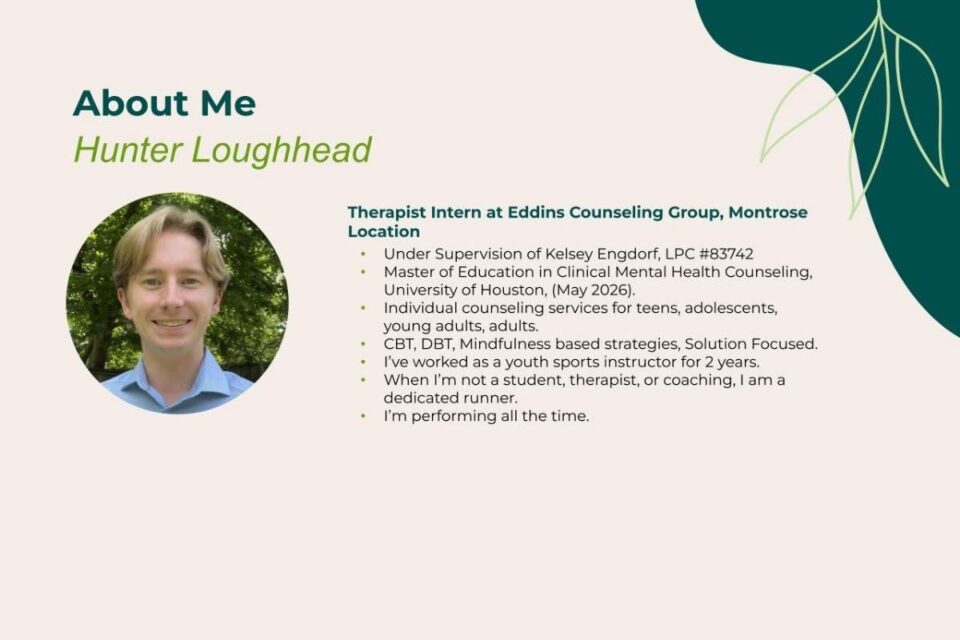
Briefly, here’s a little bit about the facilitator. Hunter is a therapist intern at Eddins Counseling & Therapy Group at the Montrose location, working under the supervision of Kelsey Engdorff.
He is currently getting his Master’s of Education in Clinical Mental Health Counseling at the University of Houston, and he is going to graduate in May of 2026. He currently provides individual counseling services for teens, adolescents, young adults, and adults, primarily using CBT, DBT, mindfulness-based strategies, and some solution-focused approaches as well.
He’s worked as a youth sports instructor for two years and counting, so he performs all the time as a student, therapist, or coach. He is also a dedicated runner, running marathons. What makes him qualified is that he puts a lot of research and time into this, and he is a person who performs. With that, sometimes there comes anxiety, which is what really brought him to this topic and why we really wanted to talk about it.
What Does It Mean To Perform?
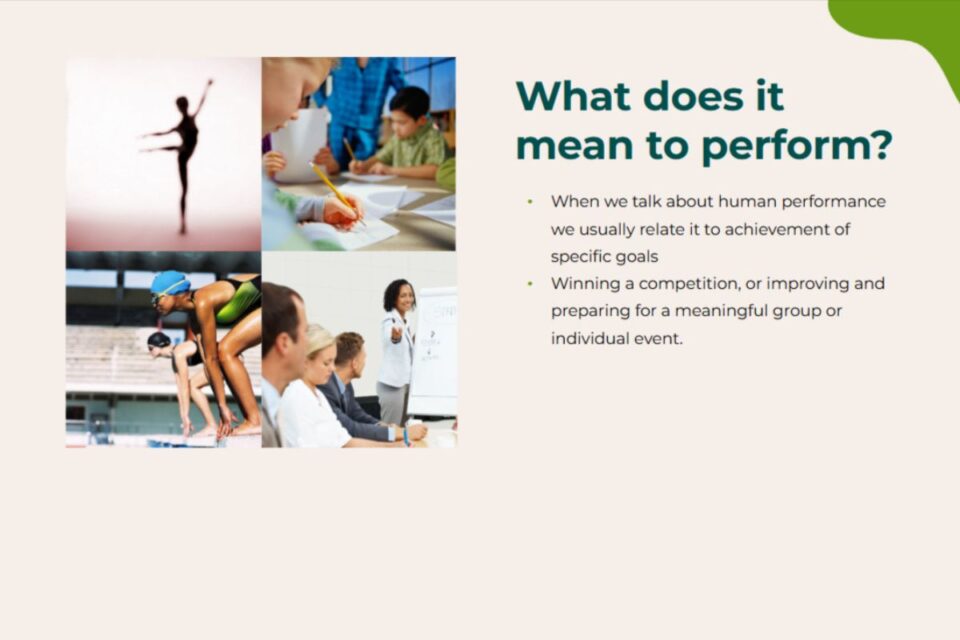
What does it really mean to perform? When we talk about human performance, we’re usually talking about achievements and specific goals – whether those goals are winning in competition, improving, or preparing for meaningful events.
Performance, in psychological terms, occurs when we’re trying to execute behaviors while also being observed or evaluated by others. These situations tend to activate social evaluation awareness, and they can really trigger potential performance anxiety.
Where/When We Perform
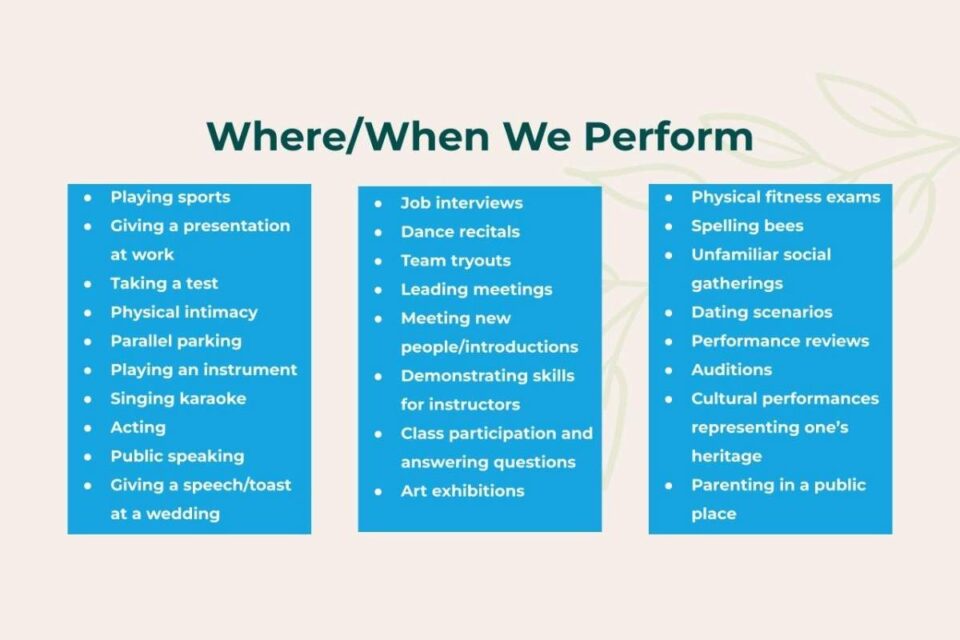
And so the contexts in which we perform are plentiful, whether they are formally structured performances, like presentations, speeches, giving talks (including what we’re doing right now), artistic performances, conferences, athletic competitions and sporting events, job interviews, legal proceedings, or religious performances. Those are all examples of formal, structured performances.
Informally, when we meet new people, and we’re trying to make first impressions, or when we’re in group discussions and meetings, telling stories, navigating dating interactions, giving toasts at a wedding, or sharing on social media – those are examples of informal performance situations.
Professionally, if we’re teaching, if we’re educators, working in customer service, managing or leading others, or demonstrating our professional expertise in any way, those also count. And then there are more intimate performances, as we mentioned earlier – dating, being with our partners, or parenting under the observation of others. These are all contexts in which performance anxiety can arise.
As we look more closely at these scenarios, we might recognize that there are many different contexts in which we are performing, and we are performers in one way or another. All of these contexts have the potential to bring about performance anxiety.
What Really Is Performance Anxiety?
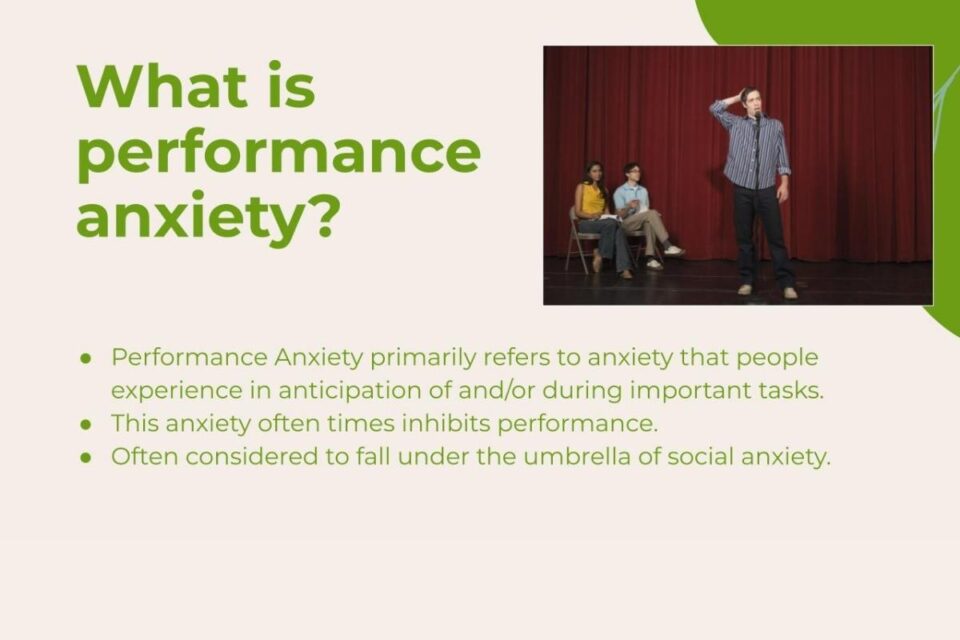
Performance anxiety primarily refers to the anxiety that we experience in anticipation of and/or during important tasks.
This anxiety often inhibits our performance. It’s sometimes known as stage fright or fear. It can be a psychological and physiological response, as we’ll talk about later. It’s usually triggered when there is potential for evaluation or scrutiny while we’re performing tasks in front of others. It tends to be situational anxiety that arises specifically in response to evaluation.
Performance anxiety can share some features with social anxiety and can fall under that umbrella, but it’s not all-encompassing of all social experiences. When we’re in a specific performance context, that may be when we experience anxiety, rather than in any social event or interaction.
Many of us who experience performance anxiety might find that it’s limited to that particular context instead of all social situations. We might feel anxious standing on a stage giving a speech, as opposed to simply having a conversation with a friend. That’s really how we distinguish the two.
Experience of Performance Anxiety
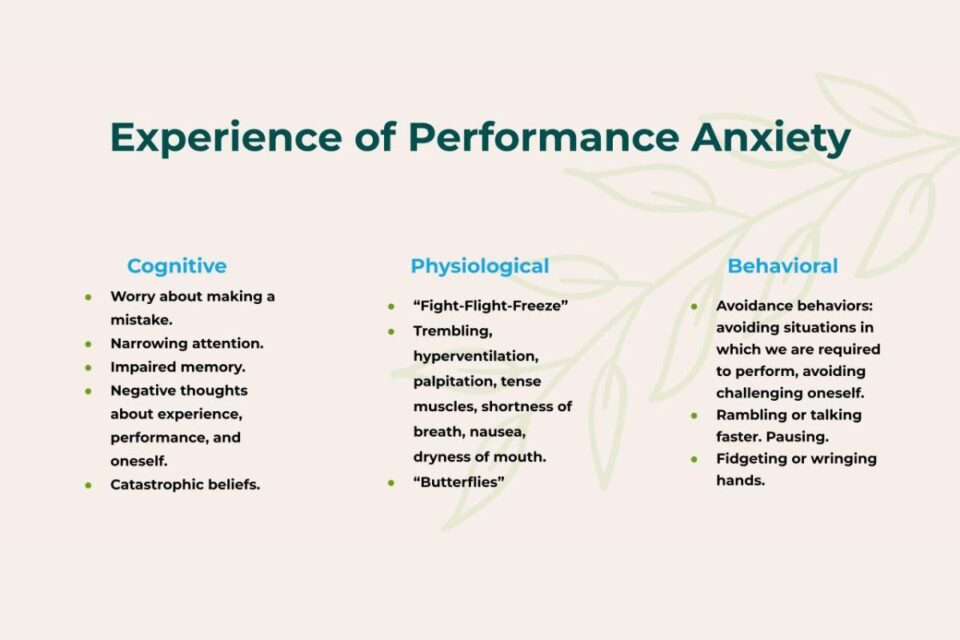
Going into the actual experience of performance anxiety, we have cognitive, physiological, behavioral, and emotional responses.
Cognitive Response to Performance Anxiety
Cognitively, we might notice worry about making a mistake, narrowed attention, impaired memory, negative thoughts about our experience, our performance, or ourselves, and even catastrophic beliefs.
Maybe we have excessive concern about evaluation and judgment. Maybe there’s self-focused attention that interferes. Maybe we’re being perfectionistic and expecting really unrealistic things. Or maybe we’re having negative anticipatory thoughts about what might happen. And sometimes, even after the performance or event, we’re ruminating about it, and everything we thought went wrong.
When we experience that, we’re really impaired because our focus is taken away from the goal – away from goal-directed processing and intentional thinking about what our performance actually is. We end up paying much more attention to potential threats than to what we’re actually doing.
For example, if we were giving this presentation and we were looking at everyone’s faces for any sign of a frown, or discontent, or if someone was looking at their phone instead of at us, we might turn our attention toward the threat of the presentation going poorly. We’d be so focused on whether the audience enjoys it or is entertained that we could forget our notes or lose focus on the presentation itself.
Maybe we’d even develop negative thoughts about our performance – maybe thinking, Man, this is really going poorly. I hate this. Everyone thinks I suck. Or maybe we’re being catastrophic: I’m going to get fired after this because this is so bad. These beliefs are really unhelpful and oftentimes untrue.
Physiological Response to Performance Anxiety
Then there’s the physiological response. Our autonomic nervous system becomes aroused with increased heart rate and blood pressure. There are elevated cortisol and adrenaline levels. We might experience muscle tension and tremors. There are respiratory changes, like hyperventilating or shortness of breath.
Maybe we experience some digestive disruption – nausea, that “butterflies” feeling people talk about, or a dry mouth. Maybe we’re sweating or having difficulty with temperature regulation. And then at the top there, we see fight, flight, freeze – maybe we’re activating that real stress response when we’re experiencing performance anxiety. That can really be a distraction and make it hard to focus on what we’re doing. We feel our hearts pounding and feel like we can’t breathe, and it takes our focus away.
Behavioral Response to Performance Anxiety
Then there are the behavioral aspects of the experience, which could include avoidance behaviors – avoiding situations in which we’re required to perform or avoiding challenging ourselves. Maybe we’re rambling or talking faster. Maybe we’re pausing. Maybe we’re fidgeting or wringing our hands. Sometimes we might volunteer to take lesser roles so we don’t have to present.
Sometimes it may look like we’re turning down promotion opportunities because we might have to take on increased duties in which we present to other people. Maybe when someone requests volunteers, we can use the bathroom so that we don’t have to be involved. Maybe at work, we’re asking our colleagues to deliver information on our behalf so that we don’t have to, or we’re sending an email instead of going and talking to the person and presenting it in person.
Sometimes it’s more subtle than that. Maybe we’re overpreparing to the point where we’re memorizing scripts so we don’t have to talk genuinely, or making slides super detailed. Maybe we’re standing hidden away from the camera so people can’t see us as well. Maybe we’re speaking quickly just to get it over with.
Some of us might use alcohol or anti-anxiety medication as an attempt to cope before presentations. Maybe we’re insisting on only presenting to smaller groups. These are all examples of ways we might avoid or cope behaviorally with performance anxiety.
We’re not saying that we should never take medication if we’re anxious, but avoiding performance situations doesn’t necessarily prevent the anxiety from continuing, or help us acknowledge and challenge the catastrophic beliefs or potential negative outcomes.
It might solve the immediate distress by avoiding these situations, but it also reinforces the belief that performance anxiety and performance itself are dangerous. It reinforces the idea that, in order to be safe, we have to modify the environment or limit our exposure so we don’t experience it.
Then a little bit on the emotional experience. Of course, we have the experience of anxiety, but sometimes there’s also shame or low self-esteem that may be present as a result. We might feel ashamed about the fact that we’re having anxiety—thinking, Oh, we shouldn’t be feeling this way. Or maybe we have low self-esteem, and that’s contributing to the anxiety. These are all symptoms that we might experience, and that other people might experience, when we have performance anxiety.
Why Is It So Hard To Perform?
- High personal investment in the outcome.
- Perceived expertise expectations.
- Unfamiliar environments or audience.
- Significant consequences for failure.
- Limited control over circumstances.
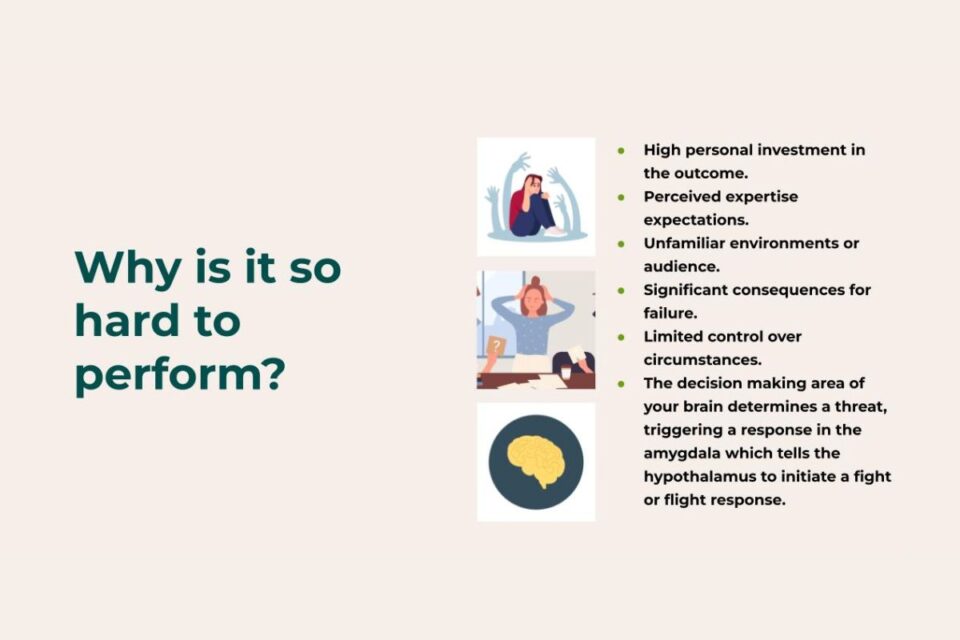
- The decision-making area of your brain determines a threat, triggering a response in the amygdala, which tells the hypothalamus to initiate a fight or flight response.
So why is it so hard? Performance anxiety tends to be heightened when there’s a high personal investment in the outcome. Maybe this is something that’s extremely meaningful to us, and we really want to get it right. Maybe there are perceived expertise expectations – I have to know everything about this. I have to be an expert. Maybe the environment is unfamiliar – We’ve never been on stage before. We’ve never spoken to these people before.
Maybe there are real, significant consequences for failure. If we have a poor tryout, then we might not make the team. If we don’t make the team, that could feel horrible. Maybe there’s limited control over the circumstances, which is sometimes the case. We can’t control everything that’s going to happen, and that can be anxiety-provoking.
There’s also a biological aspect – our brain may interpret a situation as a threat, which triggers a response in the amygdala. The amygdala signals the hypothalamus to initiate a fight-or-flight response, producing those physiological symptoms and experiences that make it hard for us to focus, stay in tune with what we’re doing, and perform effectively.
Yerkes-Dodson Curve
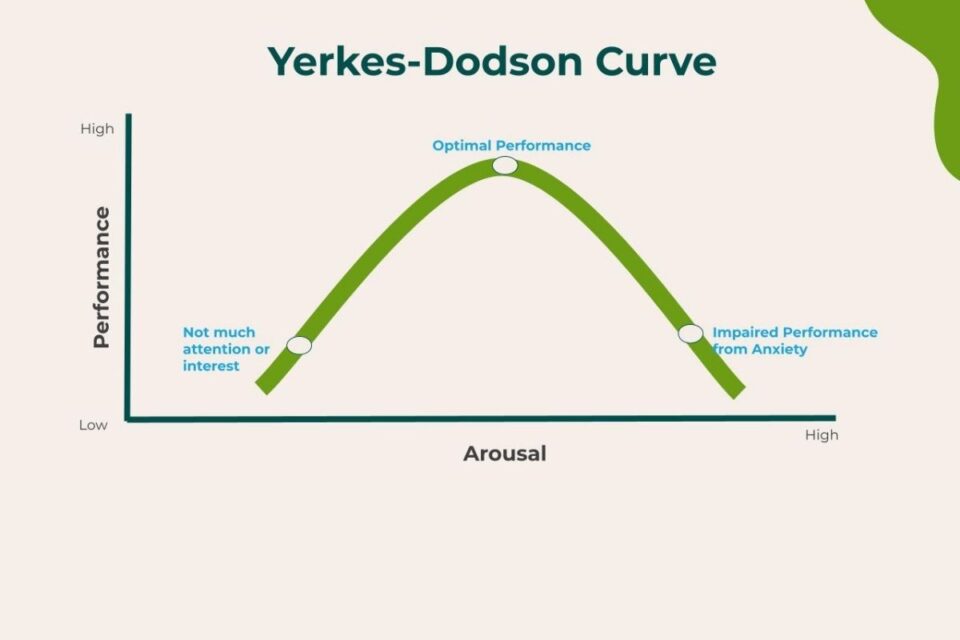
Now, when we do perform, there is a certain level of arousal that we’re really looking for to optimize our performance. This is illustrated by the Yerkes-Dodson Curve, also known as the Yerkes-Dodson Law.
They developed this theory while performing experiments on mice, using electric shocks that were able to teach the mice to learn a task, which they called a habit, more quickly. Without the shock, the mice showed less attention or interest in learning the activity.
But as the shocks got stronger, the mice took longer to learn the task. It’s believed that maybe they were more focused on avoiding the shock than actually completing the task. The idea here is that a moderate level of stress goes a long way. As long as it’s manageable, it can be motivational and performance-enhancing.
Maybe our hearts beat a bit faster, but we’re still feeling a sense of clarity and alertness. Our brains and bodies are activated, but in a way that gets us ready to perform at our best – at an optimal point. Once we surpass that point, our performance starts to deteriorate. We might get too stressed or too anxious to really perform our best.
So what’s the optimal amount? Well, it depends on the task. A simpler task, like ordering at the drive-through, doesn’t require much arousal or stress. More challenging tasks, like giving a speech at a wedding or performing on stage, might require a bit more arousal to ensure we’re performing at our best.
Traits of Successful Performers
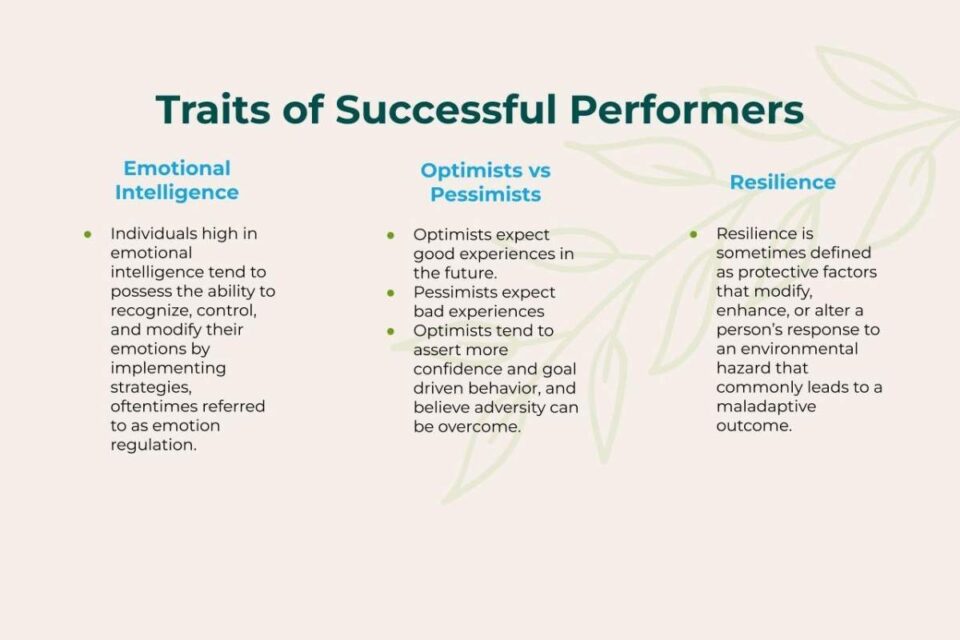
Who is good at performing? Traits of successful performers include emotional intelligence, optimism, and resiliency. We tend to find that people with these traits are more successful at performing.
Individuals who are high in emotional intelligence tend to assess their ability to recognize, control, and modify their emotions by implementing strategies often referred to as emotional regulation.
We tend to see that people with high emotional intelligence perform better in settings like academic performance, experimental tasks such as learning and decision-making, and sports. Emotional intelligence seems to be correlated with both short-term and long-term successful performance, and these individuals also tend to score higher on academic exams.
When it comes to optimism and pessimism, optimists tend to expect good experiences in the future, while pessimists tend to expect bad experiences. Optimists are generally more competent, goal-driven, and believe that challenges can be overcome.
For example, a group of researchers conducted a study with a group of elite swimmers, rating them on traits of optimism or pessimism. The swimmers were required to swim 100 meters, and then they were told that they had received a penalty on that swim – a one-and-a-half-second penalty – and were asked to swim again. What they found was that swimmers who demonstrated more of the trait of optimism, or could be characterized as optimists, tended to perform better than the swimmers who were pessimists.
This indicates that optimism can predict more successful performance, particularly after a setback. Despite the adversity and being told, “Oh, you messed up. You got this penalty,” optimists are able to take in that information and still perform better than pessimists might.
Resilience is defined as protective factors that modify, enhance, or alter our response to environmental hazards that commonly lead to maladaptive outcomes.
In other words, some of us tend to cope well – or even flourish—in response to stressful situations. Resilience is sometimes developed through adversity or very stressful life circumstances. Some people intentionally put themselves in challenging situations – for example, in the world of sport, a basketball player who has to make a free throw after a really hard foul must be resilient both physically and mentally.
One study found that people high in resilience experienced greater positive emotions in response to stressful situations. Additionally, those of us who are more resilient are more likely to interpret a stress-inducing task as a challenge rather than a threat. This brings to mind a little anecdote about Andy Murray: it is believed that experiencing failure repeatedly can build adversity and resilience for future performance.
More on Resilience
The tennis player Andy Murray, in 2012, had experienced a lot of major losses in his career. Most recently, he lost in the Wimbledon final to Roger Federer. Murray described it as one of the worst losses of his career – it was devastating. Despite these losses, in recent matches, he had shown greater maturity and reported feeling calmer under pressure. He wasn’t losing his temper as much – no more smashing his racket on the ground or yelling at officials.
Even after losing that match to Federer, Murray had to turn around and play the Olympics just two weeks later in London, on the same court as Wimbledon. Murray ended up playing an excellent tournament and reached the final against the same man he had just lost to in the Wimbledon final, Roger Federer, for the gold medal match. He ended up winning that match in straight sets, having just lost to Federer on that exact same court a month prior. He continued to find success afterward, winning Wimbledon the next year in 2013 against Novak Djokovic.
All of this illustrates how he built resiliency to bounce back from the adversity he experienced, which really helped him and supported him in these situations. He approached it more as a challenge than a threat, and his mindset is credited for carrying him into those more successful competitions and tournaments.
Strategies for Overcoming Performance Anxiety
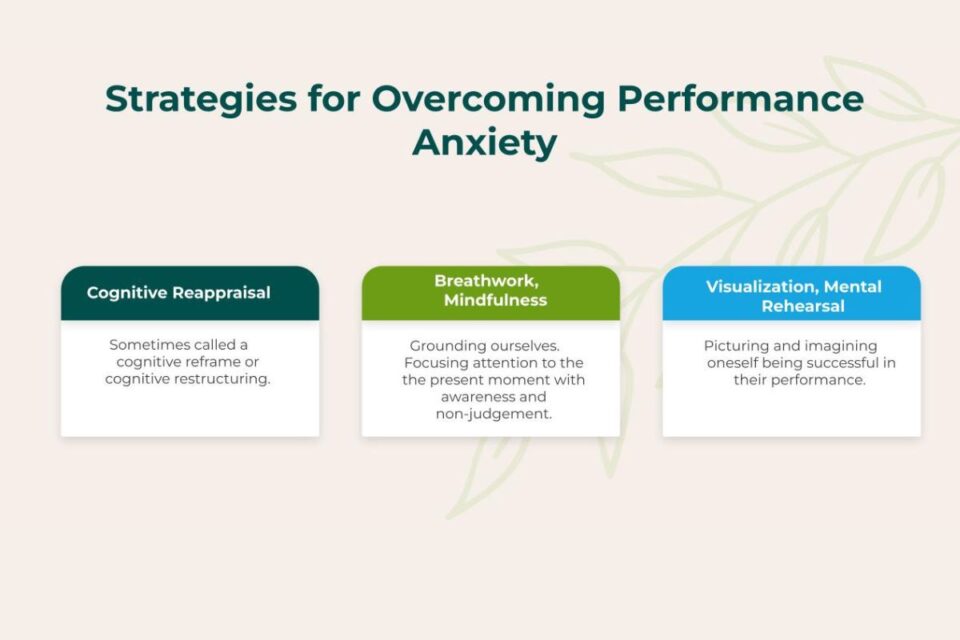
To really get into the “meat and potatoes” – the strategies for overcoming performance anxiety – the three that we’ll talk about today are cognitive reappraisal, breathwork and mindfulness, and visualization with mental rehearsal.
Cognitive reappraisal is sometimes called a cognitive reframe or cognitive restructuring. Breathwork and mindfulness involve grounding ourselves, focusing our attention on the present moment with awareness and non-judgment. And lastly, visualization and mental rehearsal involve picturing and imagining ourselves being successful in our performance.
Cognitive Reappraisal
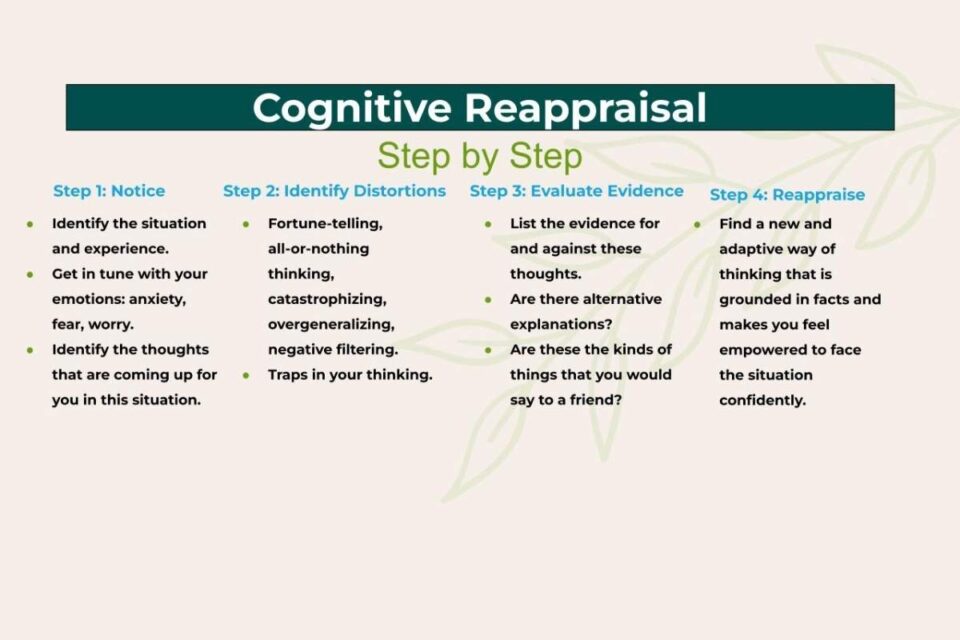
So, let’s break down cognitive reappraisal step by step. First, we want to notice and identify the situation and experience – really getting in tune with what the emotional experience is in terms of anxiety, fear, or worry. Then, we start identifying the thoughts that are coming up for us in this situation.
Are we telling ourselves, “I’m really stressed out. This is going to be a terrible experience. I’m going to fail?” Once we start noticing what’s coming into our minds, we can begin identifying the distortions there. Are we fortune-telling? Are we trying to make predictions about the future, like, “We’re going to do badly?” Are we saying things in all-or-nothing terms – black and white thinking? Are we catastrophizing? Are we overgeneralizing? Maybe we’re negative filtering, meaning we’re looking through a negative lens instead of a positive one. The key is really identifying the traps in our thinking.
Step three is evaluating the evidence. We can list all the evidence for and against these thoughts. Are there alternative explanations? Are these the things we would say to a friend? If we put this on a scale of 1–100, is it really completely true? For example, if a gymnast thinks, “If I do this one move, I’m going to hurt myself or fall off the bar,” we can ask, How likely is that on a scale of 1–100? Maybe it’s more like 33-50. If someone like me were on the bar, it might feel closer to 99-but what we’re really doing is weighing the evidence. Are these thoughts really true?
Finally, we want to reappraise – finding a new, adaptive way of thinking that’s more grounded in the facts and helps us feel empowered to face the situation confidently.
A lot of times, those initial thoughts that we have in response to anxiety are not necessarily helpful or true. We want to replace those with thoughts or affirmations that better prepare us to take on the performance in a confident way.
Cognitive Reappraisal: Examples
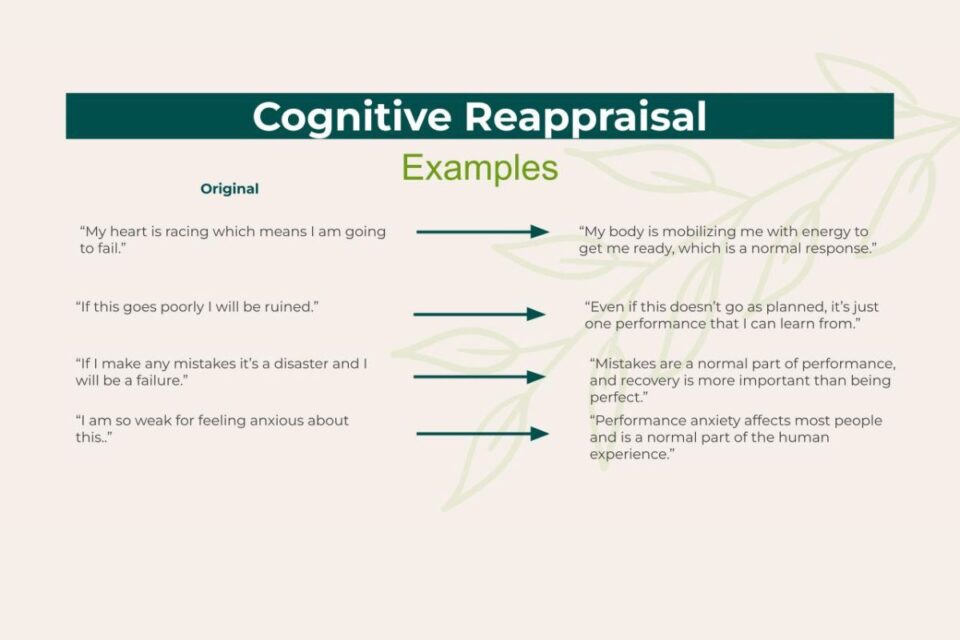
For example, an original statement might be, “My heart is racing, which means I’m going to fail.” Our reappraised thought could be, “My body is mobilizing energy to get me ready, which is a normal response.”
Another example: “If this goes poorly, I will be ruined.” That’s more catastrophizing and may not be true. Our reappraised statement could be, “Even if this doesn’t go as planned, it’s just one performance that I can learn from.”
Or, “If I make any mistakes, it’s a disaster, and I will be a failure.” That might reflect perfectionism or all-or-nothing thinking. If we really look at it, it’s not necessarily a helpful thought. We can put it on a scale of 1 to 100 – would we say this to a friend that they would be a failure if they made a mistake? Probably not.
Mistakes are a normal part of performance, and recovery is more important than being perfect.
We might also think, “I’m so weak for feeling anxious about this.” Maybe we feel that way from anxiety, but are we really weak because of it? A lot of people feel anxious. Is that really true? Again, is that the type of thing we would tell a friend – that they’re weak for feeling anxious? We might rephrase it to something like, “Performance anxiety affects most people. It’s a part of the human experience.”
This is something we would recommend practicing not just when we’re feeling super anxious, but at other times as well. Maybe we take some time to journal and write down the thoughts we’re having, and try to replace them with more helpful and adaptive thinking.
As we can see from the original thoughts, if we take all of those as true and tell ourselves these things, it’s not necessarily helpful and won’t optimize our performance. But if we reframe them in a more optimistic way, we might experience a little less anxiety and really optimize our performance.
Breathwork, Mindfulness
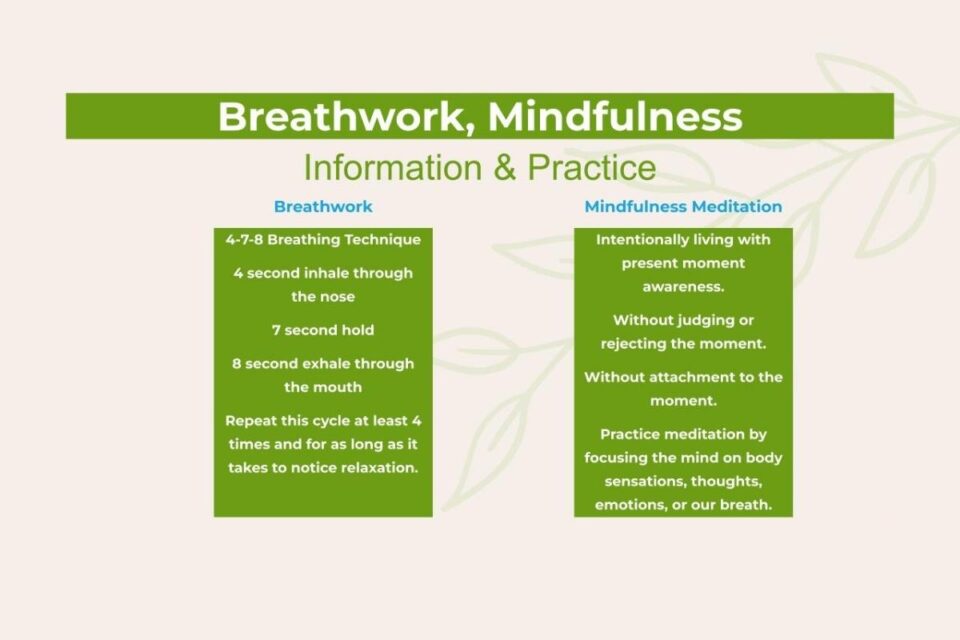
Now, moving into breathwork and mindfulness.
Breathwork is really about bringing down that fight, flight, or freeze response – really trying to calm ourselves. We might notice our hearts pounding or feel like we’re short of breath. One technique we like most, and have used for years, even before becoming therapists, is the 4-7-8 breathing technique: a 4-second inhale through the nose, a 7-second hold, and an 8-second exhale through the mouth. Typically, we want to repeat this cycle at least four times—or for as long as it takes to notice a sense of relaxation.
Then there’s mindfulness meditation. Mindfulness is intentionally living in the present moment – actively thinking about the present moment without judgment, without rejecting it, and without attachment. In practice, this is often done through meditation by focusing our minds on body sensations, thoughts, emotions, or our breath.
The goal is that when our attention has wandered, and we’re not fully focused on what we’re doing, we bring ourselves back to the present moment. When our thoughts are running amok, and we’re not really focused, we’re intentionally returning our attention to what we’re doing right now.
Practice 4-7-8 breathing
We’d like to take just a few minutes to practice. First, find a comfortable position, either seated or lying down, and allow our bodies to really settle, releasing any tension. We can close our eyes or maintain a soft gaze. Begin by noticing our natural breathing without changing it – simply observing the rhythm and sensation of each breath.
Now, we’ll transition to 4-7-8 breathing. Close the mouth and inhale quietly through the nose for a count of four. Hold your breath for a count of seven. Exhale completely through the mouth for a count of eight. Repeat: inhale for four, hold for seven, exhale for eight. Again: inhale for four, hold for seven, exhale for eight. One more time: inhale for four, hold for seven, exhale for eight. Now, return to natural breathing.
Next, bring awareness to our bodies. Notice any sensations without judgment. Starting with our feet, observe any tension, temperature, or tingling. Gradually move attention upward through our legs, then our torso, followed by arms and hands. Finally, bring awareness to the neck and head. For any areas holding tension, imagine our breath flowing there, bringing softness with each exhale.
Now, expand awareness to include the sounds around us, noticing the temperature of the room and any emotions present in this moment. When thoughts arise, notice them without attachment, letting them pass like clouds in the sky. Return to the anchor of our breath whenever needed.
To complete the practice, return to 4-7-8 breathing for two cycles: inhale 1-2-3-4, hold 1-2-3-4-5-6-7, exhale 1-2-3-4-5-6-7-8. Repeat for the second cycle. Gradually widen awareness of the room around us. When ready, gently open our eyes, carrying this centered awareness forward.
Mindfulness, like any skill, takes practice, and we can practice it anytime, anywhere.
All it takes is focusing our attention on the present moment and what we’re experiencing without judgment or attachment. We can anchor ourselves on our breath or on the things around us, simply noticing and describing the experience. This can be especially helpful in experiences of performance anxiety, when emotions feel overwhelming and difficult to manage.
Mindfulness is a way to bring ourselves back, and we recommend using it as a daily practice. Practicing in times when we don’t necessarily need it can make it easier when we do.
Visualization and Mental Rehearsal
Lastly, visualization and mental rehearsal. Imagery is a mental and psychological technique in which we imagine and visualize ourselves giving a successful performance or recalling a past successful performance.
For example, in a free-throw scenario, before taking the shot, we imagine what it looks like for it to already go in. We focus on the specific stages, techniques, and experiences as vividly as possible. When we imagine something in detail, our brains activate many of the same neural pathways we use during the actual performance. It’s essentially giving our brains extra practice without the physical action.
Research shows that elite performers across fields (from musicians to athletes to doctors) use this technique to enhance performance. It strengthens the mental blueprint of our performance, makes movements more automatic, and helps manage anxiety by familiarizing ourselves with the environment and potential challenges.
It also builds confidence through repeatedly experiencing success mentally and improves focus by training our attention on relevant cues rather than distractions or worries.
Visualization and Mental Rehearsal: Step by Step
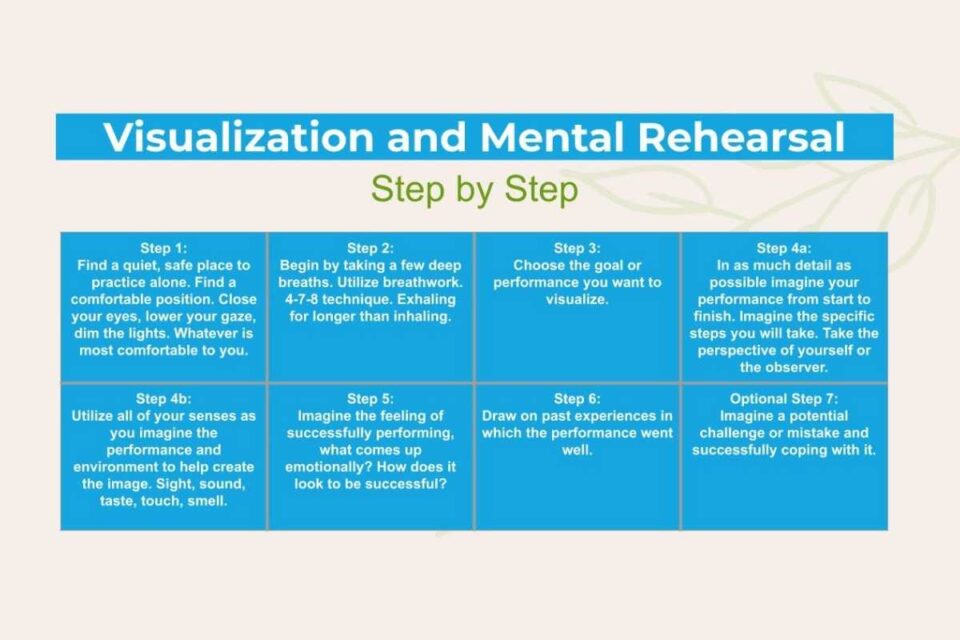
Step by step, first we want to find a safe, quiet place to practice and get into a comfortable position. Just like with mindfulness, we might lower our gaze, close our eyes, or dim the lights – whatever makes us feel comfortable. Then we might use the breathwork we just practiced to calm our system and get into a centered state.
Next, we clarify and choose a goal or performance we want to visualize. For example, We want to feel confident and deliver this meeting really well. We want to have a good practice. We want to have a great game. We want to play this song perfectly.
In as much detail as possible, we imagine our performance from start to finish.
We picture the specific steps we’ll take, either from our own perspective or as an observer, whichever makes sense, and imagine it vividly. We want to engage all our senses: sight, sound, taste, touch, and smell.
What will it look like? How will we look? What does the environment look like? What will it sound like? Are we touching or holding anything – a clipboard, paper, notebook? What does it smell like? We immerse ourselves fully in the environment.
Then, we imagine the feelings that come with successfully performing. What emotions arise? Is there a sense of confidence, accomplishment, or joy? What does success look like? We can also draw on past experiences of successful performances. Have we done this before and had it go well?
For example, if we’re leading a meeting at work, we visualize the room, who’s present, projectors, a board, people talking, ticking clocks, videos, or music – anything that’s part of the environment. Are we using a clicker, a laser pointer, or a clipboard? What do we want to happen? How will it unfold? Maybe we pace it just right, make a joke that everyone enjoys, or ensure a particular point comes across. How will we phrase things? What does it look like? Were past presentations successful?
An optional final step: once we’ve imagined the ideal scenario, we can imagine potential challenges or mistakes and see ourselves coping successfully. Maybe the room is too cold or hot, so we adjust a sweater or jacket. Maybe the projector fails, and we ask everyone to wait while we restart. We imagine recentering ourselves and continuing confidently, performing well despite obstacles.
We recommend practicing in five-minute increments, as often as possible. Imagine the performance in vivid detail, step by step, seeing it successfully completed. The more we practice, the more confident and prepared we feel, ready to perform and achieve the desired outcome.
Summary
To summarize: we perform in many different contexts throughout our lives, and performance anxiety can arise in anticipation of or during performance. It can inhibit our ability to perform, especially when stress exceeds optimal levels. Performance anxiety can manifest cognitively, physiologically, behaviorally, and emotionally, influenced by both internal and external factors. People who perform well tend to be high in emotional intelligence, optimism, and resiliency.
The three strategies we discussed – cognitive reappraisal, breathwork and mindfulness, and visualization with mental rehearsal – can help us reduce anxiety and perform better. They work by changing negative thought patterns, bringing our focus back to the task at hand, and building confidence through mental practice and visualization of success.
If we have questions, Hunter can be reached at [email protected]. There will also be a questionnaire we’re encouraged to fill out. This webinar will be posted on YouTube for us to watch at our convenience.
A little about Hunter: therapist intern at Eddins Counseling & Therapy Group. He can also be contacted by phone at 832-810-0817, extension 528, or visit the website for other resources and webinars. The office can be reached at 832-559-2622.
Thank you for participating—we hope we got something valuable from this session, and we can reach out with any further questions at [email protected]
Feel free to visit additional resources:
- Articles on specific topics on our blog.
2. RSVP for one of our free monthly webinars (or view past webinars)
3. Follow us on Facebook and Instagram for additional interviews and tips
4. Take another one of our self-test quizzes
5. Schedule a consult and find out how we can support you.
Whether we’re learning how to manage performance anxiety or building habits that help us stay calm and focused under pressure, confidence and resilience are skills we can strengthen—one step at a time. With the right support, we can experience greater clarity, steadiness, and self-compassion, even when the stakes feel high.
If we’re ready to explore how to better understand our thoughts, emotions, and physical responses in performance situations, and create strategies to respond more effectively, our therapists are here to help. To begin, give us a call at 832-559-2622 or schedule an appointment online. We also offer online therapy for added convenience and flexibility.