February 12, 2026
Webinar: Flourishing: Simple Practices for Greater Well-Being
Written by Guest Author
Posted in Emotional & Mental Health, Self Help / Personal Development, Webinars and with tags: positive self-talk, self improvement

Have you ever looked around and thought, “I should feel happier than this”?
You’ve done everything you were supposed to—checked all the boxes, worked hard, cared for others, kept it all together. And yet, something still feels off. Life has started to feel like one long to-do list. You’re functioning, but not fulfilled. The spark you once had feels distant.
If this sounds familiar, you’re not alone—and it doesn’t have to stay this way.
In “Flourishing: Simple Practices for Greater Well-Being,” Kimberly Williams, MA, LPC-A, invites you to explore the science of flourishing and rediscover what it means to feel alive again. This webinar offers gentle, research-based practices to help you reconnect with meaning, increase joy, and cultivate emotional balance in your everyday life. You’ll learn small but powerful ways to shift from simply getting through the day to truly savoring it.
Kimberly combines the insights of positive psychology with a compassionate, person-centered approach, guiding you toward a more grounded, grateful, and connected way of living. Her passion is helping people move from “just surviving” to thriving—to wake up to a life that feels rich, purposeful, and authentically yours.
If you’re ready to stop running on autopilot and start feeling more energy, gratitude, and connection, this is your moment to begin.
Watch a replay of the presentation here.
This webinar is called Flourishing: Simple Practices for Greater Wellbeing. It is facilitated by Kimberly Williams, a professional counseling associate here at Eddins Counseling & Therapy Group.
Have you ever felt stuck, or like you’re ticking all the boxes—taking care of all your responsibilities and going through all the motions—but something just feels off?
You think, ‘Okay, I’ve accomplished this and that—so why don’t I feel fulfilled? Why am I feeling a little disconnected or flat?’ If you’ve ever felt that way, you’re not alone. We’ve felt that way, too, at various points in our lives. It’s common.
That’s what tonight is about. We’re going to talk about flourishing and how we can incorporate simple, small things into our daily lives to create more well-being. Tonight’s presentation is part of our Focus on Wellness series, a free monthly webinar that covers a variety of mental health topics, which our clinicians provide to the community. So be on the lookout—there are a lot of really good ones.
Agenda
- Understanding Flourishing
- Positive Psychology
- PERMA Model
- Practical steps you can start using today
All right, so what we’ll cover tonight is, first, understanding what flourishing is. Then we’ll go into positive psychology, the science of well-being, and how it studies flourishing. After that, we’ll go over a simple framework called PERMA, which is easy to remember and easy to implement in everyday life. Then we’ll move into some practical steps that you can use in your daily life.
Flourishing
What does it mean to flourish?
Flourishing is an optimal state of well-being.
It’s the ability to experience positive emotions, strong psychological functioning, and healthy social connections as well. It’s about feelings, activities, and thoughts that contribute to your overall life satisfaction.
One thing it is not is constant happiness—that’s a misconception. It’s about having meaning, connection, growth, and moments of joy alongside life’s stressors and struggles.
Flourishing Is a Skill
One of our favorite things about positive psychology is that it teaches us that well-being is not a personality trait—it’s a skill. That means it can be learned. You don’t have to change who you are, and it doesn’t have to involve big changes in your life. Small, consistent practices can create meaningful change.
Positive Psychology
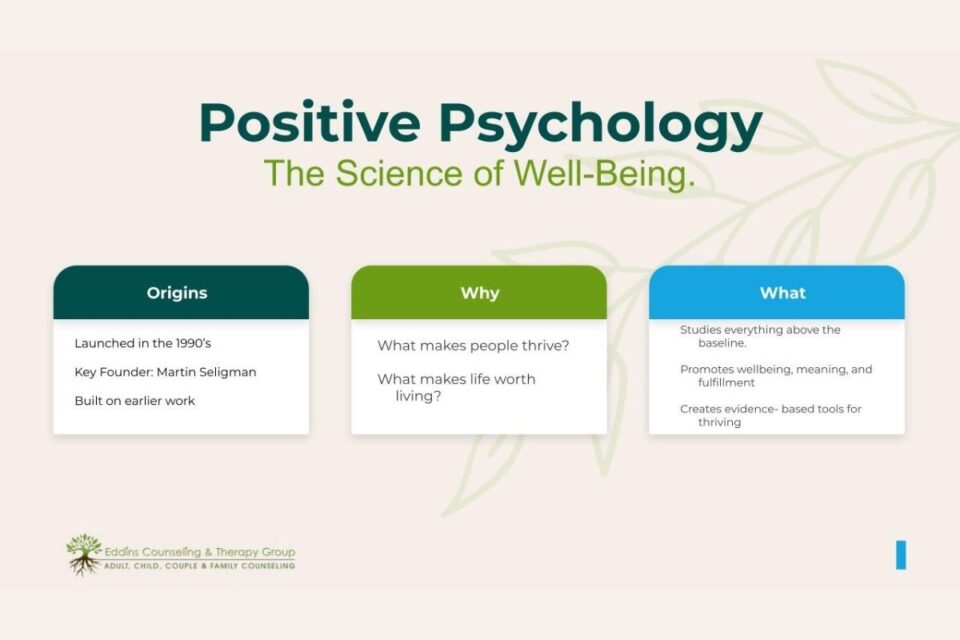
Moving on to positive psychology: Positive psychology is the science of well-being. It was developed in the late ’90s, and one of its key founders is Martin Seligman, often called the father of positive psychology.
One thing we want you to take away is that positive psychology was never meant to replace traditional psychology—that’s very important in addressing and diagnosing mental health issues. Instead, it complements it. Rather than asking ‘What’s wrong?’ positive psychology asks, ‘What makes people thrive?’
What makes life worth living? Positive psychology studies everything above the baseline. It promotes well-being and fulfillment, and it has helped create evidence-based tools to help people thrive. In studying everything above the baseline, we look at meaning, fulfillment, gratitude, resilience—that’s a big one—and your strengths.
The PERMA Model
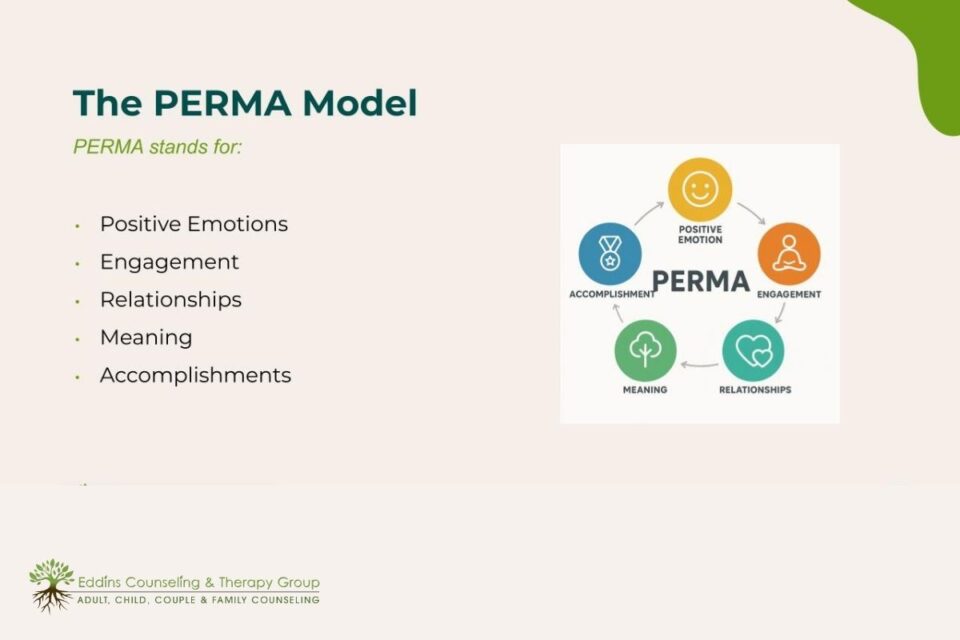
One of the most well-known frameworks that Martin Seligman designed is the PERMA model. PERMA stands for Positive Emotions, Engagement, Relationships, Meaning, and Accomplishment.
Positive Emotions
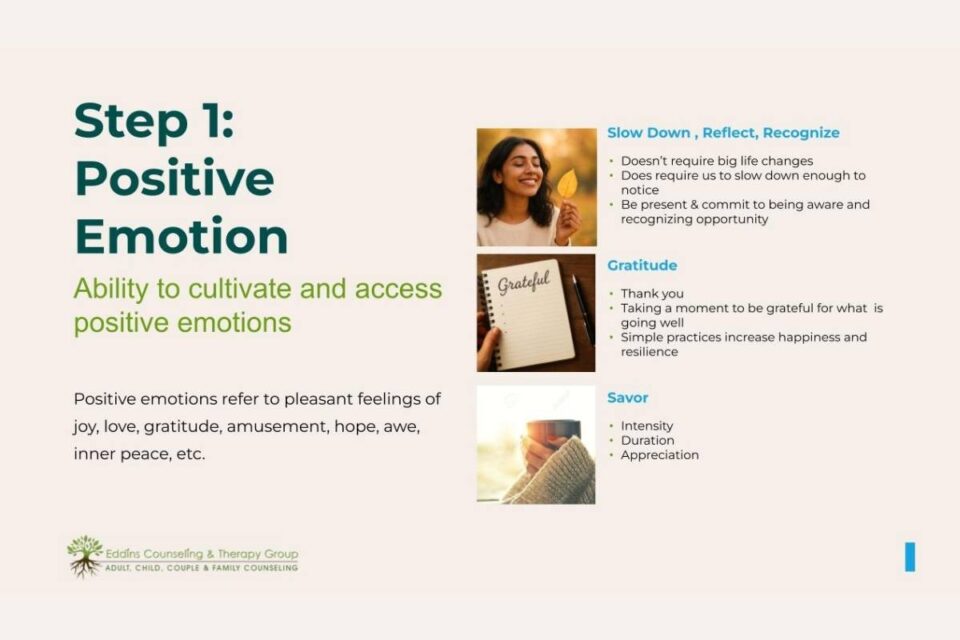
Let’s start with Positive Emotions. This is the ability to cultivate and access positive emotions. Positive emotions include feelings like joy, love, gratitude, amusement, hope, awe, and inner peace.
Yes, all of these things feel good, but they also broaden our awareness and build resilience over time. Research shows that positive emotions can help us think more creatively and cope more effectively.
And again, it’s not about constantly chasing big highs. It’s about slowing down and reflecting—taking time to recognize what’s good, what makes you feel good. That can look like simply slowing down and feeling relief in a moment. Sit with that. You don’t have to search for grand feelings of elation.
Just be present and commit to that connection with yourself.
Even a kind interaction—if you slow down enough instead of letting it pass you by—you can really sit with it and think, ‘Oh, that was nice. That felt good.’
Exercise is another great example. It boosts endorphins and creates that natural workout high. When we’re moving, the body does what it’s meant to do.
Then there’s gratitude. Gratitude is one of the most researched practices in positive psychology. Studies have found that simple gratitude practices increase happiness and resilience, and can even rewire the brain toward a more positive outlook.
Practicing gratitude in daily life can look like just saying thank you when you feel appreciative, or taking a moment to be grateful for what’s going on in your life. Knowing that these simple practices can increase happiness and resilience is powerful.
That then leads us to savoring. Savoring is a big one. Think about the kid who gets a new toy and then, after a couple of days, moves on to the next one. Or as adults, you get a new car, and then a new model comes out, and suddenly you want that new model.
Savoring is about sitting with what’s good and appreciating it for longer—truly enjoying the positive moments in our lives instead of immediately chasing the next thing. It increases the intensity, duration, and appreciation of positive experiences. With that in mind, we just need to slow down, pay attention, connect to what’s happening in our lives, and notice what’s good and what makes us feel good.
Engagement
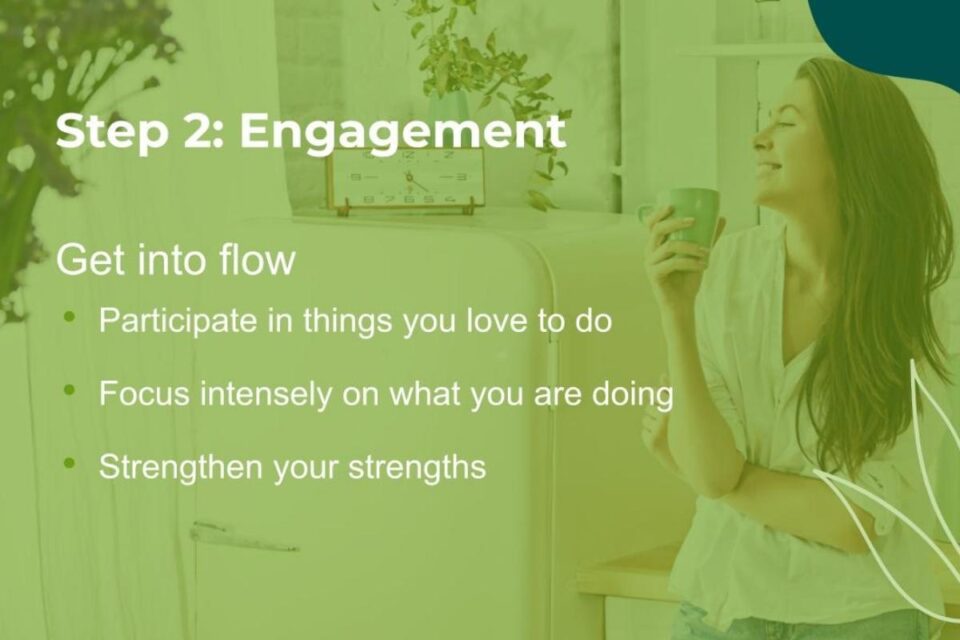
Step two is Engagement. Engagement is about getting into the flow. Think about athletes when they get into the zone—what makes you feel like you’re in the flow? When do you lose all track of time and become completely absorbed in what you’re doing? This isn’t about disconnection; it’s about deep connection. It’s about doing more of what we love and what we’re naturally good at.
Each of us has natural strengths—kindness, curiosity, honesty, resilience. Research shows that regularly using our personal strengths is linked to greater satisfaction and lower levels of depression. Too often, we focus on what we’re lacking, but we need to find a balance and spend just as much time strengthening our strengths.
And that’s what flourishing is all about. It requires intentional focus on our strengths. So ask yourself: When do we feel our best? When do we lose track of time? That could be something as simple as putting on your favorite song, belting it out at the top of your lungs, and fully committing to that moment—being present. If we’re runners, it might mean going for a run and letting the world melt away around us, just getting into that flow.
You’ll notice a pattern: it’s not about huge things. It’s small, consistent practices. We don’t have to become someone else, and we don’t have to make big changes. Flourishing happens when we learn to lean into who we truly and authentically are. And authenticity is something you’ll see keeps coming up—it carries over into each step of PERMA.
Relationships
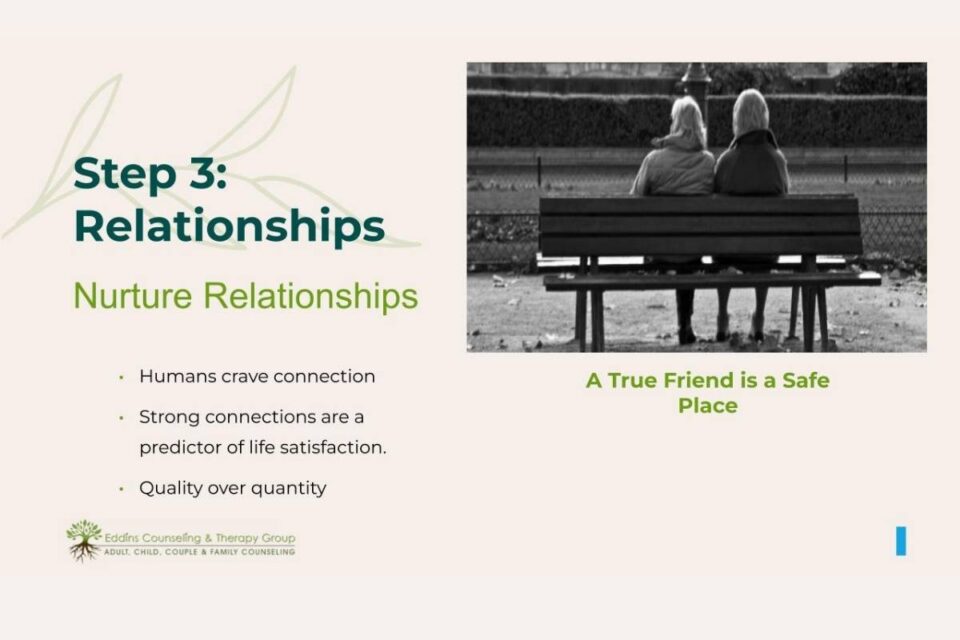
Step three is Relationships. We nurture the good relationships in our lives. Relationships provide connection, support, intimacy, love, and help us feel seen and valued. All humans crave connection, and it’s essential to well-being. Strong connections are a key predictor of life satisfaction.
There’s a Harvard Study of Adult Development—one of the longest studies ever conducted—, and it found that strong relationships are the single best predictor of happiness and longevity. It’s not about having a ton of friends; it’s about having one or two really strong, meaningful connections in our lives. These connections can dramatically improve our quality of life. This isn’t about money or status—it’s about connection.
If you’re wondering how to make new connections, look toward your interests—you can find your people there. If you really enjoy reading, try joining a book club. And if you enjoy gaming, put that headset on and connect online—or better yet, go to a friend’s house and play together. If you enjoy volunteering, find a cause that resonates with you and go find your people. And if you have friends or family you’ve lost contact with who feel safe and supportive, reach out.
Meaning
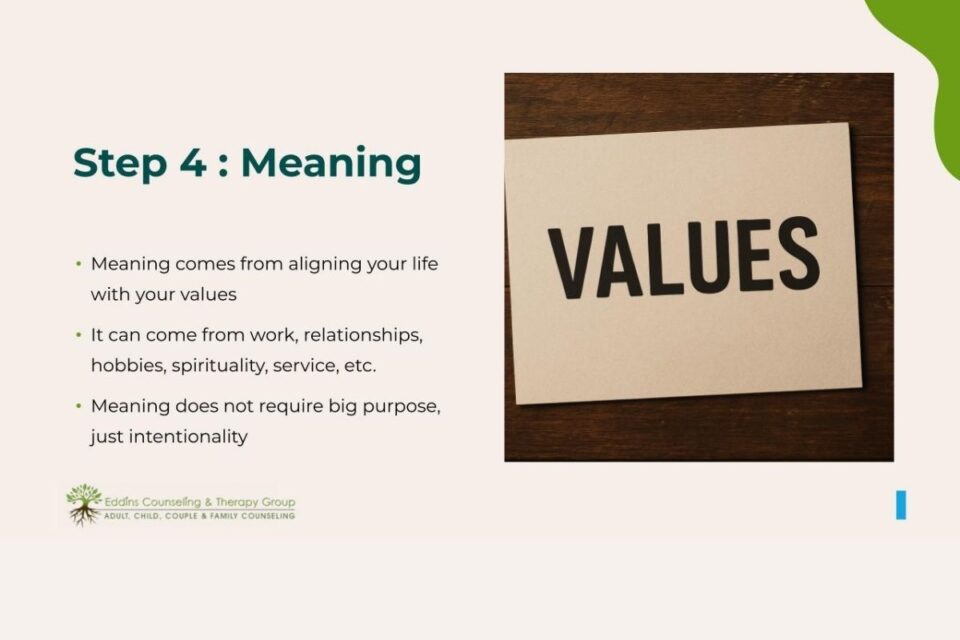
The next part of PERMA is Meaning. Meaning often comes from involvement in causes or activities that matter to us. Look to your values—they’re going to be your compass. Meaning can come from sharing life with others, finding your “why,” and identifying where we can make the most impact.
Meaning can come from work, relationships, hobbies, spirituality, or service. It doesn’t require a big purpose—just intentionality. We can assign meaning to even the small tasks we do throughout the day.
One really great way to connect to meaning is through a values clarification. This is something we do with a lot of our clients: we go domain by domain in our lives—work, relationships, friendships, family, spirituality, service, health—and ask questions like: How important is this to us? Are we putting enough time into it? Too much? Do we really care about it? In what ways can we put more time into the things we truly value or step back from the things we don’t value as much?
We also check if our values are really ours. Are they truly authentic, or are they influenced by society or our family? It’s about getting clear on what matters to us. Again, it’s not about a grand purpose—it’s about intentionality. Once we figure out our values, they can guide us through all aspects of our lives, whether it’s work, relationships, or friendships. That’s your compass.
Accomplishment
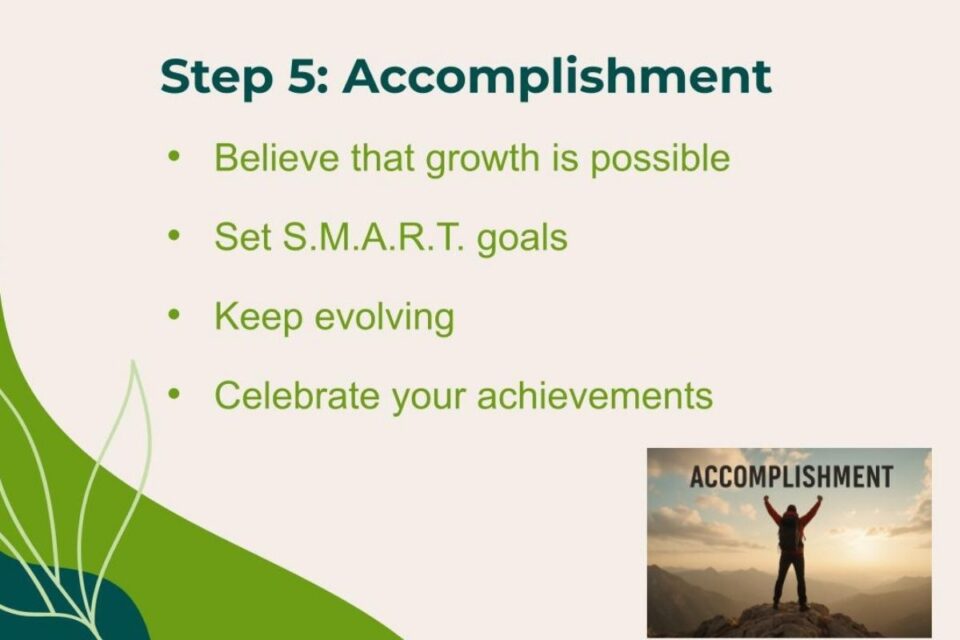
The last element of PERMA is Accomplishment. The first step is believing that growth is possible at any stage of life—whether we’re five or 95. Having a growth mindset and believing in our potential is essential because accomplishment requires growth. Research shows that believing growth is possible increases resilience, and even military resilience studies support this idea, showing that mindset influences adaptability.
We can set SMART goals to help make our objectives more achievable. SMART goals are Specific, Measurable, Achievable, Realistic, and Time-bound. And remember, small wins are still wins. As we talked about earlier, it’s about slowing down, reflecting, and connecting to ourselves. Recognize the small wins—they create momentum. Celebrate achievements, both big and small. Take time to sit and reflect on past successes, and don’t downplay your hard work.
Our brains do something interesting: sometimes they can’t tell the difference between what’s happening now and what’s happened in the past. So we can literally look at past accomplishments and get a dopamine boost from them, almost as if it’s happening in the present—just like we can when we focus on positive emotions.
Look back at things that have happened in the past and replay those moments. We can even journal about positive times in our lives.
Why Does It Seem So Hard To Flourish?
- Exhaustion
- Autopilot
- Cultural pressure to be productive
- Disconnection from values
- Lack of time or tools
All of this sounds really easy—but why does it sometimes feel so hard to flourish? Because life is life. We’re exhausted. Many of us are on autopilot, stuck in survival mode. Cultural pressures push us to be constantly productive and always reach for the next goal. We disconnect from ourselves and our values. Sometimes, we just lack the time or the tools.
It’s important to remember that flourishing happens when our basic needs are met. We need shelter, proper nutrition, hydration, and to take care of our bodies.
What Does NOT Work:
- Toxic Positivity
- Overcommitment
- Ignoring emotions
- Trying to be happy all the time
- Living out of alignment with Values
- Disconnection
What doesn’t work? Toxic positivity. This isn’t about ignoring what’s going wrong or pretending everything is fine. Instead, it’s about authenticity—tuning into what genuinely feels good for us.
Overcommitment is another big challenge. We have to set healthy boundaries and recognize that our time is valuable and necessary for our well-being. Taking time for ourselves isn’t selfish—it’s essential to flourishing.
Ignoring our emotions and stuffing things inside doesn’t work. Sometimes, yes, we have to put things aside for the moment, but it’s important to come back to them and address them. Trying to be happy all the time doesn’t work either—happiness isn’t sustainable 24/7.
None of us is perfect, and life happens. Another reason flourishing can feel difficult is living out of alignment with our values. That’s why it’s so important to get clear on what our values truly are. Another challenge that comes up a lot is disconnection.
What Does Work?
Connection
- Connection with self
- Connection with others
- Connection with our values
- Connection with the present moment
Connection—connection with ourselves, connection with others, connection with our values, and connection with the present moment. Just remember that one word: connection. Let it be imprinted in your mind. When you’re feeling flat, off, or unfulfilled, remind yourself: connection, connection, connection. Connection with ourselves, with others, with what truly matters, and being present in this moment.
PERMA in Practice
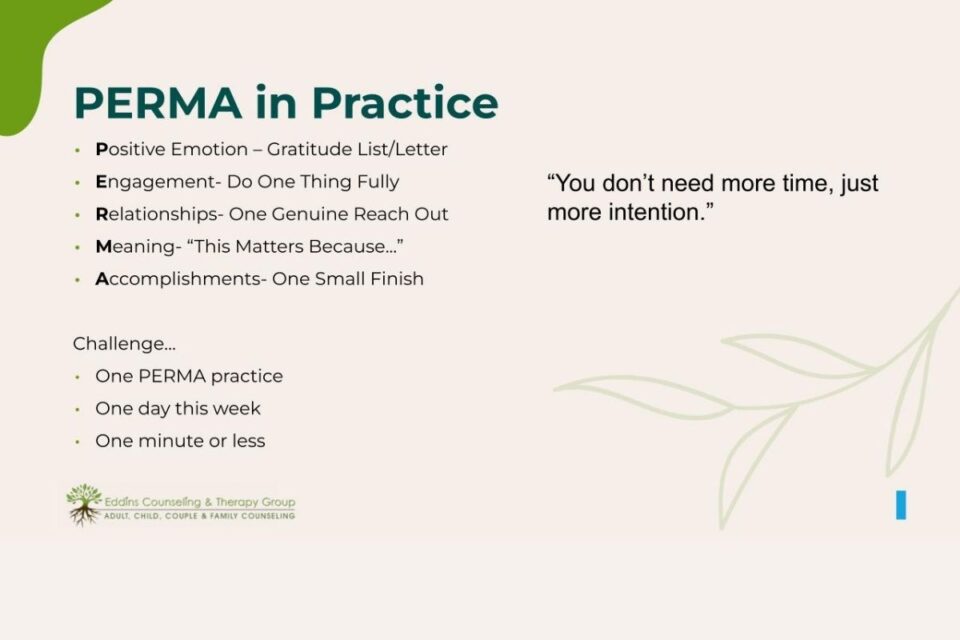
What are some simple practices we can do in our daily lives?
Positive Emotion
First up: Positive Emotion. One great practice is expressing gratitude. That can include writing a gratitude letter—you don’t even have to send it. Think of anyone who has contributed to your well-being over your life, and write them a letter.
You don’t have to send it. It’s nice if you do—how many of us actually get a gratitude letter from someone? But if you don’t, that’s okay too. Even the simple act of reflecting on it is beneficial.
Another practice is keeping a gratitude list. There’s a lot of science behind this. Keeping a list consistently—whether in the morning or at night—can really retrain your brain to notice the positive and develop a more optimistic outlook. You can say it out loud, but it helps to write it down. Over time, even small things—like someone letting you over in traffic—can go on the list.
It doesn’t have to be big things. Some days it might be something as simple as, ‘Hey, I brushed my teeth today.’ Other days, it could be something major, like getting a promotion. Practicing gratitude and saying thank you consistently really helps create a more positive perspective. At first, some people think it’s silly—but that’s just the beginning.
We’ve even had people say, ‘That’s foolish,’ and then come back later and say, ‘Yeah, I’ve been doing it—and it really works.’ So give it a try.
Engagement
Another practice is Engagement. Do one thing fully. As we said before, turn off your phones and remove interruptions. It doesn’t have to be for a long time—it can be just a few minutes. Turn on your favorite song and dance in your living room, fully committing to that moment. If you love drawing, draw. If you’re a runner, go for a run and really get into the flow. It can even look like a mindfulness walk—whatever allows you to be fully present.
Relationships
Then there’s Relationships, that connection. Try to connect with someone—one genuine reach-out. Call, text, or check in with a friend and say, ‘Hey, how are you doing? I just wanted to check in.’ You can combine this with positive emotion or gratitude, like saying, ‘Thanks so much for bringing me food when I was sick,’ or ‘Thanks for checking in the other day.’
Meaning
Next is Meaning. We can assign meaning even to small tasks because everything we do in life matters. Making yourself a meal can be meaningful: ‘I’m caring for myself, nourishing my body.’ Work can have meaning too—if you’re a realtor, you’re helping people find a home where they’ll create a life. It doesn’t have to be grandiose; there’s always time to connect to meaning.
Accomplishments
Finally, Accomplishments. Look for one small finish each day. What can we accomplish today, this week, this year? Even something as simple as unloading the dishwasher and ticking it off the to-do list counts. Give yourself credit—it matters.
When we first discovered positive psychology, we were surprised by how much impact small practices could have. We did inventories on what made our days better, writing down everything we did for weeks and rating our days. The biggest impact wasn’t from big events like concerts—it was the small things: connecting with people, taking a walk, calling a loved one, or even folding laundry. Those small finishes really resonated and made a difference.
Our challenge to you: practice one PERMA activity this week, even for a minute or less, and fully commit to it. If you’re ambitious, try one each day: Monday, Positive Emotion; Tuesday, Engagement; Wednesday, Relationships; Thursday, Meaning; Friday, Accomplishment. Remember, it’s not about perfection—it’s about making small, compassionate choices repeatedly. Each small practice adds up. You don’t need to overhaul your life; just start noticing and connecting to these moments.
Bringing It All Together
- Flourishing isn’t about perfection
- It’s about making small, compassionate choices again and again
- Each small practice adds up
References
- Achor, S. (2010). The happiness advantage: How a positive brain fuels success in work and life. Crown Business.
- Emmons, R. A., & McCullough, M. E. (2003). Counting blessings versus burdens: An experimental investigation of gratitude and subjective well-being in daily life. Journal of Personality and Social Psychology, 84(2), 377–389. https://doi.org/10.1037/0022-3514.84.2.377
- Harvard Study of Adult Development. (ongoing). Findings summarized in Waldinger, R., & Schulz, M. (2023). The good life: Lessons from the world’s longest scientific study of happiness. Simon & Schuster.
- Peterson, C., & Seligman, M. E. P. (2004). Character strengths and virtues: A handbook and classification. Oxford University Press.
- Rohde, J. S., Goldy, S., Graziosi, M., et al. (2024). Centering and flourishing: An online intervention study assessing the effects of a Christian contemplative practice on stress reduction and human flourishing. BMC Psychology, 12, 373. https://doi.org/10.1186/s40359-024-01836-0
- Seligman, M. E. P. (2011). Flourish: A visionary new understanding of happiness and well-being. Free Press.
- Skrzelinska, J., Ferreira, J. A., Linharelhos, M., Aguiar, E., & Matos, M. (2024). The impact of gratitude practice on well-being and mental health in post-COVID times among Portuguese adults. Current Psychology, 43, 34863–34874. https://doi.org/10.1007/s12144-024-06974-7
- Wang, Y., et al. (2025). The relationship between growth mindset and adolescent psychological well-being: The mediating roles of grit and learning engagement. BMC Psychology, 13, 1298. https://doi.org/10.1186/s40359-025-03609-9
- Yale University: Santos, L. (2018–present). The science of well-being [Online course]. Empirical findings are summarized in Yale OpenCourses materials.
About the Facilitator
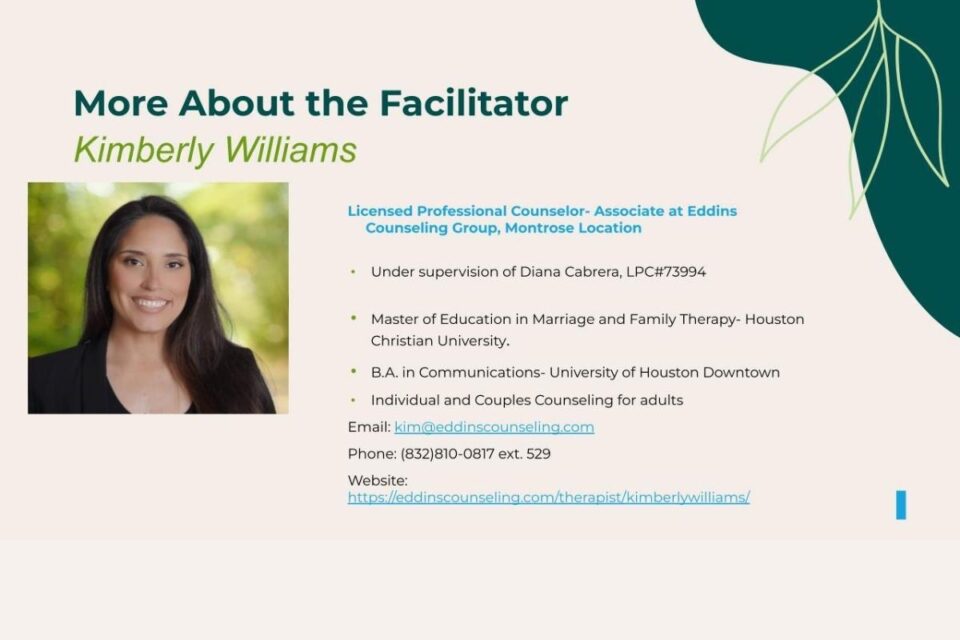
This webinar was facilitated by Kimberly Katie Williams, licensed professional counselor associate, here, at Eddins Counseling & Therapy Group. She works at the Montrose location under the supervision of Diana Cabrera. She has a Master of Education in Marriage and Family Therapy and a Bachelor of Arts in Communications. Kimberly works with adults, individually and as couples, addressing relationship issues, life satisfaction, women’s issues, life transitions, anxiety, and trauma. She is also trained in EMDR.
If you’d like to reach out, you can email [email protected]. For more information or support from our clinicians, you can call our Client Care team—they’d be happy to help schedule a free 15-minute consultation.
Finally, please fill out the feedback form in the chat and look out for our email with the replay and questionnaire. We deeply appreciate you being here. We believe everyone deserves a fulfilled life, and remember: flourishing can start today with one small practice at a time.
Focus on connection—connection with yourself, others, and what truly matters. Thank you all for being here, and reach out if you need support.
Feel free to visit additional resources:
1. Articles on specific topics on our blog.
2. RSVP for one of our free monthly webinars (or view past webinars)
3. Follow us on Facebook and Instagram for additional interviews and tips
4. Take another one of our self-test quizzes
5. Schedule a consult and find out how we can support you.
Flourishing isn’t about perfection—it’s about creating small, consistent habits that support your well-being and joy. Simple practices like mindfulness, gratitude, self-care, and meaningful connection can help you feel more balanced, energized, and fulfilled each day.
If you’re ready to explore how therapy can support your journey toward greater flourishing, our therapists are here to help. To begin, give us a call at 832-559-2622 or schedule an appointment online. We also offer online therapy for added convenience and flexibility.
Why You Feel This Way
Get instant access to your free ebook.
Blog Categories
Join a Therapy Group
Events
List of events in Photo View
Adult DBT Skills Evening Group | Eddins Counseling
Virtual Event