
January 8, 2026
Webinar: Cultivating Secure Attachment with Yourself and Others
Written by Guest Author
Posted in Emotional & Mental Health, Self Help / Personal Development, Webinars and with tags: attachment, self care, self improvement, webinar

Do you find yourself struggling to communicate openly, regulate your emotions, or allow vulnerability—both with yourself and those you care about? You’re not alone. Many people carry early attachment wounds that quietly shape their relationships, leaving them feeling anxious, disconnected, or unsure of how to express their needs. Miscommunications pile up, emotional tension lingers, and it can feel like real connection is just out of reach.
Join pre-licensed therapist Carmen Lozada for the transformative webinar “Cultivating Secure Attachment with Yourself and Others”, designed to help people of all genders and ages who are navigating these challenges. This session offers practical tools for emotional regulation, communication, and vulnerability—tools that can help you break the cycle of insecure or anxious attachment. Imagine what life could feel like when you can communicate effectively, express your feelings openly, and connect with others (and yourself) from a place of security and trust.
Carmen’s approach is rooted in creating a safe, welcoming environment where you feel supported every step of the way. Vulnerability is at the heart of this process, and she empowers participants to explore their emotions openly, without judgment. Through compassionate guidance, you’ll learn to navigate your inner experiences, build stronger connections, and reclaim the confidence to move forward in your relationships and your life.
If you’re ready to stop struggling with miscommunication and emotional overwhelm, this webinar is your opportunity to take a meaningful step toward healthier, more secure connections.
Watch a replay of the presentation here.
This webinar is facilitated by Carmen Lozada. We are going to be talking about Cultivating Secure Attachment with Ourselves and Others. We want to remind everyone that we do have free monthly webinars on various mental health topics each month, so please keep an eye out for those.
Agenda
- Understand and identify attachments
- Clinical interventions of secure attachment with self and others
- Working with Rupture and Repair
- Takeaways
Today’s agenda includes talking about attachment, how we build a sense of safety and connection with ourselves and others, understanding and identifying attachment patterns, clinical interventions for attachment with the self, working through Rupture and Repair, and ending with some key takeaways.
Attachment Styles
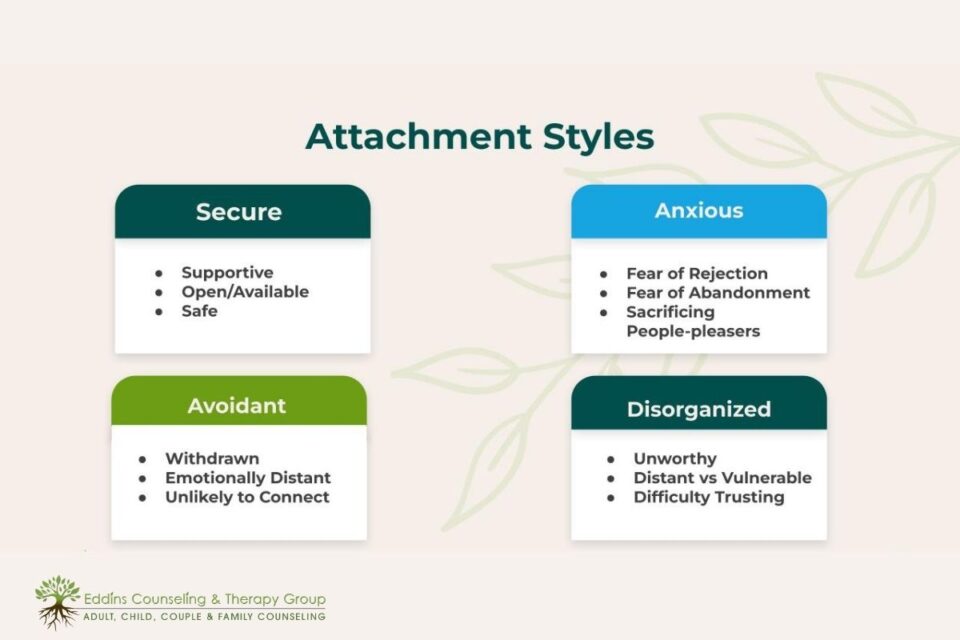
Before we get into identifying what attachment looks like, we want to note that there are four attachment patterns. These are not meant to label or diagnose, but rather reflect patterns we have learned to survive, relate, and adapt over time. Today’s goal is to approach these patterns with understanding, compassion, and without judgment when they come up.
Our hope is that by the end of today, we will have a clearer understanding of what secure attachment looks like, how attachment patterns are formed, and what helps us move toward a more secure attachment with ourselves and others.
In an overview of attachment, we have secure, anxious, avoidant, and disorganized attachment.
Attachment theories help us explain connections that feel so important to us as humans. From a very early age, we learn who feels safe, available, and responsive. Over time, we internalize these experiences, and they shape how we relate to others and how we relate to ourselves as well.
The important thing to remember about these patterns is that they are learned, and learned patterns can be relearned. To go over the four different attachment styles, we have secure attachment, which is supportive, open, available, and safe. Anxious attachment includes fear of rejection, fear of abandonment, and sacrificing one’s needs through people-pleasing behaviors. Avoidant attachment is characterized by being more withdrawn, emotionally distant, and unlikely to connect with others around us, and sometimes not able to connect with ourselves emotionally as well.
With disorganized attachment, we may experience feelings of unworthiness when it comes to connection, and a push-pull between distance and vulnerability. Sometimes this looks like being distant in relationships while also being vulnerable in moments that feel a bit safer. Along with this, there can be difficulty trusting relationships and sometimes even trusting ourselves.
Defining Secure Attachments
- Emotionally accessible and responsive
- Ability to regulate affect with and without others
- Capacity for healthy dependency and independence
- Stable sense of self and others as reliable
When defining secure attachment, we are looking at being emotionally accessible and responsive. We are also looking at the ability to regulate affect with others and without others, the capability for healthy dependency and independence, a stable sense of self, and a belief that others are reliable.
Secure attachment does not mean never feeling anxious, upset, or disconnected. It means having a basic sense that we can handle our emotions and be supportive and available to ourselves and others. Secure attachment allows room for both closeness and independence, and it is about feeling safe enough to be real.
Secure Attachments with Self and Others
When we look at what secure attachment looks like with ourselves versus what it looks like in relationships, there are some key differences. With ourselves, we are able to self-soothe, emotionally regulate, internalize safety and self-trust within our environment and within ourselves, engage in compassionate self-dialogue, and integrate our emotions.
Before we can feel secure in relationships, we often need to build security within ourselves. This includes noticing our emotions without judging them, offering ourselves compassion through self-compassionate self-dialogue, and learning how to soothe ourselves when we are in distress through emotional regulation. How we relate to ourselves and how we talk to ourselves internally truly matters, and this is often reflected in our relationships as well.
In the relationship piece, we are looking at communicating needs directly and respectfully, tolerating both closeness and independence, repairing ruptures effectively, and maintaining boundaries without fear of abandonment or engulfment. In relationships, secure attachment shows up as the ability to express needs, tolerate closeness, and respect boundaries, both for ourselves and with partners or other relationships such as friends and family.
Conflict does not mean failure, and disconnection does not mean abandonment. In secure attachment, there is a safe space to repair and reconnect. Communication is a really big piece when it comes to relationships. Being able to directly communicate our emotions and what we are feeling when a rupture happens is important.
A lot of people, especially in therapy—whether couples therapy or individual therapy—use and are encouraged to use I statements to help connect with that rupture and identify emotions. This helps create a sense of safety and secure attachment. When attachment feels insecure, relationships can feel overwhelming or unsafe. Some of us cope by clinging to our partner, others by pulling away, and some experience a mix of both. These responses are not wrong; they are protective. Understanding them helps us respond with curiosity rather than shame.
Identifying in the moment what insecure attachment looks like for us—whether we tend to pull away or cling—and recognizing that it is not a shameful response is an important step. It is about understanding what is happening for us in that moment. This is especially important in relationships with family, friends, and partners.
Cultivating Secure Attachment with Self
- Interventions
- Mindfulness and interoceptive awareness
- Emotion labeling and normalization
- Self-compassion practices
- Inner child and parts-based work
- Building distress tolerance
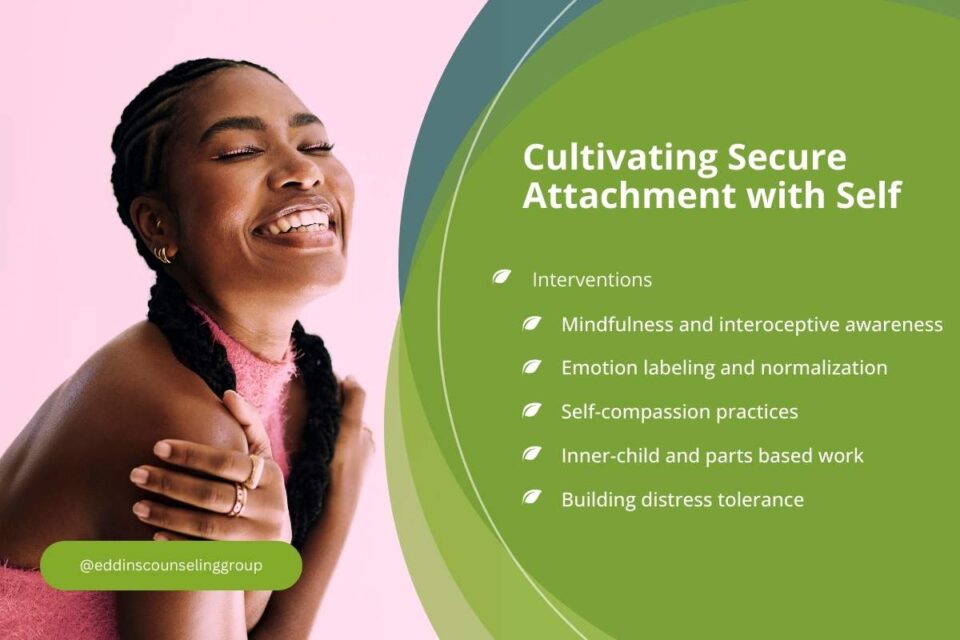
How do we cultivate secure attachment with ourselves? Some of these interventions may sound familiar: mindfulness, interoceptive awareness, emotional labeling and normalizing, self-compassionate practices, inner child and parts-based work, and building distress tolerance.
Starting with mindfulness, this can look like deep breathing, grounding, and reconnecting with our body in the moment. Emotional labeling is where I statements can be especially useful—being able to identify what is going on for us in that moment and normalizing it. Self-compassionate practices may include affirmations such as reminding ourselves that we are worthy, strong, and deserving of love.
Inner child and parts work are a significant part of attachment because we learn our attachment styles at a very young age. While attachment can change throughout adolescence, young adulthood, and even later in adulthood, inner child work often serves as the foundation for healing attachment. Building distress tolerance can look like being kind to ourselves, recognizing what is happening internally, and practicing the tools we have discussed in those moments.
Building internal security often includes slowing down, noticing what we are feeling, responding with care, and practicing mindfulness and compassionate parts work.
These practices can strengthen our internal relationship. Each time we respond to ourselves with kindness instead of criticism, we are building security within ourselves.
Cultivating Secure Attachment with Others
- Assertive communication skills
- Boundary identification and practice
- Mentalization and perspective-taking
- Attachment-informed relational reframing
- Gradual exposure to intimacy and vulnerability
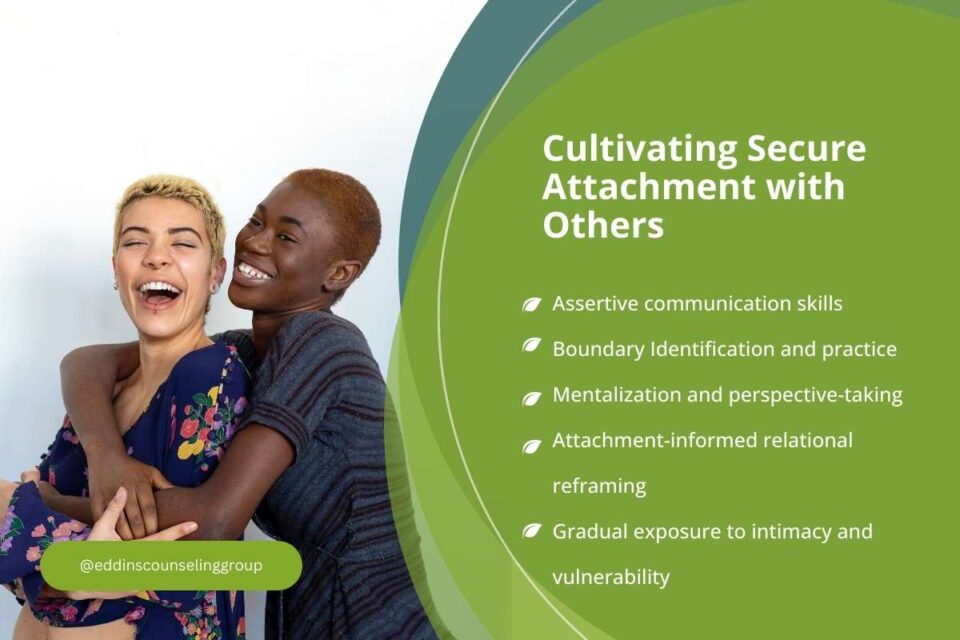
What does it look like to cultivate secure attachment with others? To build secure attachment with others, we develop communication, boundaries, and vulnerability. This can feel very uncomfortable at first, especially when we are learning what secure attachment looks like with the people around us. Security grows through small, repetitive experiences of being honest and staying connected, even when it feels hard.
Some of the ways we can do this include practicing assertive communication skills, setting and maintaining boundaries, identifying attachment patterns and practices, and being able to set boundaries and hold them with ourselves and with partners, family, or friends.
This also includes mentalizing and perspective-taking—understanding our own experience while also considering the other person involved in the attachment. Additional tools include attachment-informed relational reframing and gradual exposure to intimacy and vulnerability.
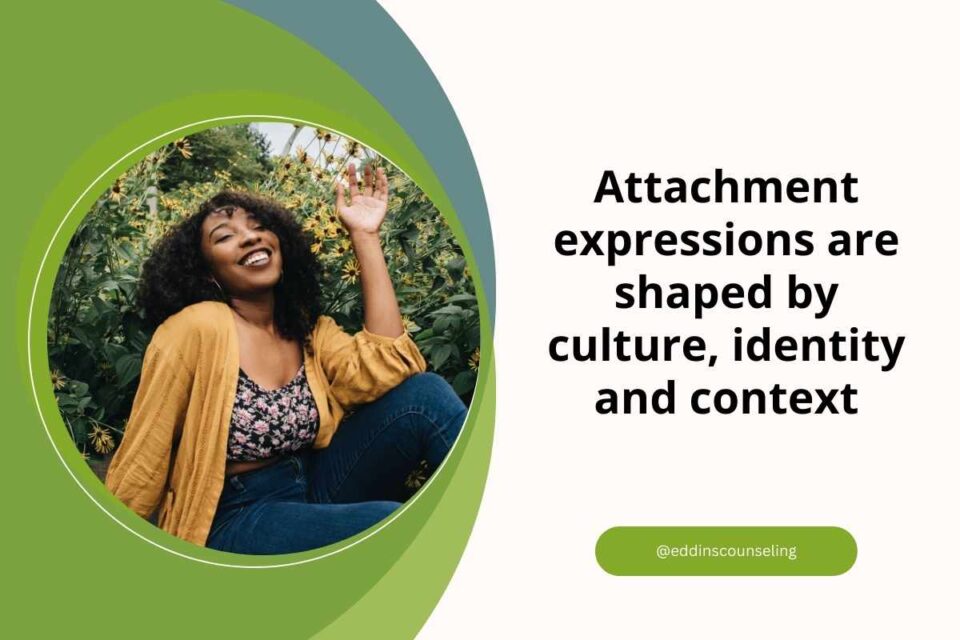
Over time, as we develop secure attachment, intimacy can grow and help strengthen the foundation of relationships, especially through vulnerability and expressing emotions with others. It is also important to note that attachment expressions are influenced by culture, identity, and context.
We think this is an important piece to talk about because different cultures have different expressions of attachment. What secure attachment looks like is shaped by culture, family systems, and lived experiences. What feels secure in one context may look different in another. It is important to honor these differences within ourselves and with others around us, and to recognize that many attachment behaviors are adaptive responses to real-world conditions.
Rupture and Repair
- Acknowledging relational ruptures
- Validating emotional impact
- Taking responsibility without defensiveness
- Restoring connection and trust
Rupture and repair are also important parts of attachment and relationships. These are experiences that come up often. We cannot avoid rupture, but we can acknowledge it and learn how to repair and recognize what it looks like when a rupture happens again. This includes acknowledging relational ruptures and validating the emotional impact. This is where I statements are helpful—being able to identify the emotion and explain why an event has made us feel a certain way.
Taking responsibility without defensiveness is a key part of repair. When a rupture happens, it is important to take responsibility, identify our role, and work toward moving forward and repairing that rupture, whether with ourselves or with others. Restoring connection and trust takes time, and even small repairs can help rebuild trust gradually over time.
As we said, all relationships experience ruptures, misunderstandings, hurt feelings, or disconnections. Secure attachment does not mean avoiding these moments. Instead, it is about learning that repair is possible. Repair teaches us that relationships can bend without breaking. This is such an important point because repairs help address the rupture—they do not mean that we are breaking with our partner, friend, or family member, but rather that we are able to bend, fix, reconnect, and rebuild trust in that moment.
Healing attachment is not about fixing what is “wrong” with us. It is about creating more moments of safety, understanding, and connection over time. Healing attachment does not mean there is something wrong with us or with the relationship; it is about identifying what is coming up for us, having an environment of safety to discuss it, connect with it, and allow compassionate self-talk to come into play.
Recommended Reading
A helpful resource is Safe and Attachment-Informed Guide to Building More Secure Relationships by therapist Jessica Baum. This book explores the attachment wound and what it looks like, while also covering the neuroscience and polyvagal theory, which explains how our nervous system state in any given moment can impact our connection with others.
The book also discusses somatic healing, which can be very helpful alongside polyvagal theory and the neuroscience of our nervous system. It provides practical tools and action strategies that we can practice with ourselves or with others. It also has a compassionate approach, which is particularly useful when learning about attachment and building secure connections with others. Overall, it is a great resource, and we highly recommend it.
If anyone wants more information, we can call and schedule a free consultation.
About the Facilitator
Finally, regarding professional background, Carmen is currently enrolled in a counseling program and is still in school, working under supervision. She has years of experience in case management, community health, and psychiatric hospitals. She currently works with individuals, couples, and families, focusing on trauma, stress management, attachment, and related areas.
We want to thank everyone for joining today and hope the session was useful. If there are any questions or if you want to revisit the material, you can look for a replay on YouTube. For example, one question from Jasmine asked for more examples of inner child or parts work and guidance on how to practice them.
That is a great question. Inner parts work, or inner child work, is an attachment-based approach. It focuses on our childhood experiences and how they played out with our parental figures or family, helping us identify different “parts” of ourselves. It allows us to explore where insecure attachment patterns come from and what they look like. We can learn to distinguish between what truly reflects us and what arises from experiences in our childhood.
A widely used modality for this is Internal Family Systems (IFS), which is considered part work. Many therapists use it, and it is a highly effective approach for working with inner child themes, attachment, and related patterns.
We appreciate the question and encourage anyone with additional questions to reach out. Again, we thank everyone for joining, and a feedback form is available for those who would like to share their thoughts.
Feel free to visit additional resources:
1. Articles on specific topics on our blog.
2. RSVP for one of our free monthly webinars (or view past webinars)
3. Follow us on Facebook and Instagram for additional interviews and tips
4. Take another one of our self-test quizzes
5. Schedule a consult and find out how we can support you.
Whether you’re learning to navigate difficult emotions, set healthy boundaries, or build stronger relationships, secure attachment is something you can cultivate—one small, intentional step at a time. With guidance and practice, you can begin to experience greater self-trust, emotional balance, and meaningful connections with the people in your life.
If you’re ready to explore how therapy can help you build secure attachment with yourself and others, our therapists are here to support you. To begin, give us a call at 832-559-2622 or schedule an appointment online. We also offer online therapy for added convenience and flexibility.
Why You Feel This Way
Get instant access to your free ebook.
Blog Categories
Join a Therapy Group
Events
List of events in Photo View
Adult DBT Skills Evening Group | Eddins Counseling
Virtual Event